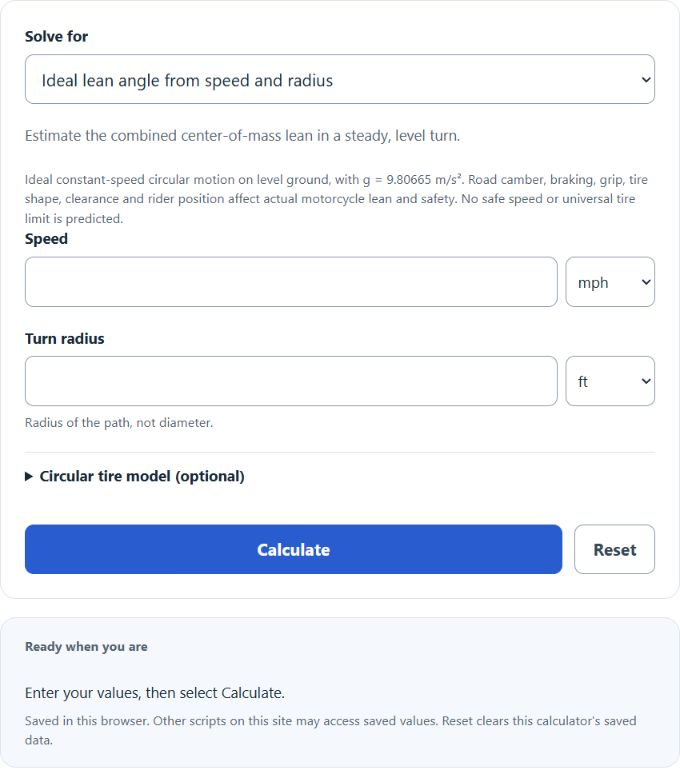
Calculate ideal steady-turn lean from speed and radius or lateral acceleration, or solve for model speed or radius at a selected ideal lean angle. These are educational model results, not safe riding limits.
Motorcycle Lean Angle Formula
LA = atan( V^2 / (g * R) )
- LA is the lean angle from vertical (degrees, after converting from radians)
- V is the forward speed (m/s)
- R is the radius of the turn (m)
- g is the acceleration of gravity (9.80665 m/s²)
The same relationship can be rearranged to solve for the other two variables, which is what the ideal speed and radius modes of the calculator do:
Vmax = sqrt( g * R * tan(LA) )
Rmin = V^2 / (g * tan(LA))
The lateral g-force mode uses the fact that the tangent of the lean angle equals the lateral acceleration in g, so LA = atan(G). This same tangent also equals the friction coefficient the tires must supply, which is why the calculator reports required grip alongside every result.
The optional circular tire-section model estimates an additional frame lean under its geometric assumptions. It is not a measurement of real frame lean; half nominal tire width is only a rough proxy for the assumed profile radius:
ADD = asin( t * sin(LA) / (h - t) )
- ADD is the extra lean added to LA (degrees)
- t is the assumed circular tire-section radius (half the entered model diameter)
- h is upright combined bike-and-rider center-of-mass height; seat height is not a measurement of this quantity
Lean Angles at Common Speeds and Turn Radii
The table shows ideal flat-road, steady-circle model angles. It does not establish available tire grip, clearance or safe public-road cornering speeds.
| Speed | 100 ft radius | 200 ft radius | 300 ft radius | 500 ft radius |
|---|---|---|---|---|
| 30 mph | 31.0° | 16.7° | 11.3° | 6.9° |
| 45 mph | 53.5° | 34.1° | 24.3° | 15.2° |
| 60 mph | 67.4° | 50.3° | 38.7° | 25.7° |
| 75 mph | 75.1° | 62.0° | 51.4° | 36.9° |
Because the tangent of the lean angle equals both the lateral g-force and the friction coefficient the tires must deliver, every lean angle maps directly to a grip requirement. This table gives mathematical angle examples only; these are not motorcycle, tire or riding-mode limits.
| Model example | Angle from vertical | Lateral g / grip needed |
|---|---|---|
| Illustrative 28–32° range | 28–32° | 0.53–0.62 |
| Illustrative 38° angle | 38° | 0.78 |
| Illustrative 45° angle | 45° | 1.00 |
| Illustrative 48° angle | 48° | 1.11 |
| Illustrative 53° angle | 53° | 1.33 |
| Illustrative 60–64° range | 60–64° | 1.73–2.05 |
Motorcycle Lean Angle Example Problems
Example 1: You take a turn with a 200 ft (60.96 m) radius at 45 mph (20.12 m/s). First square the speed: 20.12² = 404.8. Then multiply gravity by the radius: 9.80665 * 60.96 = 597.8. Divide: 404.8 / 597.8 = 0.677. The lean angle is atan(0.677) = 34.1 degrees, and the tires must supply a friction coefficient of about 0.68.
Example 2: For an ideal model angle of 40 degrees and a 100 m turn radius, solve for the corresponding speed. This does not determine a safe cornering speed. tan(40°) = 0.839. Vmax = sqrt(9.80665 * 100 * 0.839) = sqrt(822.9) = 28.7 m/s, which is 103.3 km/h or about 64.2 mph.
FAQ
Why does my bike lean more than the calculator predicts?
The basic formula treats the motorcycle as a line with zero-width tires. Real tires are wide, so the contact patch moves toward the inside of the turn as you lean, and the frame must tip further to keep the balance of forces. Under the simplified circular-section model, an assumed 6-inch section diameter and 26-inch upright combined center-of-mass height add about 3.2 degrees to a 25-degree ideal lean. Actual tire profile, contact geometry and rider posture may differ. Sitting bolt upright or leaning your body out (counterleaning) also forces the bike itself to lean more, while hanging off toward the inside lets the bike stay more upright for the same corner.
Does the weight of the bike or rider change the lean angle?
Mass cancels from the ideal steady-circle force balance, so that model gives the same center-of-mass lean at the same speed and radius. This does not imply identical real frame lean or equal riding capability. What weight placement does change is the center of mass height, which slightly alters the tire width correction, and heavier bikes work their tires harder in absolute terms.
What is the maximum lean angle a motorcycle can hold?
There is no universal safe lean angle. In the ideal flat-road steady-turn model, lateral friction demand equals tan(ideal lean), so a demand of 1 corresponds mathematically to 45 degrees. Available grip, road surface and camber, braking, tire profile, clearance and rider motion determine actual capability; the calculator cannot establish those limits.