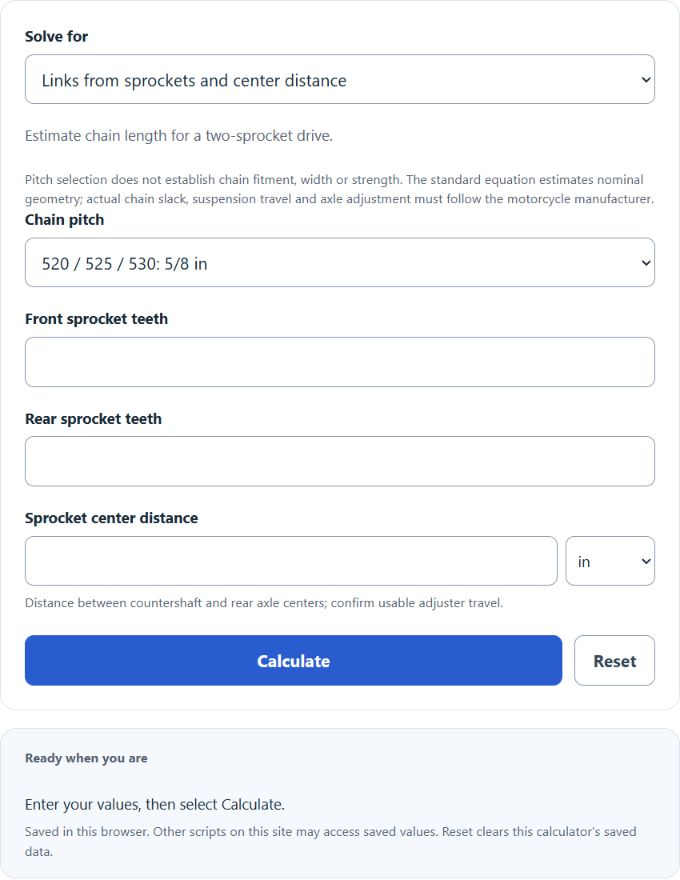
Calculate motorcycle chain length in links and inches from sprocket teeth, chain pitch, and center distance, or find the new chain length after a sprocket or swingarm change.
Motorcycle Chain Length Formula
L = 2*C/P + (F + R)/2 + P*(R - F)^2 / (4*pi^2*C)
- L = chain length in links (one link equals one pitch)
- C = center distance from the countershaft to the rear axle (inches)
- P = chain pitch in inches (520/525/530 = 0.625, 415/420/428 = 0.500, 630 = 0.750)
- F = number of teeth on the front (countershaft) sprocket
- R = number of teeth on the rear sprocket
The calculator's first mode uses this equation directly. You pick the chain size, which sets the pitch, then enter both sprocket tooth counts and the measured center distance. The result is rounded up to the nearest even number of links, because a roller chain can only be closed on an even count without a half link. The calculator also solves the equation in reverse for that even link count, giving an approximate model center distance for the rounded chain and how far the axle moves from your measurement.
L_new = L_stock + ((F_new - F_stock) + (R_new - R_stock))/2 + 2*E/P
- L_new = required chain length in links after the change
- L_stock = current chain length in links
- F and R terms = old and new sprocket tooth counts
- E = swingarm extension in inches
The second mode uses this shortcut for gearing changes: each tooth added across the two sprockets needs about half a link, and each inch of swingarm stretch needs two more pitches of chain. This shortcut omits the change in the unequal-sprocket correction term. It reports stock/new final-drive ratios and percent change; use the first mode with a measured new center distance when possible.
Chain Size and Wear Limit Reference
The chain size number encodes the geometry the calculator needs. The first digit is the pitch in eighths of an inch, and the remaining digits indicate the internal width. Use this table to match pitch only; the application examples are not fitment or strength approval. Chains with the same pitch may differ in width, roller dimensions and strength. Follow the motorcycle and chain manufacturer.
| Chain size | Pitch (in) | Roller width (in) | Typical application |
|---|---|---|---|
| 420 | 0.500 | 1/4 | Pit bikes, small bikes under about 125 cc |
| 428 | 0.500 | 5/16 | 125 to 250 cc street and trail bikes |
| 520 | 0.625 | 1/4 | Dirt bikes 250 cc and up, lightweight race conversions |
| 525 | 0.625 | 5/16 | Middleweight street bikes, roughly 600 to 1000 cc |
| 530 | 0.625 | 3/8 | Liter bikes, heavy tourers, high horsepower street |
| 630 | 0.750 | 3/8 | Older large displacement bikes, mostly obsolete |
A chain that measures long has stretched, and a stretched chain changes the effective length the formula assumes. The table shows nominal lengths across 16 pitches and illustrative elongation percentages. Measure by the chain manufacturer’s specified method and use its actual service limit; 1.5% is not a universal replacement rule. D.I.D, for example, recommends maximum elongation of 1% for sealed and 2% for non-sealed chains, with condition-related replacement also required.
| Chain size | 16 links new (in) | 1% worn (in) | 1.5% example (in) |
|---|---|---|---|
| 415 / 420 / 428 | 8.000 | 8.080 | 8.120 |
| 520 / 525 / 530 | 10.000 | 10.100 | 10.150 |
| 630 | 12.000 | 12.120 | 12.180 |
Example Problems
Example 1: A bike runs a 520 chain (0.625 inch pitch) with a 15 tooth front sprocket, a 45 tooth rear sprocket, and a measured center distance of 23.5 inches. C/P is 23.5 / 0.625 = 37.6 pitches. The formula gives L = 2(37.6) + (15 + 45)/2 + 0.625(45 - 15)^2 / (4 * pi^2 * 23.5) = 75.2 + 30 + 0.61 = 105.81 links. Rounding up to an even count gives 106 links, which is 66.25 inches of chain. The approximate model center distance for 106 links is about 23.56 inches, so the axle moves back roughly 0.06 inches from the measurement.
Example 2: A bike with stock 16/42 gearing and a 108 link 525 chain switches to 15/45 gearing with no swingarm change. The link change is ((15 - 16) + (45 - 42))/2 = 1, so the shortcut estimate is 109 links, which rounds up to 110 links. The final drive ratio goes from 2.625 to 3.000, a 14.3 percent increase. This changes the engine-speed/road-speed relationship, but acceleration and achievable top speed also depend on power, traction and other limits.
FAQ
Why does the chain need an even number of links? A roller chain alternates inner and outer plates, so standard inner/outer pairs close at an even pitch count. An odd calculated length must round up to the next even number, or you would need a half link (offset link), which is weaker and not recommended on high-powered motorcycles.
How do you measure the center distance? Measure from the center of the countershaft sprocket bolt to the center of the rear axle, with the bike straight and the axle sitting near the middle of its adjuster range. Measuring at full forward or full rear adjustment leaves no room to take up chain wear, so the calculated length may not fit once the chain stretches.
Does the calculated length work for O-ring and non-O-ring chains? Yes. O-ring, X-ring, and standard chains of the same size share the same pitch, so the link count is identical. Sealing, width, roller dimensions and strength affect compatibility; a matching pitch or estimated link count does not by itself establish safe interchangeability. Confirm manufacturer slack through suspension travel and adjuster range before cutting or riding.