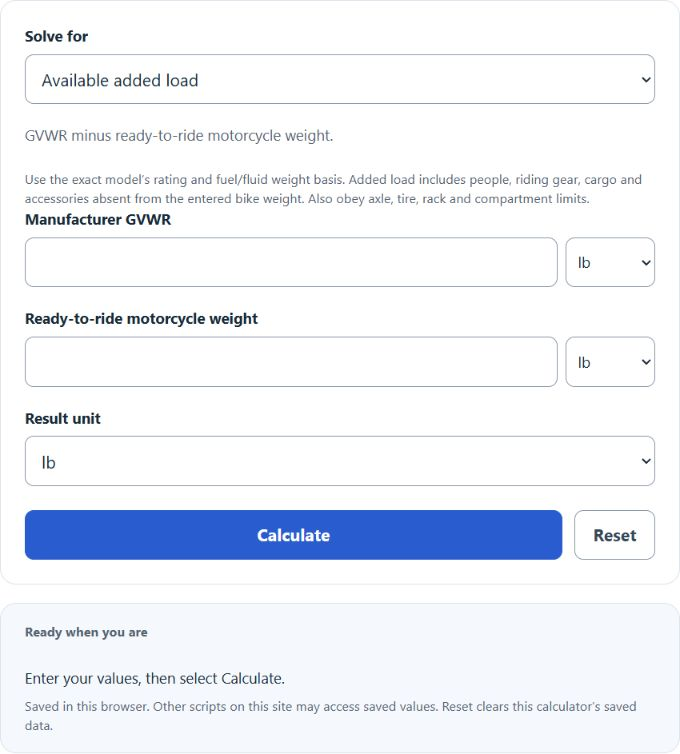
Calculate available added load, motorcycle base weight or an algebraic GVWR total from two known values in lb or kg. The calculation does not establish a manufacturer-certified rating.
- All Automotive Calculators
- All Length Calculators
- Motorcycle Acceleration Calculator
- GVWR (Gross Vehicle Weight Rating) Calculator
- Net Mass Calculator
Motorcycle Weight Limit Formula
The motorcycle weight limit is the remaining load capacity available after subtracting the motorcycle’s own weight from its gross vehicle weight rating. That remaining capacity must cover riders, riding gear, luggage and accessories not already included in the entered bike weight. Each calculator input may use pounds or kilograms; the calculator converts them before subtraction.
- MWL = motorcycle weight limit, or remaining load capacity
- GVWR = gross vehicle weight rating
- BW = ready-to-ride motorcycle weight on the stated fuel/fluid basis
If you want to check how much capacity is left after adding people and cargo, use the remaining-load formula below.
- RL = remaining load after passengers and cargo
- R = rider weight
- P = passenger weight
- C = cargo weight
- A = accessories or mounted equipment absent from BW; do not count them twice
How to Calculate the Motorcycle Weight Limit
- Find the motorcycle’s GVWR. This is the maximum allowed total weight of the fully loaded bike.
- Determine the motorcycle’s actual bike weight. Use the model’s stated wet/curb weight basis or a ready-to-ride measurement, including the corresponding fuel and fluids; dry weight cannot be substituted directly.
- Subtract the bike weight from the GVWR.
- The result is a GVWR-based added-load allowance, subject to all other applicable manufacturer limits.
- If needed, subtract the rider, passenger, and cargo from that result to see how much margin is left.
What Counts Toward the Limit
| Included in the Load | Typical Items |
|---|---|
| Rider | Body weight, helmet, boots, jacket, and any worn gear |
| Passenger | Passenger body weight plus gear |
| Cargo | Bags, camping gear, groceries, tools, and personal items |
| Accessories | Top case, panniers, crash bars, racks, audio equipment, and other add-ons |
| Fluids and fuel | Important if the bike weight entered is not a wet or curb weight |
How to Interpret the Result
| Result | Meaning | What to Do |
|---|---|---|
| Positive value | You still have available load capacity. | Compare that value to the combined weight of riders, gear, and accessories. |
| Zero | No added-load allowance remains in the calculation being interpreted. | Avoid adding more weight and verify distribution front to rear. |
| Negative value | The entered base weight or fully loaded setup exceeds GVWR, depending on which margin was calculated. | Remove cargo, reduce passenger load, or use a higher-capacity motorcycle. |
Examples
Example 1 (hypothetical): A motorcycle has a GVWR of 900 lb and a bike weight of 540 lb.
This bike can carry 360 lb of combined rider, passenger, luggage, and accessories.
Example 2 (hypothetical): A motorcycle has a GVWR of 470 kg and a bike weight of 295 kg.
The remaining load capacity is 175 kg.
Example 3: The motorcycle from Example 1 carries a 180 lb rider, a 120 lb passenger, and 35 lb of cargo and accessories.
There are 25 lb of capacity remaining.
Common Mistakes
- Mixing units manually: Convert to a common unit before hand subtraction; this calculator converts each selected input unit.
- Using dry weight: Dry weight can understate the real loaded bike weight because it may exclude fuel and fluids.
- Ignoring accessories: Hard luggage, racks, guards and electronics reduce available capacity unless already included in the entered equipped-bike weight.
- Forgetting riding gear: Helmets, boots, jackets, and packs add measurable weight.
- Assuming all load can go anywhere: Total capacity is only part of the picture; heavy items should be packed low and balanced.
Practical Loading Tips
- Use the manufacturer’s published GVWR as the upper limit for the fully loaded motorcycle.
- Start with the most realistic bike weight available, preferably curb or ready-to-ride weight.
- Place heavier cargo as low and as close to the center of the motorcycle as possible.
- Recheck capacity after adding luggage systems, backrests, racks, or other permanent accessories.
- If traveling two-up, calculate total rider and passenger weight before packing any bags.
- Even if total weight is within GVWR, verify axle, tire, rack and compartment ratings and the manufacturer’s loading instructions.
Quick Reference
| If You Know | You Can Find | Use |
|---|---|---|
| GVWR and bike weight | Total available carrying capacity | Motorcycle weight limit formula |
| Weight limit and passenger/cargo weights | Unused capacity | Remaining-load formula |
| Bike weight seems unusually high | Potential overload or incorrect input | Recheck units and whether fuel/accessories were included |
Frequently Asked Questions
Is curb weight the same as bike weight?
For this calculator, curb or ready-to-ride weight is usually the best choice because it better reflects real operating conditions.
What does a negative result mean?
A negative result means the bike is overloaded based on the values entered, or that one of the inputs may be incorrect.
Can I use this for a rider-only setup?
Yes. If there is no passenger, just compare the weight limit against the rider, gear, luggage, and accessories.
Why is this calculation useful?
It gives a fast estimate of how much carrying capacity the motorcycle has left before reaching its rated maximum loaded weight.