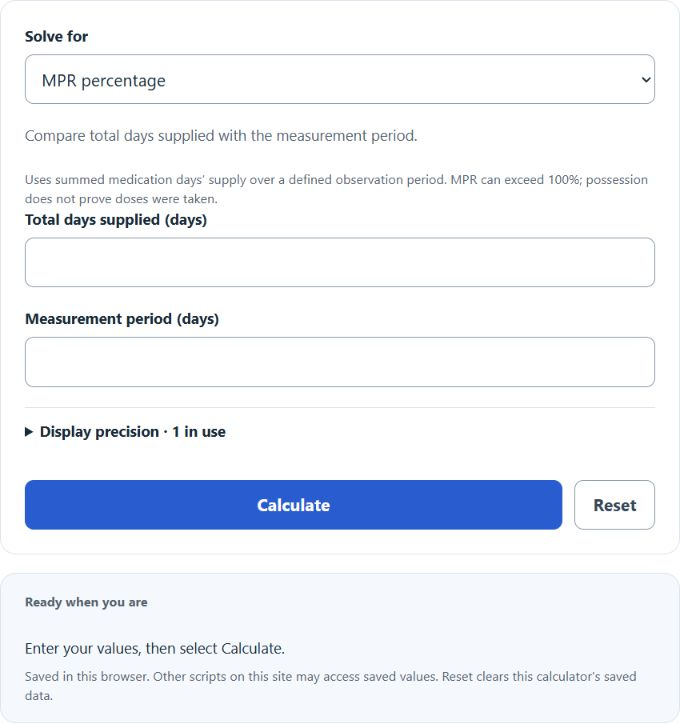
Calculate medication possession ratio (MPR) from summed medication days’ supply and a defined measurement period, or solve for either quantity. This calculator does not calculate PDC or a refill date.
Related Calculators
- Adherence Calculator
- Medication Days Supply Calculator
- Proportion of Days Covered Calculator
- 28-Day Prescription Refill Calculator
- Eye Drop Days Supply Calculator
- All Personal Finance Calculators
MPR Formula
Variables:
- MPR is the medication possession ratio (percent).
- SDS is the sum of days’ supply across fills in the measurement period.
- D is the number of days in the measurement (observation) period.
To calculate MPR, divide the sum of days’ supply by the number of days in the measurement period, then multiply by 100.
How to Calculate MPR?
The following steps outline how to calculate the MPR.
- First, determine the sum of days’ supply.
- Next, determine the number of days in the measurement period.
- Next, gather the formula from above: MPR = (SDS / D) × 100.
- Finally, calculate the MPR.
- After inserting the variables and calculating the result, check your answer with the calculator above.
Example Problem :
Use the following variables as an example problem to test your knowledge.
sum of days’ supply = 50
number of days = 60
MPR = (50 / 60) × 100 = 83.3333%
FAQ
What is MPR in medication adherence?
MPR, or Medication Possession Ratio, is a pharmacy claims–based adherence measure that compares the total days’ supply obtained during a measurement period to the total number of days in that period. (In manufacturing/supply chain contexts, a similar acronym is usually MRP for Material Requirements Planning, which is different from this MPR calculator.)
How is MPR different from PDC?
PDC (Proportion of Days Covered) uses unique covered days (it does not double-count overlapping refills) and is typically constrained to 0%–100%. MPR can exceed 100% when refills overlap or are obtained early because it sums days’ supply.
Can MPR be greater than 100%?
Yes. Because MPR is based on the summed days’ supply, early refills or overlapping fills can produce MPR values above 100%. Some reporting methods cap MPR at 100% depending on the use case.
What is considered a “good” MPR or PDC?
A commonly used adherence threshold in many quality programs is 80% (0.80) or higher, but targets can vary by medication class, condition, and program rules. Always follow the definitions and thresholds required for your specific analysis.