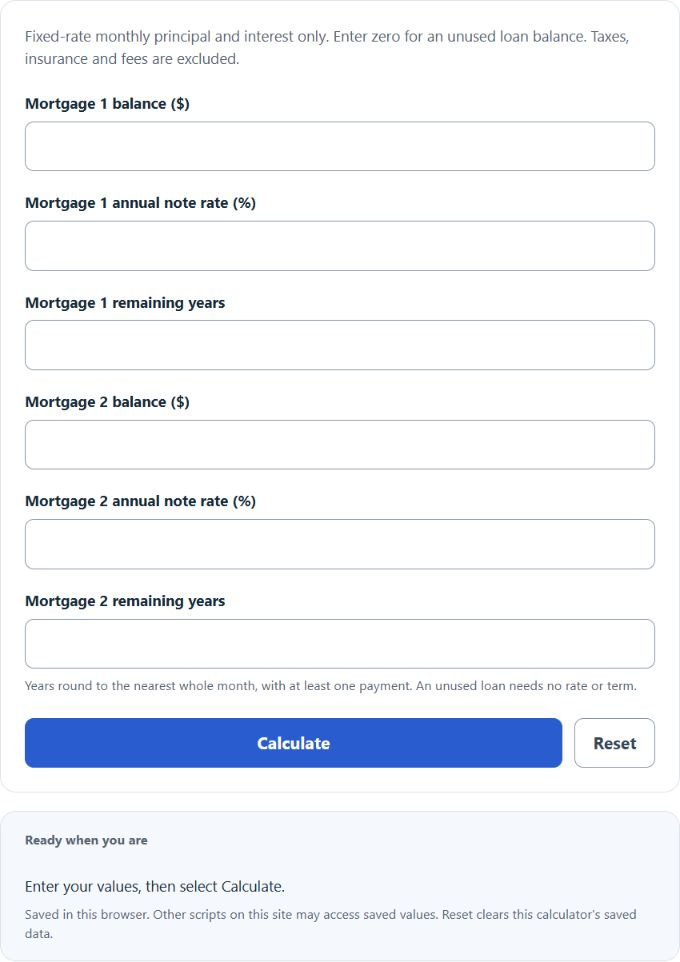
Calculate the monthly payment and combined cost of two fixed-rate mortgages or home loans. Each loan is amortized separately before the totals are combined.
Two mortgages must be amortized separately because each can have a different balance, interest rate, and remaining term. Adding balances first and applying an average rate generally does not reproduce the real payments.
How to Use This Calculator
- Enter the current balance, annual rate, and remaining term for mortgage 1.
- Enter the same information for mortgage 2.
- Calculate each amortizing payment separately.
- Review the initial combined payment and scheduled interest.
After a successful calculation, the inputs and result remain saved in this browser. Select Reset to clear the stored values and return to empty inputs.
How the Multiple Mortgage Calculator Works
The combined payment applies only while both loans remain active. After the shorter mortgage is paid off, the scheduled payment falls to the remaining loan’s payment unless the borrower redirects the difference.
The primary relationship is Payment = P × r(1+r)ⁿ ÷ ((1+r)ⁿ − 1), calculated for each loan. At zero interest, payment is P ÷ n. The monthly rate r is the annual note-rate percentage divided by 1200; n is years × 12 rounded to the nearest whole month, with at least one payment. The model assumes monthly compounding and end-of-month payments. Calculations retain full available floating-point precision internally; displayed amounts are estimates, and lender cent rounding or an adjusted final payment may differ.
Formula Variables and Input Guide
Enter the principal balance, annual interest rate, and remaining term for each mortgage.
| Variable or term | Meaning | Unit or note |
|---|---|---|
| P | Principal balance | currency |
| r | Monthly rate | annual note-rate percentage ÷ 1200 |
| n | Remaining payments | whole months |
| M | Monthly principal and interest | currency/month |
Choosing the Right Inputs
For each mortgage, enter the present principal balance, the current note rate, and the remaining repayment term. Do not use the original loan amount or original term after years of payments have already elapsed. The interest-rate input is the annual note rate used for amortization, not APR, which can include fees and other costs.
Enter the two loans separately even if they cover the same property. A zero balance can represent an unused second loan, but an active loan needs its own rate and remaining term. Convert a remaining schedule expressed in months to years consistently, and remember that the result covers scheduled principal and interest rather than escrow, insurance, association dues, or future rate changes.
Practical Uses
- Budgeting two simultaneous home-loan payments.
- Separating first- and second-mortgage cash flows.
- Estimating the payment change after the shorter loan ends.
- Comparing the current loans with a proposed refinance.
What the outputs mean
| Output | Interpretation |
|---|---|
| Mortgage 1 payment | Applies for loan 1 term |
| Mortgage 2 payment | Applies for loan 2 term |
| Combined payment | Only while both are active |
| Weighted rate | Descriptive; not a payment rate |
Understanding Your Results
You receive each principal-and-interest payment, their combined monthly amount, scheduled interest, and a balance-weighted rate.
Principal-and-interest totals exclude escrow, property tax, insurance, HOA dues, mortgage insurance, fees, and future adjustable-rate changes.
Worked Example
For a $300,000 balance at 6.5% over 30 years and a $50,000 balance at 8% over 15 years, mortgage 1 is about $1,896.20 per month and mortgage 2 is about $477.83, for an initial combined principal-and-interest payment of $2,374.03. The second payment ends after month 180.
If the second mortgage ends after 15 years while the first continues for 30, the borrower stops owing mortgage 2’s scheduled payment after month 180. The initial combined amount should not be multiplied by 360.
Checking the Result by Hand
Calculate each loan independently with its monthly rate and whole number of remaining payments. For a zero-interest loan, payment is principal divided by months. Otherwise use the amortization payment, then confirm scheduled interest as payment × months − principal for that loan.
Add the two individual payments only for the period when both loans remain active. Do not multiply the initial combined payment through the longer term. If one balance is zero, the combined result should exactly match the active mortgage.
Common Mistakes to Avoid
- Using original terms instead of remaining terms.
- Treating the weighted rate as a refinance quote.
- Multiplying the combined payment through the longer term.
- Ignoring a zero balance, prepayment, or adjustable rate.
Assumptions and Limitations
Results exclude taxes, insurance, HOA dues, mortgage insurance, fees, adjustable-rate changes, and prepayments. Confirm figures with each lender.
Frequently Asked Questions
Can this include a second mortgage?
Yes. Enter it as mortgage 2 with its own balance, rate, and term.
Are taxes and insurance included?
No. The output is scheduled principal and interest only.
What happens when one loan ends?
Only the other scheduled payment remains.
Is this the same as refinancing?
No. Refinancing requires proposed loan costs, term, rate, and break-even analysis.
Sources
- Consumer Financial Protection Bureau: fixed-rate mortgage payments
- Freddie Mac: understanding amortization