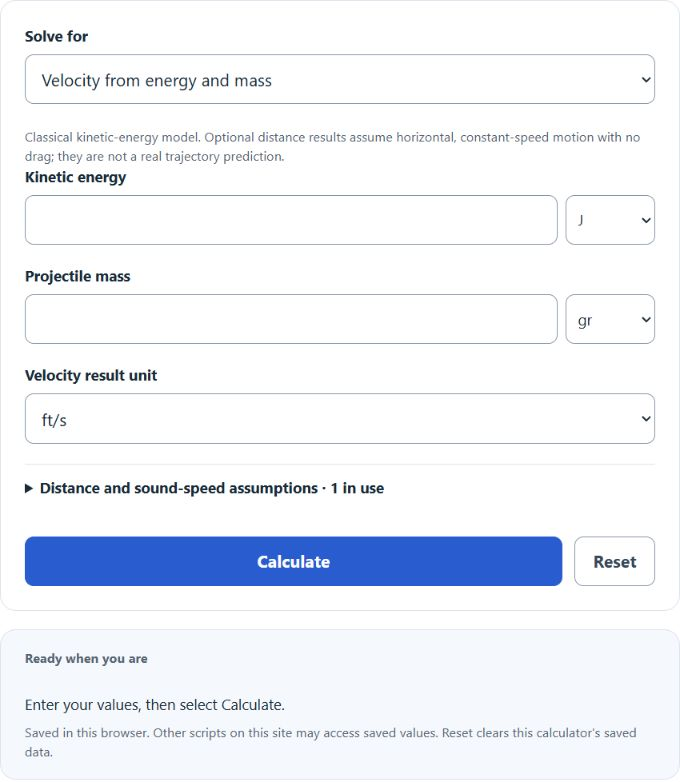
Calculate projectile muzzle velocity from kinetic energy and mass or reverse energy and mass with grains, grams, joules, foot-pounds, fps, and m/s conversions.
- All Velocity Calculators
- Muzzle Energy Calculator
- Bullet Force Calculator
- Gun Recoil Force Calculator
- All Physics Calculators
- Bullet Energy Calculator
- Muzzle Pressure Calculator
Muzzle Velocity Formula
Muzzle velocity is the speed of a projectile at the instant it leaves the muzzle. This calculator uses the kinetic energy relationship to solve for the missing value when any two of the three variables are known: muzzle energy, projectile mass, or muzzle velocity.
- v = muzzle velocity
- E = muzzle energy
- m = projectile mass
This equation is most useful when you already know the projectile’s energy and mass and want to estimate the exit speed. The key idea is simple: for a given energy, lighter projectiles leave faster, while heavier projectiles leave slower.
Rearranged Forms
The same relationship can be rearranged to solve for energy or mass.
That means this calculator is not limited to velocity alone. If you know velocity and mass, you can find energy. If you know energy and velocity, you can estimate projectile mass.
Common Ballistics Shortcut
In US customary ballistics, projectile weight is often listed in grains and energy in foot-pounds. A convenient shortcut for feet per second is:
A rounded constant near this value is also commonly used in practical ballistic calculations. The small difference usually has little effect for everyday estimating, but the important point is to keep the unit system consistent from start to finish.
How to Calculate Muzzle Velocity
- Determine the projectile’s muzzle energy.
- Determine the projectile mass or bullet weight.
- Select Velocity from energy and mass, then enter both known values.
- Choose each input unit and the desired velocity result unit; the calculator performs the conversions.
If you are using SI units, energy in joules and mass in kilograms will return velocity in meters per second. If you are using foot-pounds and grains, use the ballistics shortcut above to obtain feet per second.
Example
If a projectile has 10 ft·lbf of energy and weighs 20 grains, the estimated muzzle velocity is:
This illustrates the square-root behavior of the formula: increasing energy raises velocity, but velocity does not rise in a one-to-one proportion with energy.
Why Muzzle Velocity Matters
- Trajectory: Higher muzzle velocity generally reduces time of flight and can reduce drop over a given distance.
- Energy calculations: Velocity is one of the main inputs for determining projectile kinetic energy.
- Comparing loads: It helps compare ammunition, airgun setups, or launcher configurations under similar conditions.
- Chronograph validation: Estimated velocity can be checked against measured velocity to spot unit mistakes or unrealistic assumptions.
What Affects Muzzle Velocity
- Projectile mass: At the same energy level, a lighter projectile leaves the muzzle faster.
- Available energy: More energy typically produces more velocity.
- Barrel length: A longer barrel can provide more acceleration distance, although gains eventually taper.
- Friction and seal: Bore condition, projectile fit, and gas sealing influence how efficiently energy becomes forward motion.
- Ammunition variation: Different lots, powder characteristics, and component tolerances can change real-world velocity.
- Environmental conditions: Temperature and similar conditions can affect performance and measured speed.
Quick Interpretation Guide
| Change | Expected effect on velocity | Reason |
|---|---|---|
| Increase energy, same mass | Velocity increases | More kinetic energy is available to accelerate the projectile. |
| Increase mass, same energy | Velocity decreases | A heavier projectile requires more energy to reach the same speed. |
| Double the energy | Velocity rises by about 41% | Velocity follows a square-root relationship, not a linear one. |
| Double the mass | Velocity drops to about 71% of the original | The same energy is spread across more mass. |
Unit Notes
| Known inputs | Recommended approach | Typical output unit |
|---|---|---|
| Energy in joules, mass in kilograms | Use the standard kinetic energy form | m/s |
| Energy in ft·lbf, bullet weight in grains | Use the ballistics shortcut constant | ft/s |
| Mass in grams | Convert to kilograms before using the SI form | m/s |
Practical Notes
This type of calculation is ideal for estimation, comparison, and checking other ballistic numbers. It does not directly model pressure curves, drag, barrel friction, or downrange velocity loss. If you need the actual launch speed of a specific setup, a chronograph measurement is the better reference point.
Frequently Asked Questions
Is muzzle velocity the same as average velocity?
No. Muzzle velocity is the projectile speed at the moment it exits the muzzle. Average velocity over a distance will usually be lower because the projectile slows after launch.
Can this calculator solve for mass or energy too?
Yes. Because the kinetic energy equation can be rearranged, the calculator can determine any one of the three variables when the other two are known.
Why is unit consistency so important?
Velocity results depend entirely on the unit system used. Mixing joules with grains or foot-pounds with kilograms without proper conversion will produce incorrect results.