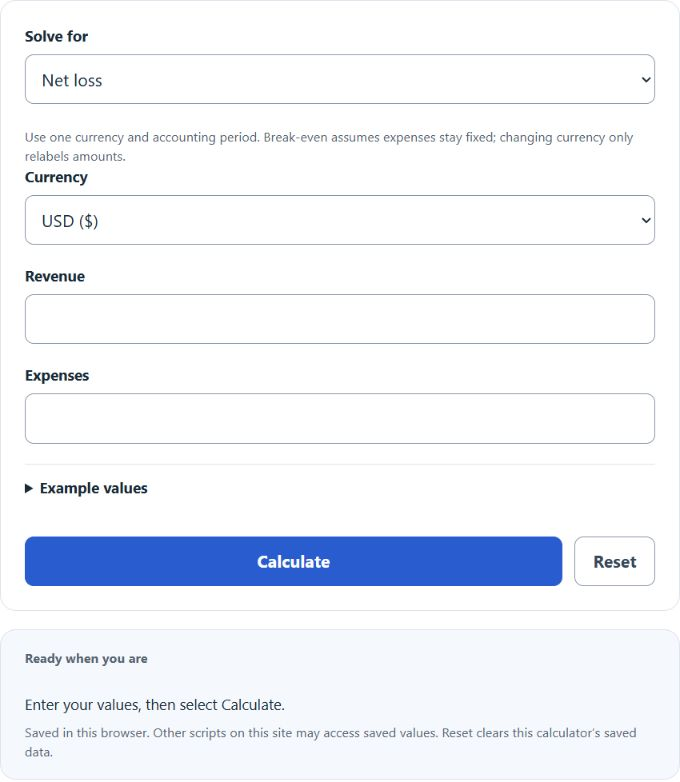
Choose a loss, profit or break-even calculation and enter the two requested amounts in one currency and accounting period. Break-even holds expenses fixed; a zero loss or profit does not uniquely determine missing revenue or expenses.
Net Loss Formula
The following formula is used to calculate the net loss amount (when total expenses exceed total revenue).
- Where L is the net loss amount ($)
- R is the total revenue ($)
- E is the total expenses ($)
To calculate the net loss amount, subtract total revenue from total expenses. If expenses are less than or equal to revenue, the net loss is 0 (because there is no loss).
Net Loss Definition
A net loss is the amount by which a business’s total expenses exceed its total revenue over a given time period. This corresponds to a negative net income (net income = revenue − expenses).
When analyzing a loss using net income, the value of revenue minus expenses will be negative. For example, $200 revenue and $300 expenses gives net income of -$100, which corresponds to a $100 net loss. Many people report the net loss as a positive number using expenses minus revenue.
Example Problem
How to calculate net loss?
For this example, we will analyze the net loss of a candy store over a one-month period.
First, determine the total revenue of the shop. For this problem, 1000 candy bars were sold at an average price of $5.00. To calculate the total revenue the number of units sold is multiplied by the average price to get $5,000.00.
Next, determine the total expenses. This includes the cost of the candy bars, the cost of the labor to man the shop, and any other overhead costs. For this problem, the candy bars’ COGS was $2.00 each, which would be $2,000 total at the 1000 units sold, the labor for the month was $2,000.00, and the overhead of the store (i.e. rent/AC cost/etc.) was $2,000.00.
Finally, calculate the net loss using the formula above.
L = E – R
= ($2,000 + $2,000 + $2,000) – $5,000.00
= $6,000 – $5,000
= $1,000.00 net loss
FAQ
Is net loss the same as net profit?
No. Net profit and net loss are opposite outcomes based on the same underlying relationship between revenue and expenses.
If revenue is greater than expenses, the business has a net profit (net income is positive). If expenses are greater than revenue, the business has a net loss (net income is negative, and the loss amount is often reported as a positive number equal to expenses minus revenue).
What happens if a business has a net loss?
Depending on the time period or stage of a business, a net loss is not necessarily a bad thing.
For example, if a company is in an early-stage startup stage, then the company is likely spending lots of money to grow as fast as possible without regard to making a profit. In this case, as long as the invested money is covering losses, it is ok.
If, however, you are looking at a long-term steady-state company like a restaurant, then running at a loss for an extended period of time will cause the business to go bankrupt if it cannot receive further funding.