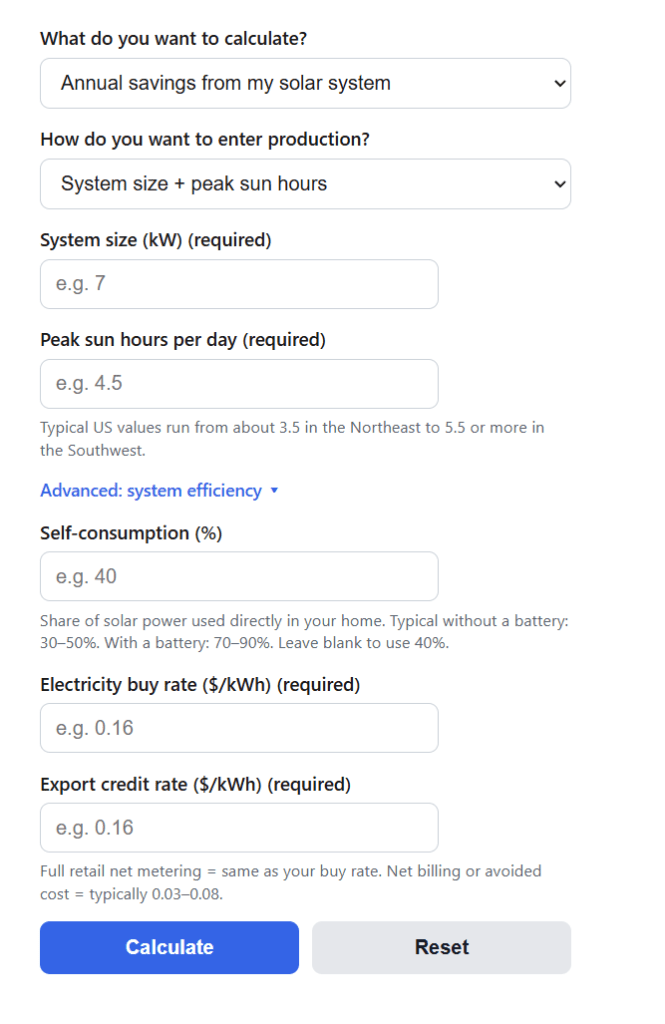
Calculate your annual net metering savings from solar, including export bill credits, your monthly bill with credit rollover, and full retail vs net billing.
Net Metering Savings Formula
Annual net metering savings depend on three things: how much electricity your system produces, how much of that production your home uses directly, and the rate your utility credits for exports:
S = E * SC * Rb + E * (1 - SC) * Re
If you do not know your annual production, the calculator estimates it from system size:
E = kW * PSH * 365 * DF
The monthly bill mode settles a single billing cycle by netting export credits against your grid charges in dollars:
Bill = Imp * Rb - min(Imp * Rb, Exp * Re + C) + F
- S is your total annual savings, in dollars
- E is annual solar production, in kWh
- SC is the self-consumption fraction, the share of solar power used directly in the home (0 to 1)
- Rb is your electricity buy rate, in $/kWh
- Re is the export credit rate, in $/kWh (equal to Rb under full retail net metering, lower under net billing)
- kW is the system size in kilowatts, PSH is daily peak sun hours, and DF is the efficiency factor (about 0.85) covering inverter, wiring, soiling, and temperature losses
- Imp and Exp are the kWh imported from and exported to the grid in one billing cycle
- C is unused credit carried in from earlier months, and F is the fixed monthly charge that credits usually cannot offset
The annual savings mode applies the first two formulas: solar power you use directly is worth the full buy rate because it replaces electricity you would have purchased, while exported power earns the export rate. The comparison mode runs the same production twice, once with exports credited at the full retail rate and once at your net billing rate, and reports the annual gap between the two plus what each 10 point rise in self-consumption is worth. The monthly bill mode applies the third formula, so you can check a single utility bill and see how much credit rolls forward to the next month.
Export Credit Rates and How They Change Your Savings
The single biggest driver of net metering savings is how your utility compensates exports. The table below shows the common compensation structures and the export rates they typically pay.
| Compensation type | Typical export rate | Effect on savings |
|---|---|---|
| Full retail net metering (1:1) | Same as buy rate, about $0.10 to $0.40 | Every solar kWh is worth the retail rate; self-consumption barely matters |
| Net billing / avoided cost | $0.03 to $0.08 | Exports earn 3 to 6 times less than imports cost; self-consumption drives savings |
| Time-of-use export (California NEM 3.0 style) | $0.04 to $0.08 average, higher on summer evenings | Roughly 75% below retail; batteries that shift exports to peak windows recover value |
| Wholesale cash-out at annual true-up | $0.02 to $0.05 | Leftover annual surplus is paid near wholesale, so oversizing a system pays poorly |
The second table shows why self-consumption is the lever you actually control. It holds production at 10,000 kWh per year and a buy rate of $0.17/kWh, then varies the self-consumption share. Under full retail credits the savings never move. Under a $0.05 net billing rate, every 10 point rise in self-consumption adds $120 per year, which is the production times the 10 point step times the gap between the two rates.
| Self-consumption | Savings at full retail ($0.17 export) | Savings at net billing ($0.05 export) | Lost to the lower rate |
|---|---|---|---|
| 30% | $1,700 | $860 | $840 |
| 40% | $1,700 | $980 | $720 |
| 50% | $1,700 | $1,100 | $600 |
| 60% | $1,700 | $1,220 | $480 |
| 70% | $1,700 | $1,340 | $360 |
Practical ways to raise self-consumption without a battery: run the dishwasher, laundry, and EV charging between 10am and 2pm, heat water during the solar peak, and pre-cool the house in the afternoon. These habits alone can move a typical home from 30% to 50 or 60%.
Example Problems
Example 1: An 8 kW system in a location with 4.5 peak sun hours, using the default 85% efficiency factor, produces 8 * 4.5 * 365 * 0.85 = 11,169 kWh per year. The home uses 40% directly, pays $0.16/kWh, and is on a net billing plan that credits exports at $0.06/kWh. Self-consumed power is worth 11,169 * 0.40 * 0.16 = $714.82, and the exported 6,701 kWh earns 6,701.4 * 0.06 = $402.08 in credits. Total annual savings are $1,116.90, about $93 per month, and each solar kWh is effectively worth about $0.10.
Example 2: In one billing cycle a home imports 620 kWh and exports 450 kWh. The buy and export rates are both $0.15/kWh (full retail), and the fixed monthly charge is $12. The grid energy charge is 620 * 0.15 = $93.00, export credits are 450 * 0.15 = $67.50, so the remaining energy charge is $25.50. Adding the fixed charge, the estimated bill is $37.50, and no credit rolls forward.
Frequently Asked Questions
What is the difference between net metering and net billing?
Under full retail net metering, each exported kWh cancels an imported kWh one for one, so exports are effectively worth the retail rate you pay. Under net billing, imports and exports are valued separately: you pay the retail rate for what you draw from the grid, but exports are credited at a lower rate based on the utility’s avoided cost, commonly $0.03 to $0.08 per kWh. The comparison mode of the calculator quantifies exactly how much that difference costs you per year at your own numbers.
Do unused net metering credits expire?
In most programs, dollar credits roll forward from month to month, which is why summer overproduction can wipe out winter bills. Many utilities then run an annual true-up: leftover credits are either cashed out at a low wholesale rate, typically $0.02 to $0.05 per kWh, or zeroed out entirely. Check your utility’s true-up month before oversizing a system, because banked credits are usually worth far less than avoided purchases.
Can net metering bring my electric bill to zero?
It can bring the energy portion of your bill to zero, but fixed charges such as connection fees, minimum bills, and grid access charges usually cannot be offset by export credits. A home with a $15 monthly fixed charge will still pay about $180 per year even if solar covers 100% of its energy use. The monthly bill mode of the calculator keeps fixed charges separate so the estimate reflects this.