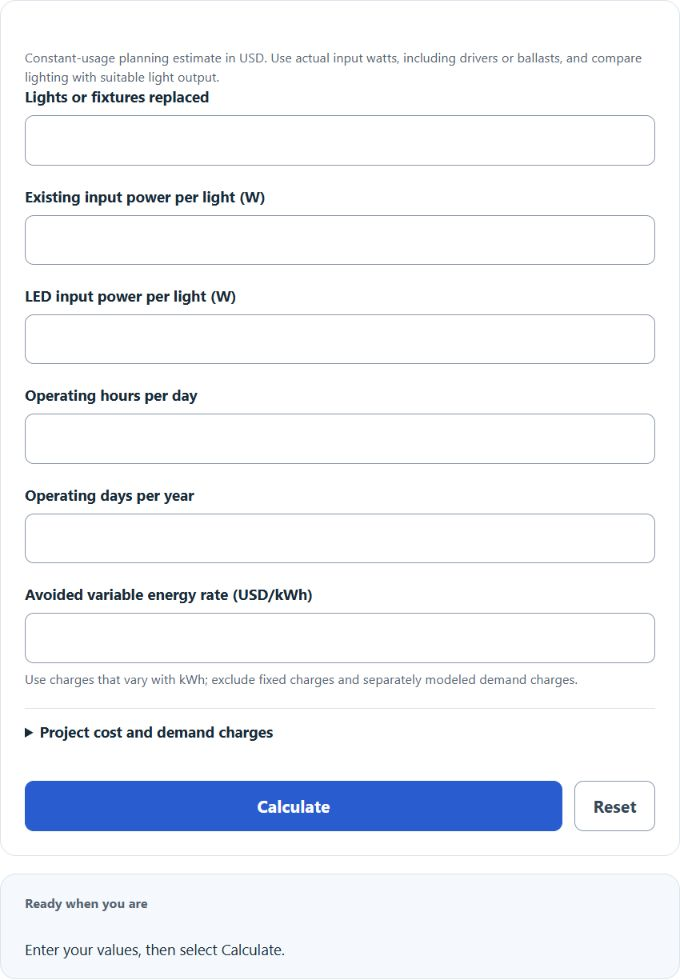
Estimate annual lighting utility savings in USD and kWh, with optional upfront project costs, simple payback and explicitly modeled billed-demand savings. Replacement purchases, maintenance, emissions and heating/cooling effects are excluded.
LED Lighting Savings Formula
kWh = N * (Wo - Wl) / 1000 * h * d
S = kWh * R + annual billed-demand savings
P = net upfront project cost / S * 12
- kWh = electricity saved per year (kilowatt-hours)
- N = number of bulbs replaced
- Wo = wattage of each current bulb (W)
- Wl = wattage of each LED replacement (W)
- h = hours the lights are on per day
- d = operating days per year, from 0 to 366
- S = money saved per year; R = your electricity rate per kWh
- P = simple payback in months, only for positive net investment and positive annual savings
Annual hours equal hours per operating day times operating days per year. Use actual input watts, including drivers or ballasts, and the variable charges avoided per kWh. Optional project inputs include LED purchase, installation, rebates and other upfront costs. Demand savings require a monthly demand rate, charged months and the percentage of connected-load change that actually changes billed peak. The calculator retains negative savings and net rebate credits. Simple payback and 5-/10-year totals hold usage and rates constant; they exclude replacement purchases, maintenance, heating/cooling, taxes, financing and discounting.
Savings by Bulb Swap and the Air-Conditioning Bonus
The table below shows the yearly savings from replacing one bulb, assuming 3 hours of use per day for 365 days per year and an electricity rate of $0.17 per kWh. Both bulbs in each row produce roughly the same brightness.
| Swap (same brightness) | Brightness | kWh saved per year | Saved per year |
|---|---|---|---|
| 100 W incandescent to 15 W LED | ~1,600 lm | 93.1 | $15.82 |
| 75 W incandescent to 11 W LED | ~1,100 lm | 70.1 | $11.91 |
| 60 W incandescent to 9 W LED | ~800 lm | 55.8 | $9.49 |
| 43 W halogen to 9 W LED | ~800 lm | 37.2 | $6.33 |
| 14 W CFL to 9 W LED | ~800 lm | 5.5 | $0.93 |
Lighting changes can also affect space heating and cooling, but these effects are outside this calculator. The following table is only an illustrative cooling sensitivity: assume all reduced lighting energy becomes reduced indoor heat during the stated fraction of the year, usage is evenly distributed, and cooling coefficient of performance remains 3. The percentages are not measured project savings.
| Months of AC cooling per year | Extra savings on top of direct savings |
|---|---|
| 3 months | about 8% |
| 4 months | about 11% |
| 6 months | about 17% |
| 9 months | about 25% |
| 12 months (year-round AC) | about 33% |
If you heat with electric resistance heating in winter, bulb waste heat was offsetting a little of your heating bill, which trims the net benefit slightly during the heating season. The net effect depends on the building, climate, heating efficiency and fuel prices; no universal adjustment is assumed.
Example Problems
Example 1: Replace ten 60 W lights with 9 W LEDs, operating 4 hours daily for 365 days/year at $0.17/kWh. Annual hours = 4 × 365 = 1,460. Saved energy = 10 × (60 − 9)/1000 × 1,460 = 744.6 kWh; energy-cost savings = 744.6 × 0.17 = $126.58/year. With only $3 per LED and no other costs, net investment is $30 and simple payback is about 2.84 months. This assumes unchanged usage and rates, with no demand savings.
Example 2: You want the LED equivalent of a 75 W incandescent bulb. Incandescent bulbs produce about 15 lumens per watt, so the bulb puts out 75 * 15 = 1,125 lumens. At a typical LED efficacy of 90 lumens per watt, the matching LED is 1,125 / 90 = 12.5 W. In a store, look for a bulb labeled as a 75 W equivalent, rated near 1,100 lumens, which usually draws 10 to 13 W.
LED Lighting Savings FAQ
How much does replacing one bulb with an LED actually save? A single 60 W incandescent swapped for a 9 W LED saves about 55.8 kWh per year at 3 hours of daily use for 365 days, which is $9.49 per year at $0.17 per kWh. Double the daily hours and you double the savings. Rated lifetimes and replacement purchases differ by product and conditions; those savings are excluded from this calculator.
Can LEDs affect air-conditioning costs? Reduced lighting input power can reduce indoor heat gains while cooling operates. Actual cooling savings depend on heat location, cooling efficiency and coincident use. The illustrative cooling table is outside the calculator’s direct utility model, and heating effects may offset part of the benefit.
Why should replacement lights be compared by lumens instead of watts? Watts measure electricity use, not light output, and each technology produces a different amount of light per watt: incandescents manage about 15 lumens per watt while LEDs deliver 80 to 110. If you match watts you will buy an LED that is far too bright. Compare product lumen ratings and lighting quality, then enter each fixture’s actual input watts. This calculator does not infer an LED size from a brightness-match mode.