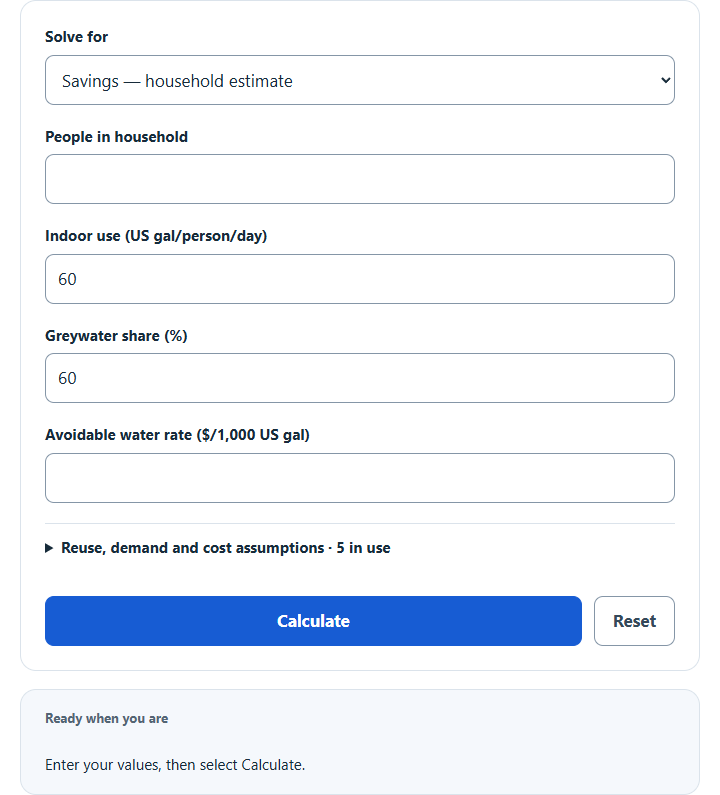
Calculate the gallons and dollars you save by reusing household greywater, plus system payback time and the landscape area your greywater can irrigate.
Greywater Reuse Savings Formula
The calculator estimates the greywater your household produces, then converts the portion you reuse into gallons and dollars saved. The quick estimate uses total indoor water use:
GW = P * IU * (GS/100)
The detailed estimate builds the same number from individual sources:
GW = (N * t * F) + (L * V / 7) + (P * S) + other permitted sources
Annual savings come from the reused share priced at your utility rate:
AS = (min(GW * E/100, demand per day) * reuse days / 1000) * (WR + SR)
Payback and irrigation coverage use:
PB = max(C - R, 0) / (AS - M), when AS > M
A = (7 * GWd) / ((144/231) * D)
- GW is greywater produced (gal/day)
- P is people in the household
- IU is indoor water use (gal/person/day)
- GS is the share of indoor use that is greywater (%)
- N is showers per day, t is minutes per shower, F is showerhead flow (gal/min)
- L is laundry loads per week, V is gallons per load
- S is bathroom sink use (gal/person/day)
- E is reuse efficiency (%), the share of collected greywater actually put to use
- AS is annual savings ($/yr), WR and SR are water and sewer rates ($/1,000 gal)
- PB is simple payback (years), C is system cost, R is rebates, M is annual maintenance
- A is irrigable area (sq ft), GWd is greywater used (gal/day), D is plant water demand (in/week)
Savings count only purchased water actually displaced, with an optional weekly demand cap and entered reuse days (365 by default). Monthly values are annual averages. Payback uses constant first-year net savings; the ten-year rate scenario is undiscounted, keeps volume and operating costs constant, and does not predict future bills. Irrigation coverage uses the exact US gallon conversion: one inch over one square foot is144/231 ≈0.623376623 US gallons, before distribution losses and soil loading limits.
Typical Greywater Output by Source
These are illustrative fixture and household scenarios, not measured national ranges or guaranteed collectable water. Use actual fixture consumption and eligible sources; efficient fixtures reduce potential greywater volume.
| Source | Standard fixture | Efficient fixture |
|---|---|---|
| Shower (8 minutes) | 20 gal (2.5 gal/min) | 14.4 gal (1.8 gal/min) |
| Laundry (per load) | 30 to 40 gal | 14 to 20 gal |
| Bathroom sink (per person/day) | 4 to 6 gal | 2 to 3 gal |
| Household of 4 (per day) | 120 to 200 gal | 80 to 120 gal |
Landscape Area Your Greywater Can Irrigate
Savings only count when greywater replaces water you would have purchased, so match your reuse to real irrigation demand. This table shows how much landscape different daily greywater volumes can support at three plant demand levels, using A =7 x US gallons per day / ((144/231) x inches per week). Depths are illustrative; coverage does not establish safe soil loading or system approval.
| Greywater (gal/day) | Low demand (0.5 in/wk) | Moderate (1.0 in/wk) | High (1.5 in/wk) |
|---|---|---|---|
| 50 | 1,123 sq ft | 561 sq ft | 374 sq ft |
| 100 | 2,246 sq ft | 1,123 sq ft | 749 sq ft |
| 150 | 3,369 sq ft | 1,684 sq ft | 1,123 sq ft |
| 200 | 4,492 sq ft | 2,246 sq ft | 1,497 sq ft |
Select a net irrigation depth for the actual plants, weather, rainfall and soil. The example depths are not universal plant classifications. Use the demand cap and seasonal reuse days so water beyond real demand is not counted as savings. Prevent ponding and runoff; avoid spray, human contact and contact with edible plant portions, and follow local reuse and treatment requirements.
Greywater Reuse Savings Example Problems
Example 1: Annual savings for a family of four. The household has 4 people using 60 gallons per person per day indoors, with 60% of that water being greywater. The system reuses 80% of what it collects and water costs $6.00 per 1,000 gallons.
Greywater produced: GW = 4 x 60 x 0.60 = 144 gal/day. Reused: 144 x 0.80 = 115.2 gal/day. Annual volume: 115.2 x 365 = 42,048 gallons. Annual savings: (42,048 / 1,000) x $6.00 = $252.29 per year, or about $21 per month. At a 4% annual rate increase, that compounds to roughly $3,029 over 10 years.
Example 2: How much garden 100 gallons per day can water. A laundry and shower system delivers 100 gal/day to plants with moderate demand of 1.0 inch per week.
Weekly volume: 100 x 7 = 700 gallons. Area:700 / ((144/231) x1.0) =1,122.917 sq ft, about33.51ft per side for an equivalent square. At the illustrative0.5inch/week depth the geometric coverage is2,245.833 sq ft; actual usable coverage may be lower.
Greywater Reuse Savings FAQ
Does reusing greywater lower my sewer bill too? Usually not directly, and this is the most common reason savings estimates run high. Most utilities bill sewer on the metered water entering your home, and greywater reuse does not change that meter reading; it replaces outdoor water you would have bought separately. Some utilities set sewer charges from winter average use, which already excludes summer irrigation. Only add a sewer rate in the calculator if the water you are offsetting is genuinely billed for sewer, for example when treated greywater replaces toilet flushing water inside the home.
Which household water counts as greywater? Eligible sources differ by jurisdiction and treatment system. Showers, baths, bathroom sinks and laundry are common candidates; toilet waste is excluded. Kitchen and dishwasher rules vary, so do not include them without local approval. Exclude hazardous chemicals and contaminated laundry streams as required by local safeguards.
Is greywater reuse legal, and what does a system cost? Permit and treatment requirements depend on the jurisdiction, sources, system and site. Check the local building, health and environmental authorities before installation. Use current local quotes for installed and operating costs rather than a national price assumption. Arizona guidance, Oregon ORS454.610 and EPA watering guidance illustrate why local checks matter.