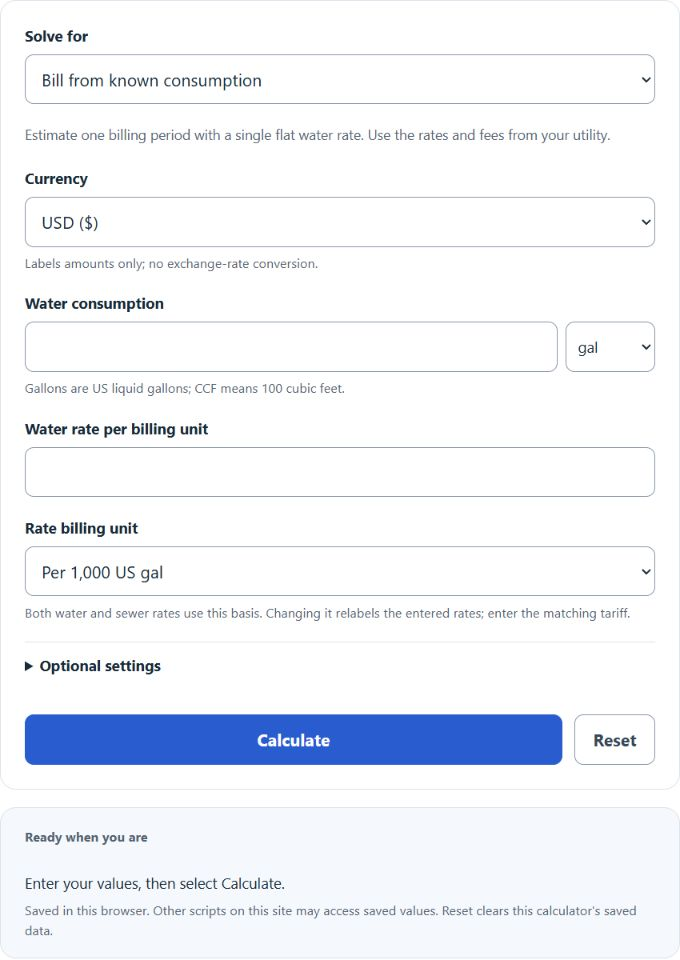
Estimate a water bill from gallons, CCF or meter readings and your utility’s rate, or work back from a bill to the water used or the rate per unit.
How to calculate water bill
For a water-only uniform tariff with no other charges, the usage charge is:
- Where WB is the water usage charge in the selected currency
- GWU is the US gallons of water used
- POW is the water price per US gallon
The full calculator uses: bill = [usage ÷ billing-unit volume × (water rate + sewer rate) + fixed fee + other fee] × (1 + tax ÷ 100). Reverse usage first removes tax and fixed fees, then divides by the combined usage rate. Both rates use the selected billing basis. For example, 5,000 US gal at 4.00 water + 3.00 sewer per 1,000 gal, with 15.00 service + 5.00 other fees and 5% tax, gives 57.75; reversing 57.75 with the same inputs gives 5,000 US gal.
Utilities use several billing units. CCF means 100 cubic feet (about 748 US gallons); a cubic metre is 1,000 litres, and a US liquid gallon is exactly 3.785411784 litres. Compare the meter’s unit with the tariff’s unit. Household use per day varies with household size, weather, irrigation and appliances; a national average is not a personal usage prediction.
Enter the utility’s actual rates for the same billing period. This model assumes uniform rates, sewer based on the same water consumption, and tax on the whole subtotal. Tiered or seasonal rates, minimum bills, billing-unit rounding, credits and sewer caps need the utility’s own method. Currency labels do not convert money. Meter rollover is not inferred.
How to reduce water bill
5 Ways to reduce your water bill.
- Take Shorter Showers
Shorten showers and turn off the tap when it is not needed. Savings depend on flow rate and the time reduced.
- Run a full dishwasher load
A full dishwasher typically uses less water than hand washing. Scrape food instead of pre-rinsing; if washing by hand, use a filled basin instead of a running tap.
- Water landscapes efficiently
Match irrigation to plant needs, rainfall and local restrictions. Repair leaks and runoff; outdoor savings vary by climate and landscape.
- Wash full laundry loads
Run full loads or select the appropriate water level. Follow the washer’s instructions; hand washing has no universal percentage advantage.
- Invest in a lower water usage toilet
Fix leaking toilets and consider a WaterSense-labeled replacement when appropriate. Actual savings depend on the old fixture and household use.