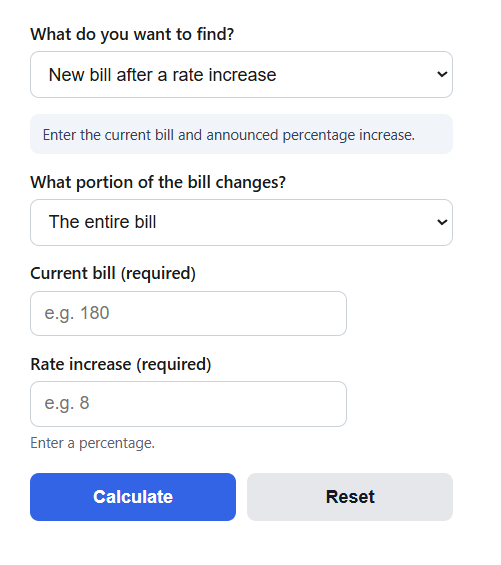
Estimate a monthly utility bill after a rate increase, calculate the change from two bills, or find the usage reduction needed to keep costs steady.
Utility Rate Increase Formula
If the entire bill changes by the announced percentage, multiply the current bill by one plus the decimal increase:
Bnew = Bold * (1 + R)
If only usage-based charges increase and fixed charges stay the same:
Bnew = F + (Bold - F) * (1 + R)
The percentage usage reduction required to offset a usage-rate increase is:
D = R / (1 + R)
Variables:
- Bnew is the estimated new bill
- Bold is the current bill at the same usage level
- R is the rate increase written as a decimal
- F is the fixed portion of the bill that does not increase
- D is the fraction by which usage must fall to keep the usage-based cost unchanged after the rate increase
To calculate the rate change from old and new bills, divide the comparable new amount by the old amount and subtract one. When only variable charges change, subtract the unchanged fixed charge from both bills before calculating the percentage.
Rate Increase and Required Usage Reduction
A usage reduction is slightly smaller than the rate increase because the lower usage is multiplied by the new, higher rate.
| Usage-rate increase | Usage reduction needed | New bill if the entire $200 bill rises |
|---|---|---|
| 5% | 4.76% | $210.00 |
| 10% | 9.09% | $220.00 |
| 15% | 13.04% | $230.00 |
| 20% | 16.67% | $240.00 |
| 25% | 20.00% | $250.00 |
For example, after a 20 percent rate increase, using 83.33 percent of the previous quantity produces the same usage-based cost: 0.8333 * 1.20 is approximately 1.00.
Example Problems
Example 1: Estimate a new bill when only the variable portion increases.
A current electric bill is $180, including a $20 fixed customer charge. The usage rate increases by 8 percent. The variable portion is $160, so:
Bnew = $20 + $160 * 1.08 = $192.80.
The increase is $12.80 per month, or $153.60 across 12 similar monthly bills.
Example 2: Find the usage reduction needed to offset an increase.
A utility raises its usage rate by 12 percent. The required reduction is:
D = 0.12 / 1.12 = 0.1071, or about 10.71 percent.
Reducing usage by about 10.71 percent keeps the usage-based charge at its previous level, assuming no other bill component changes.
Frequently Asked Questions
Why might my bill increase by a different percentage than the announced rate increase?
The announcement may apply only to a generation, delivery, fuel, water, or other variable component. Fixed fees, taxes, credits, tier thresholds, weather, and actual consumption can cause the total bill to change by a different percentage.
How do I calculate the increase when fixed charges do not change?
Subtract the unchanged fixed charge from the old and new bills. Compare the two remaining variable amounts. This isolates the portion affected by the rate change.
Does reducing usage by 10 percent offset a 10 percent rate increase?
It more than offsets it slightly. The exact reduction is 10 / 110 = 9.09 percent because the reduced quantity is multiplied by the new rate. The formula is increase divided by one plus the increase.