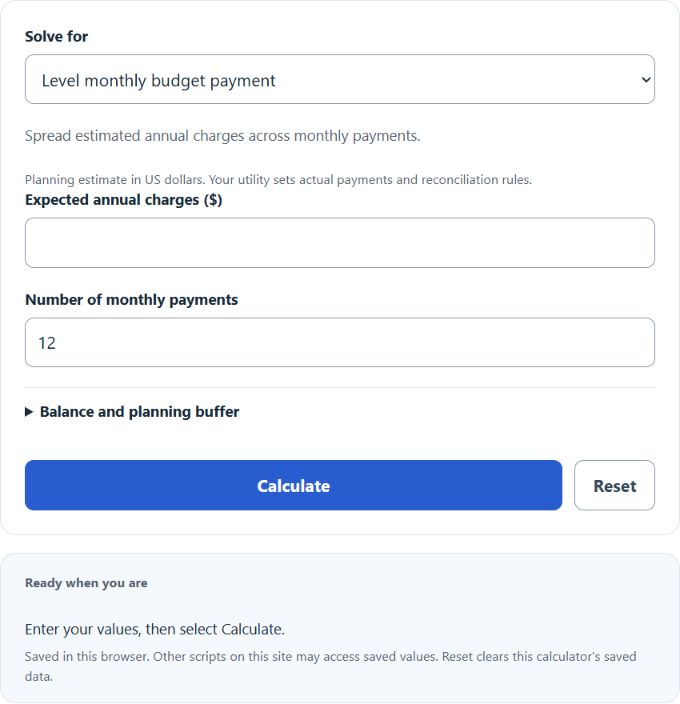
Estimate a level monthly utility payment from annual charges, balances, and a planning buffer, or calculate an expected budget-billing true-up balance.
Budget Billing Formula
A level-payment estimate spreads expected utility charges across a selected number of payments. A planning buffer can be added to expected usage charges, and a prior balance or credit can be carried into the plan:
P = max(0, A * (1 + R) + D) / N
An opening credit exceeding planned charges gives a zero payment estimate and a remaining credit. The estimated true-up balance after payments are made is:
T = C + D - (P * Nm + X)
Variables:
- P is the level budget payment
- A is expected utility charges for the planning period
- R is the planning buffer written as a decimal
- D is a prior amount owed; enter a credit as a negative number
- N is the number of payments in the budget period
- T is the true-up balance, where a positive result is owed and a negative result is a credit
- C is actual utility charges for the period, D is the opening balance or credit, Nm is the number of budget payments made, and X is other payments or credits not already in D
Budget billing changes the timing of payments, not the underlying cost of energy or water. Actual charges continue to accumulate, and the difference between charges and payments eventually becomes a balance or credit.
Budget Billing Example
The table shows a household with $2,400 in expected annual charges, a $120 prior balance, a 5 percent planning buffer, and 12 monthly payments.
| Component | Calculation | Amount |
|---|---|---|
| Expected annual charges | Entered estimate | $2,400.00 |
| Planning buffer | $2,400 * 5% | $120.00 |
| Prior balance | Amount owed | $120.00 |
| Planned total | $2,400 + $120 + $120 | $2,640.00 |
| Monthly payment | $2,640 / 12 | $220.00 |
If actual annual charges are only $2,500 and all 12 payments of $220 are made, total payments are $2,640. Including the $120 opening balance, total charges and balance are $2,620, leaving an estimated $20 credit before any utility-specific adjustments.
Example Problems
Example 1: Estimate a level monthly payment.
Expected annual charges are $1,800, there is no prior balance, and the customer adds a 4 percent buffer. The planned total is $1,800 * 1.04 = $1,872. Dividing by 12 produces a payment of $156 per month.
Example 2: Estimate the year-end settlement.
Actual charges are $2,520. The customer paid $200 for 12 months and made an additional $50 payment. Total payments are $2,450. The true-up is:
T = $2,520 - $2,450 = $70 owed.
Frequently Asked Questions
Does budget billing save money?
Not by itself. It smooths seasonal bills into more predictable payments. Total cost is still based on actual usage, utility rates, fees, and the provider’s reconciliation rules.
Why can a budget-billing payment change during the year?
Providers may review actual charges, weather, usage trends, rate changes, account balances, and the months remaining in the plan. A payment can be adjusted when the previous estimate is no longer likely to cover the account.
What does a positive true-up balance mean?
A positive balance means actual charges exceeded payments and credits, so that amount may be due or added to a future budget calculation. A negative balance means payments exceeded charges and generally represents an account credit.