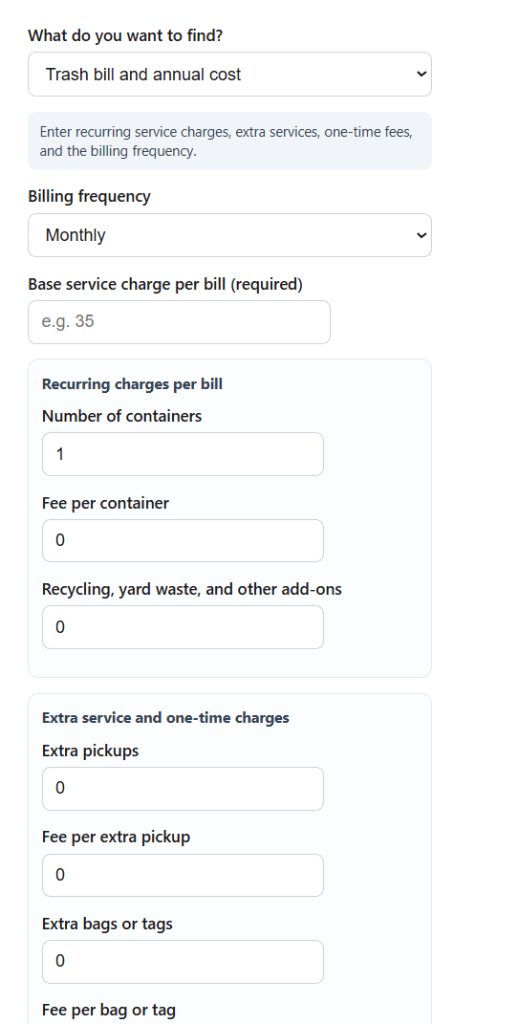
Estimate a trash bill from base service, containers, recycling, extra pickups, bags, fees, tax, and billing frequency, including monthly and annual costs.
Trash Bill Formula
Add the base service charge, container charges, recurring add-ons, extra pickups, extra bags or tags, and one-time fees. Then apply the entered tax or surcharge rate:
C = (B + Nc * Fc + A + Np * Fp + Nb * Fb + O) * (1 + T)
For a service billed k times per year, annual cost is the recurring bill repeated k times plus entered one-time and extra charges:
Y = R * k + X
Variables:
- C is the estimated bill for the current billing period
- B is the base service charge
- Nc and Fc are the number of containers and the fee per container
- A is the recurring recycling, yard-waste, or other add-on charge
- Np and Fp are the number and fee for extra pickups
- Nb and Fb are the number and fee for extra bags or tags
- O is other one-time fees and T is the tax or surcharge rate as a decimal
- Y is annual cost, R is the recurring bill, k is bills per year, and X is nonrecurring cost
Use the maximum-extra-pickups mode to subtract all known charges from a bill budget and divide the remaining pretax amount by the pickup fee. The result is rounded down because a partial pickup cannot be purchased.
Trash Billing Frequencies
The selected frequency determines how often recurring service charges are included in the annual estimate.
| Billing schedule | Bills per year | Monthly equivalent of one bill |
|---|---|---|
| Monthly | 12 | Bill amount |
| Every 4 weeks | 13 | Bill amount * 13 / 12 |
| Every 2 months | 6 | Bill amount / 2 |
| Quarterly | 4 | Bill amount / 3 |
| Every 6 months | 2 | Bill amount / 6 |
| Annually | 1 | Bill amount / 12 |
Every-four-week billing creates 13 bills in a typical year, not 12. This difference matters when comparing it with a monthly service quote.
Example Problems
Example 1: Calculate a quarterly trash bill.
The base quarterly charge is $75. Two containers cost $8 each, recycling costs $10, one extra pickup costs $20, and tax is 5 percent. The subtotal is $75 + 2 * $8 + $10 + $20 = $121. The bill is:
C = $121 * 1.05 = $127.05.
With four bills per year and no other one-time charges, the annual cost is $508.20.
Example 2: Find extra pickups within a budget.
A monthly bill budget is $100. Known pretax charges total $62, each extra pickup costs $15, and there is no tax. The available amount is $38. Dividing by $15 gives 2.53, so the household can add two whole pickups and remain within budget.
Frequently Asked Questions
What charges can appear on a trash bill?
Common items include a base collection charge, cart or container fees, recycling, yard waste, extra pickups, bulky-item collection, extra bags or tags, disposal fees, fuel or environmental surcharges, and tax.
How do I compare municipal and private trash service?
Convert each option to an annual cost and match the service level. Compare pickup frequency, cart size, recycling and yard-waste inclusion, bulk-item rules, extra-bag pricing, contract term, and any cost already embedded in property taxes or association dues.
Why is every-four-week billing more expensive than monthly billing?
A four-week cycle occurs 13 times in 52 weeks, while monthly billing occurs 12 times per year. A service priced at the same amount per bill therefore costs one additional bill each year under a four-week schedule.