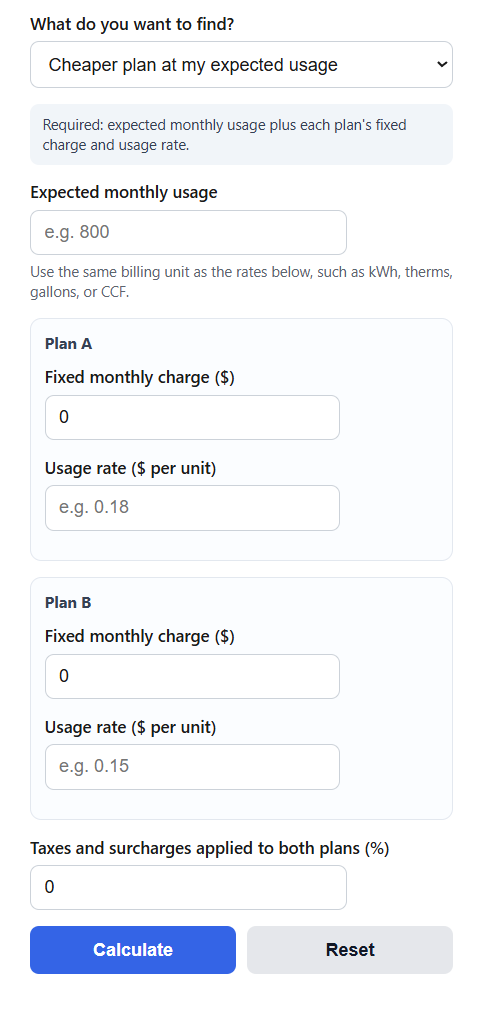
Compare two utility rate plans by fixed charge and usage rate, see monthly and annual costs, and calculate the exact break-even usage level for either plan.
Utility Rate Plan Comparison Formula
For a plan with one fixed monthly charge and one usage rate, monthly cost is:
CA = (FA + RA * U) * (1 + T)
 CB = (FB + RB * U) * (1 + T)
The usage level at which the two plans cost the same is:
Ubreak-even = (FB - FA) / (RA - RB)
Variables:
- CA and CB are the monthly costs of Plans A and B
- FA and FB are the plans’ fixed monthly charges
- RA and RB are the usage rates per unit
- U is expected monthly usage in a matching unit, such as kWh, therms, CCF, or gallons
- T is the common tax and surcharge rate written as a decimal
- Ubreak-even is the monthly usage where both plans have the same cost
At usage below or above the break-even point, the cheaper plan depends on which plan has the lower fixed charge and which has the lower variable rate. A plan with a higher fixed charge can still be cheaper for a high-usage household when its per-unit rate is sufficiently lower.
Plan Cost at Different Usage Levels
The table compares Plan A with a $10 fixed charge and $0.18 per unit against Plan B with a $30 fixed charge and $0.15 per unit, before tax.
| Monthly usage | Plan A | Plan B | Cheaper plan |
|---|---|---|---|
| 300 units | $64.00 | $75.00 | Plan A by $11.00 |
| 500 units | $100.00 | $105.00 | Plan A by $5.00 |
| 666.67 units | $130.00 | $130.00 | Break-even |
| 700 units | $136.00 | $135.00 | Plan B by $1.00 |
| 1,000 units | $190.00 | $180.00 | Plan B by $10.00 |
The break-even calculation is useful when choosing among electricity, natural-gas, water, propane, trash, or other utility plans that combine a fixed fee with a flat usage charge.
Example Problems
Example 1: Compare plans at expected usage.
A household expects to use 800 units per month. Plan A costs $10 + $0.18 * 800 = $154. Plan B costs $30 + $0.15 * 800 = $150. Plan B is cheaper by $4 per month, or $48 per year.
Example 2: Find break-even usage.
Using the same plans:
Ubreak-even = ($30 - $10) / ($0.18 - $0.15) = 666.67 units per month.
Below about 666.67 units, Plan A’s lower fixed fee wins. Above that point, Plan B’s lower usage rate wins.
Frequently Asked Questions
Can this compare plans that use different billing units?
Not until the units are converted. Both usage rates must use the same unit and the expected usage must be expressed in that unit. For example, do not compare a rate per therm directly with a rate per CCF.
What does a negative break-even result mean?
It means the two cost lines cross only at a negative usage level, which is not practical. For every nonnegative usage level, one of the plans is cheaper than the other.
Can I use this for tiered or time-of-use plans?
Use a dedicated tiered or time-of-use calculator instead. The break-even formula here assumes one fixed charge and one flat usage rate for each plan; credits, demand charges, minimum bills, and multiple rate periods can change the result.