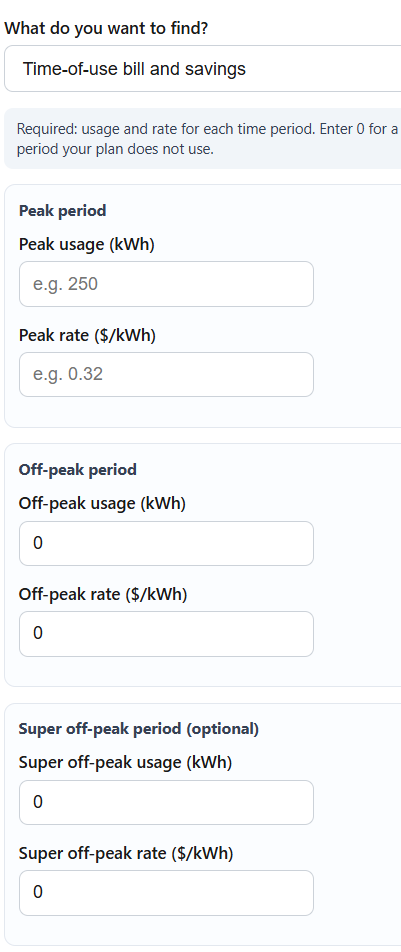
Calculate a monthly time-of-use electricity bill from peak, off-peak, and super off-peak rates, then compare flat rates and load-shifting savings.
Time-of-Use Electricity Cost Formula
A time-of-use bill charges a different rate for energy used in each pricing period. Add the energy cost for all periods, add the fixed charge, and then apply the entered tax and surcharge rate:
C = (Kp * Rp + Ko * Ro + Ks * Rs + F) * (1 + T)
If x kWh can be moved from the peak period to the off-peak period, the estimated savings are:
S = x * (Rp - Ro) * (1 + T)
To find the maximum peak usage that fits a target bill, rearrange the first equation:
Kp = [B / (1 + T) - F - Ko * Ro - Ks * Rs] / Rp
Variables:
- C is the estimated monthly electricity bill
- Kp, Ko, and Ks are the kWh used during peak, off-peak, and super off-peak periods
- Rp, Ro, and Rs are the electricity rates per kWh for those periods
- F is the fixed monthly customer charge
- T is the tax and surcharge rate written as a decimal
- S is the savings from shifting x kWh out of the peak period
- B is the target monthly bill
Use usage totals from a bill, smart-meter portal, or utility interval-data download. The period definitions must match the rate schedule because peak hours can vary by season, weekday, holiday, and utility plan.
Time-of-Use Bill Example by Period
The table shows a sample month before comparing it with a flat-rate plan.
| Period or charge | Usage | Rate | Cost |
|---|---|---|---|
| Peak | 200 kWh | $0.32/kWh | $64.00 |
| Off-peak | 500 kWh | $0.14/kWh | $70.00 |
| Super off-peak | 100 kWh | $0.09/kWh | $9.00 |
| Fixed charge | — | — | $12.00 |
| Subtotal | 800 kWh | — | $155.00 |
| 5% taxes and surcharges | — | — | $7.75 |
| Estimated bill | 800 kWh | — | $162.75 |
The effective all-in rate in this example is $162.75 / 800 = about $0.2034 per kWh, even though none of the listed energy rates equals that amount.
Example Problems
Example 1: Calculate a time-of-use bill.
A customer uses 200 kWh at $0.32, 500 kWh at $0.14, and 100 kWh at $0.09. The fixed charge is $12 and taxes are 5 percent. Energy charges total $143. Adding the fixed charge gives $155, and applying 5 percent gives:
C = $155 * 1.05 = $162.75.
Example 2: Estimate savings from shifting peak use.
The same customer moves 50 kWh from the $0.32 peak period to the $0.14 off-peak period. Before tax, the savings are 50 * ($0.32 - $0.14) = $9.00. Including the 5 percent surcharge, the estimated savings are $9.45 per month.
Frequently Asked Questions
What is a time-of-use electricity rate?
It is a rate design in which the price per kWh changes by time period. Electricity is generally more expensive during designated peak hours and less expensive during off-peak or super off-peak hours.
How do I know how many kWh I used during each period?
Check the usage breakdown on the utility bill or the interval-data section of the utility’s online account. A whole-home monitor can help estimate the timing of individual loads, but the utility meter remains the billing source.
Does moving usage always reduce the bill?
It reduces the energy portion when the destination period has a lower rate and the same amount of energy is used. Fixed charges do not change, and some plans also include demand charges, minimum bills, credits, or seasonal rules that require a separate calculation.