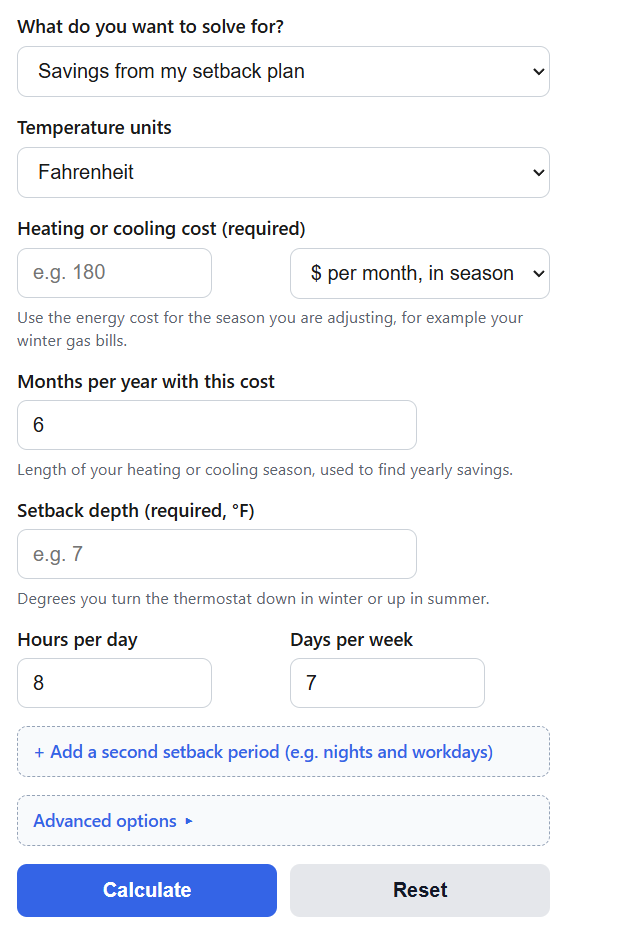
Calculate thermostat setback savings in percent and dollars per year from your setback degrees, hours, and energy cost, plus smart thermostat payback time.
Thermostat Setback Savings Formula
The calculator’s default method uses the Department of Energy rule of thumb: each degree Fahrenheit of setback held for 8 hours saves about 1% of the seasonal heating or cooling bill.
S = D * (h / 8) * (d / 7)
The percentage is then applied to your energy cost to get dollars, and an optional thermostat price gives a payback time:
Dollar Savings = (S / 100) * C
Payback Years = P / Annual Dollar Savings
The advanced climate-adjusted method replaces the flat rule with a balance-point model, which divides the average indoor temperature reduction by the indoor to outdoor temperature gap:
S = 100 * D * (h / 24) * (d / 7) / (T_in - T_out)
Variables:
- S is the estimated savings as a percent of the seasonal bill (%)
- D is the setback depth, meaning how many degrees you turn the thermostat down in winter or up in summer (°F; Celsius entries are converted automatically)
- h is the hours per day the setback is held
- d is the days per week the setback is used
- C is the heating or cooling cost for the period you entered ($)
- P is the installed price of a smart or programmable thermostat ($)
- T_in is the normal indoor setpoint and T_out is the average outdoor temperature over the season (same unit as D)
The default mode applies the first formula to your schedule, adds a second setback period if you use one (for example nights plus workdays), and caps the combined estimate at 20%, since measured field studies rarely show deeper setbacks beating that figure. The target mode rearranges the same formula to solve for D, telling you how many degrees of setback you need to hit a dollar or percent goal with the hours you can tolerate. The climate-adjusted method needs your indoor and average outdoor temperatures and shows why the same schedule saves a larger share of the bill in a mild climate than in a severe one.
Setback Savings by Depth, Duration, and Climate
The first table applies the quick rule to common schedules used 7 days per week. Read it as the percent of your seasonal heating or cooling bill saved.
| Setback depth | 8 h/day (night or workday) | 12 h/day | 16 h/day (night + workday) |
|---|---|---|---|
| 2°F | 2% | 3% | 4% |
| 4°F | 4% | 6% | 8% |
| 6°F | 6% | 9% | 12% |
| 8°F | 8% | 12% | 16% |
| 10°F | 10% | 15% | 20% (cap) |
The flat rule hides a real geographic effect. Heating loss is proportional to the gap between indoor and outdoor temperature, so the same setback removes a bigger share of a small heating load than of a large one. The second table runs the climate-adjusted formula for one fixed schedule, an 8°F setback for 8 hours every night with a 70°F indoor setpoint, across different winter climates. This is why a utility calculator in Georgia and one in Minnesota quote different savings for identical habits.
| Winter climate | Average outdoor temp | Indoor-outdoor gap | Bill saved by 8°F x 8 h nightly |
|---|---|---|---|
| Mild (Gulf South, coastal CA) | 50°F | 20°F | 13.3% |
| Moderate (Mid-Atlantic, Southwest) | 40°F | 30°F | 8.9% |
| Cool (Ohio Valley, Pacific NW inland) | 30°F | 40°F | 6.7% |
| Cold (Upper Midwest, New England) | 20°F | 50°F | 5.3% |
| Very cold (northern MN, ND, interior AK) | 10°F | 60°F | 4.4% |
Cold-climate homes still save more absolute dollars per degree of setback because the bill itself is larger, but the percentage is smaller. If your winters are mild, the quick rule tends to understate your savings; if they are severe, it overstates them slightly.
Example Problems
Example 1: Your winter gas bills average $180 per month over a 6-month heating season. You set the thermostat back 8°F for 8 hours every night and want to know whether a $130 smart thermostat pays for itself.
S = 8 * (8/8) * (7/7) = 8%. Dollar savings = 0.08 * $180 = $14.40 per month, which is $86.40 per year over the 6-month season. Payback = $130 / $86.40 = about 1.5 years, or roughly 18 months.
Example 2: You spend $1,000 per year on heating and cooling and want to save $100 per year. The house is empty 10 hours a day, 7 days a week. In target mode, $100 is 10% of the bill, so D = 10 / ((10/8) * (7/7)) = 8°F. Setting back 8°F during those empty hours reaches the goal, which matches the DOE guidance that a 7°F to 10°F setback for 8 hours saves about 10% per year.
Thermostat Setback FAQs
Does a setback really save money, or does reheating the house cancel it out? It saves. The rate at which a house loses heat is proportional to the indoor to outdoor temperature difference, so every hour the house sits cooler in winter it leaks less heat than it would at the normal setpoint. The furnace does run longer during recovery, but the fuel used to reheat is always less than the fuel avoided while the house coasted at the lower temperature. The longer the setback holds, the more clearly you come out ahead, which is why the formulas scale with hours.
Should I use setbacks with a heat pump? Be careful. A standard heat pump recovering from a deep setback can trigger its electric resistance backup heat, which costs 2 to 3 times as much per unit of heat and can erase the savings. With a heat pump, either keep setbacks small, around 2°F to 4°F, or use a smart thermostat with adaptive or smart recovery that starts the recovery early and ramps up without engaging the backup strips. Furnaces and boilers have no such penalty and tolerate deep setbacks well.
Does the same idea work for air conditioning in summer? Yes, in reverse: you raise the temperature while you are away, and the DOE applies the same guidance of 7°F to 10°F for 8 hours to cooling. Enter your summer electric cost in the calculator and treat the depth as degrees raised. In humid climates, use a smaller setup of 2°F to 4°F, because letting the house warm too far also lets humidity build, and the air conditioner must remove that moisture again when it recovers.