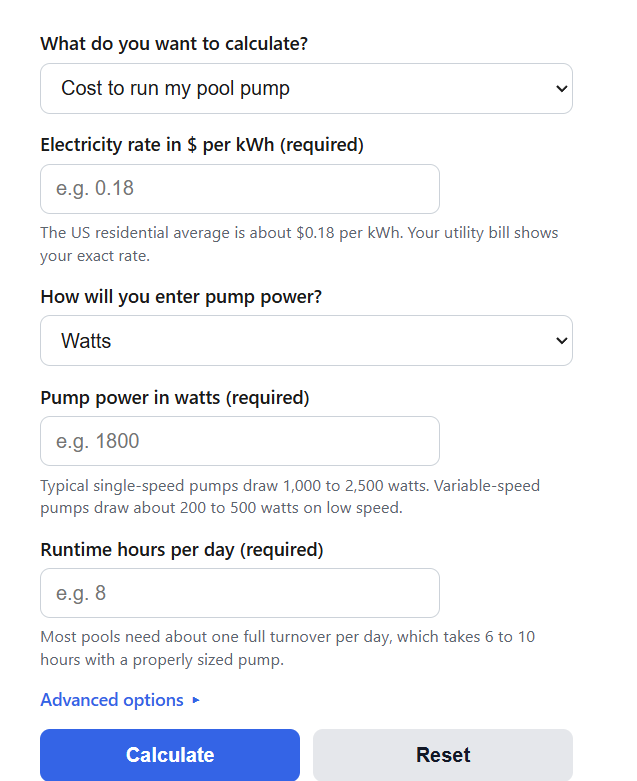
Calculate the daily, monthly, and yearly cost to run your pool pump from watts, horsepower, or amps, plus upgrade savings, payback, and runtime for a budget.
Pool Pump Energy Cost Formula
The cost of running a pool pump comes from three numbers: the input power of the pump, how long it runs, and what you pay for electricity.
kWh/day = (W * h) / 1000
Cost/day = kWh/day * R
Cost/month = Cost/day * 30.44
If you only know the horsepower or the nameplate amps, convert to watts first:
W = (HP * 746) / (n / 100)
W = A * V
Variables:
- W is the electrical input power of the pump in watts
- h is the runtime in hours per day
- R is your electricity rate in dollars per kWh (the US residential average is about $0.18)
- HP is the rated horsepower of the pump motor
- n is the overall efficiency in percent, typically 55 to 65 for single-speed pool pumps once motor losses and service factor are included
- A is the nameplate amps and V is the supply voltage, usually 115 or 230
The calculator’s cost mode applies these formulas directly and reports cost per hour, day, month, and year, along with the kWh used. The comparison mode runs the daily cost formula for two pumps and subtracts the results, then divides the new pump’s price by the annual savings to get a payback period. The budget mode inverts the monthly cost formula to solve for hours: it divides your monthly budget by 30.44 times the rate times the pump’s kilowatts, which tells you how many hours per day you can run before exceeding your budget.
Typical Pump Wattage and What Speed Does to the Bill
The first table shows typical input wattage for single-speed pumps by horsepower, with the running cost at the national average rate of $0.18 per kWh and an 8 hour daily schedule. Use it to sanity-check your inputs or to estimate when you cannot read the nameplate.
| Pump size | Typical input watts | Cost per hour | Cost per month (8 h/day) |
|---|---|---|---|
| 0.75 HP | ~1,000 | $0.18 | $43.83 |
| 1.0 HP | ~1,350 | $0.24 | $59.18 |
| 1.5 HP | ~1,800 | $0.32 | $78.90 |
| 2.0 HP | ~2,300 | $0.41 | $100.82 |
| 3.0 HP | ~3,100 | $0.56 | $135.88 |
The second table explains why variable-speed pumps cost so much less to run. Pump power follows the affinity laws: power draw falls with the cube of motor speed, while flow falls only in direct proportion. Slowing down means the pump must run longer to filter the same water, but even after that longer runtime the total energy drops with the square of the speed reduction. Half speed moves the same water for about one quarter of the energy.
| Motor speed | % of full speed | Power draw (1,800 W pump) | Energy to move the same water |
|---|---|---|---|
| 3,450 RPM | 100% | 1,800 W (100%) | 100% |
| 2,588 RPM | 75% | 759 W (42%) | 56% |
| 1,725 RPM | 50% | 225 W (12.5%) | 25% |
| 1,150 RPM | 33% | 67 W (3.7%) | 11% |
Example Problems
Example 1: Monthly cost of a single-speed pump. A 1.5 HP single-speed pump draws about 1,800 watts and runs 8 hours per day. Electricity costs $0.18 per kWh. Daily energy is 1,800 × 8 / 1000 = 14.4 kWh, so the daily cost is 14.4 × 0.18 = $2.59. Over an average month of 30.44 days that is 438.3 kWh and $78.90. Over a full year it comes to about 5,260 kWh and $946.81.
Example 2: Upgrade savings and payback. The same 1,800 watt pump running 8 hours per day is replaced by a variable-speed pump that runs 16 hours per day at 300 watts. At $0.18 per kWh the old pump costs $946.81 per year while the new schedule uses 4.8 kWh per day and costs $315.60 per year. The upgrade saves $631.20 per year, roughly a 67% reduction. If the new pump costs $1,200 installed, the payback period is 1,200 / 631.20, or about 1.9 years.
Frequently Asked Questions
How many hours per day should a pool pump run?
Run the pump long enough to filter the full volume of the pool about once per day, which is called one turnover. Divide the pool volume in gallons by the pump’s flow rate in gallons per minute, then divide by 60 to get hours. For most residential pools that works out to 6 to 10 hours daily. You do not have to run it in one block: splitting the runtime into two or three cycles keeps the water mixed and lets you shift usage to cheaper off-peak hours if your utility uses time-of-use rates.
How do I find my pump’s actual wattage?
The nameplate on the motor lists amps and voltage, and multiplying them gives a maximum figure, since real draw is usually a little lower. For an exact number, use a plug-in power meter on a 115 volt pump, or read your utility’s smart meter with everything else off and the pump running. If all you know is the horsepower, the calculator’s HP mode estimates input watts by dividing HP × 746 by an overall efficiency of about 60%.
Why does a variable-speed pump cost so much less to run?
Because of the pump affinity laws. When motor speed drops by half, flow drops by half but power draw falls to about one eighth. Even though the pump must run twice as long to filter the same water, the total energy is still only about one quarter of what full speed uses. That is why running a variable-speed pump slow and long, rather than fast and short, routinely cuts pump energy use by 50 to 80% compared with a single-speed model on the same pool.