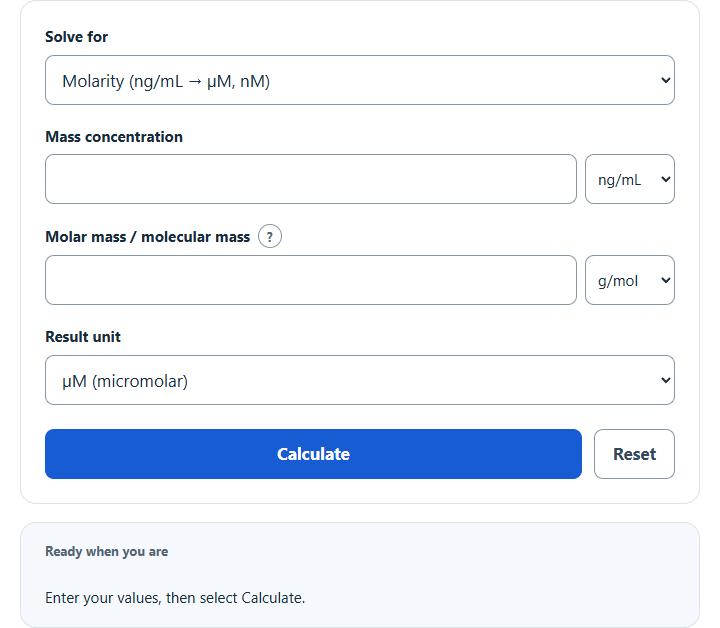
Convert ng/mL and other mass concentrations to M, mM, µM, nM, or pM using molecular weight, or solve for mass concentration or molecular weight.
- All Chemistry Calculators
- All Medical and Health Unit Converters
- Molarity to Weight Percent Calculator
- PPM to Molarity Calculator
- ml to mg
Calculator Functions
| Function | What it does | What it requires |
|---|---|---|
| Molarity (ng/mL → µM, nM) | Converts a mass concentration to a molar concentration in M, mM, µM, nM or pM | Requires the mass concentration and the molar mass of the solute |
| Mass concentration (µM → ng/mL) | Converts a molar concentration to a mass concentration in pg/mL, ng/mL, µg/mL, mg/mL or g/L | Requires the molarity and the molar mass of the solute |
| Molar mass | Finds the molar mass that links a mass concentration to a molar concentration | Requires the mass concentration and the molarity of the same solution |
Mass concentration can be entered in pg/mL, ng/mL, µg/mL, mg/mL or g/L, molarity in M, mM, µM, nM or pM, and molar mass in g/mol, Da or kDa. Each result is also listed in every other unit of its kind. No sample volume is needed, because both concentrations are already per unit volume.
ng/mL to Molarity Formulas
| c | Molar concentration (mol/L) |
| C | Mass concentration (ng/mL) |
| MW | Molar mass of the solute (g/mol) |
Molar concentration is the amount of solute in moles divided by the volume of the solution, mass concentration is the mass of solute divided by that volume [1], and molar mass is mass divided by amount [1]. Dividing a mass concentration in g/L by the molar mass in g/mol therefore gives mol/L. One ng/mL is 10−6 g/L, which is where the factor of 106 comes from.
Molarity (ng/mL → µM, nM)
For a result in µM, the mass concentration in ng/mL is divided by MW alone. A solution of 50 ng/mL of a compound with a molar mass of 100 g/mol is 50 ÷ (100 × 106) = 5 × 10⁻⁷ mol/L, which is 0.5 µM or 500 nM. For 10 ng/mL at 300 g/mol the result is 33.33 nM, and for 100 ng/mL of a 150 kDa protein it is 0.667 nM.
Mass concentration (µM → ng/mL)
C is in ng/mL. A 1 µM solution of a 300 g/mol compound is 1 × 300 = 300 ng/mL, and 1 µM of a 50 kDa protein is 50,000 ng/mL, or 50 µg/mL. Starting from nM, the result is divided by 1,000: 1 nM of the 300 g/mol compound is 0.3 ng/mL.
Molar mass
C is in ng/mL and c in mol/L. A solution that is both 50 ng/mL and 0.5 µM has a molar mass of 50 ÷ (5 × 10−7 × 106) = 100 g/mol. Both concentrations must be greater than zero.
ng/mL to nM Conversion Table
The conversion depends on the molar mass, so there is no single factor. For each molar mass, the table gives 1 ng/mL in nM and 1 µM in ng/mL.
| Molar mass | 1 ng/mL equals | 1 µM equals |
|---|---|---|
| 100 g/mol | 10 nM | 100 ng/mL |
| 200 g/mol | 5 nM | 200 ng/mL |
| 300 g/mol | 3.333 nM | 300 ng/mL |
| 500 g/mol | 2 nM | 500 ng/mL |
| 1,000 g/mol (1 kDa) | 1 nM | 1,000 ng/mL |
| 10 kDa | 0.1 nM | 10,000 ng/mL |
| 50 kDa | 0.02 nM | 50,000 ng/mL |
| 150 kDa | 0.006667 nM | 150,000 ng/mL |
Limits of This Estimate
- The molar mass must be that of the exact form in the solution. A salt, a hydrate or an oligomer has a different molar mass from the free compound, and the result changes in proportion.
- A molecular mass in daltons is treated as the same number in g/mol. The dalton is another name for the unified atomic mass unit [2], and for laboratory work the two numbers agree.
- The result is a unit conversion. It makes no adjustment for purity, biological activity, dissociation or how an assay responds.
- M and “molarity” are still common on reagent labels, but the SI guide treats them as obsolete and writes the unit as mol/L [1].
Sources
- NIST, Guide to the SI (SP 811), Chapter 8: definitions of amount-of-substance concentration, mass concentration and molar mass (sections 8.6.4 and 8.6.5)
- NIST, Guide to the SI (SP 811), Chapter 5: the dalton and the unified atomic mass unit