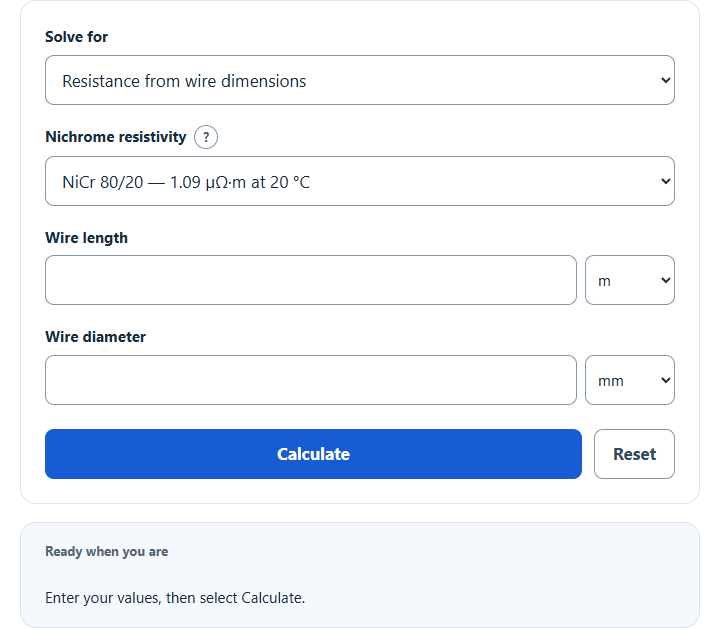
Calculate nichrome wire resistance, length or diameter using typical NiCr 80 or 60 resistivity, plus ohms per meter and AWG coil length and power.
- All Physics Calculators
- Wire Resistance Calculator
- Copper Wire Weight Calculator
- Motor Winding Resistance Calculator
- Resistance Per Meter Calculator
Nichrome Resistance Formula
The following formula is used to calculate the resistance of a nichrome wire.
- Where R is the resistance (ohms)
- p is the resistivity at the wire temperature (ohm-meters); the example assumes 150 × 10-8 Ω·m
- L is the length of the wire (m)
- A is the cross-sectional area of the wire (m2)
To calculate the resistance of a nichrome wire, multiply the resistivity by the length, then divide by the cross-sectional area of the wire.
What is the resistance of nichrome?
Definition:
Nichrome resistivity depends on alloy and temperature. For example, the manufacturer’s Nikrothal 80 and 60 data give approximately 1.09 × 10⁻⁶ and 1.11 × 10⁻⁶ Ω·m at 20 °C. Wire resistance also depends on its length and cross-sectional area.
How to calculate nichrome resistance?
Example Problem:
The following example outlines how to calculate the resistance of a nichrome wire.
First, use resistivity for the actual alloy and temperature. This example assumes 150 × 10-8 ohm-meters for illustration.
Next, determine the length of the wire. This wire is 100 m long.
Next, determine the cross-sectional area of the wire. Given a diameter of the wire of .025 m, the cross-sectional area can be calculated with the formula:
πD²/4 = π × .025²/4 ≈ .000490874 m²
Finally, calculate the total resistance using the formula above:
R = p*L / A
R = (150 × 10-8) × 100 / (π × .025²/4)
R ≈ .305577 ohms (about .306 ohms)