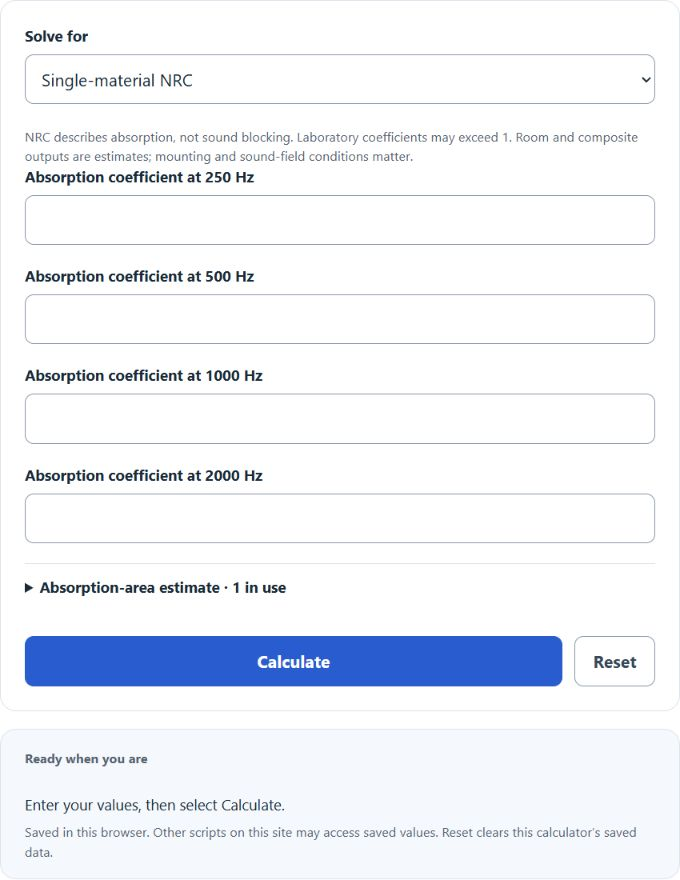
Calculate noise reduction coefficient, composite NRC, sabins, and RT60 from band absorption values, room size, panel area, and count.
Related Calculators
- Noise Reduction Rating Calculator
- Sound Pressure Level Calculator
- Decibel Calculator
- Average Noise Level Calculator
- Leq Noise Calculator
- TWA Noise Exposure Calculator
- All Construction Calculators
Noise Reduction Coefficient Formula
The following formula is used to calculate the Noise Reduction Coefficient (NRC) for given absorption coefficients at different frequencies.
Variables:
- NRC is the Noise Reduction Coefficient
- α₁ is the absorption coefficient at 250 Hz
- α₂ is the absorption coefficient at 500 Hz
- α₃ is the absorption coefficient at 1000 Hz
- α₄ is the absorption coefficient at 2000 Hz
To calculate the Noise Reduction Coefficient, sum the absorption coefficients at 250 Hz, 500 Hz, 1000 Hz, and 2000 Hz, then divide the result by 4 and round the mean to the nearest 0.05.
What is a Noise Reduction Coefficient?
The Noise Reduction Coefficient (NRC) is a scalar representation of the amount of sound energy absorbed upon striking a particular surface. It is an average rating of how much sound an acoustic product can absorb. NRC rates sound absorption rather than sound blocking or transmission loss. Higher values indicate greater measured absorption over these four bands; mounting and test conditions matter. It is particularly useful in environments where controlling noise levels is crucial, such as recording studios, theaters, and offices.
How to Calculate Noise Reduction Coefficient?
The following steps outline how to calculate the Noise Reduction Coefficient (NRC).
- First, measure the absorption coefficient at 250 Hz (α₁).
- Next, measure the absorption coefficient at 500 Hz (α₂).
- Then, measure the absorption coefficient at 1000 Hz (α₃).
- Finally, measure the absorption coefficient at 2000 Hz (α₄).
- Calculate the NRC using the formula: NRC = round_to_nearest_0.05((α₁ + α₂ + α₃ + α₄) / 4).
- After inserting the values and calculating the result, check your answer with the calculator above.
Example Problem :
Use the following variables as an example problem to test your knowledge.
Absorption Coefficient at 250 Hz (α₁) = 0.5
Absorption Coefficient at 500 Hz (α₂) = 0.6
Absorption Coefficient at 1000 Hz (α₃) = 0.7
Absorption Coefficient at 2000 Hz (α₄) = 0.8