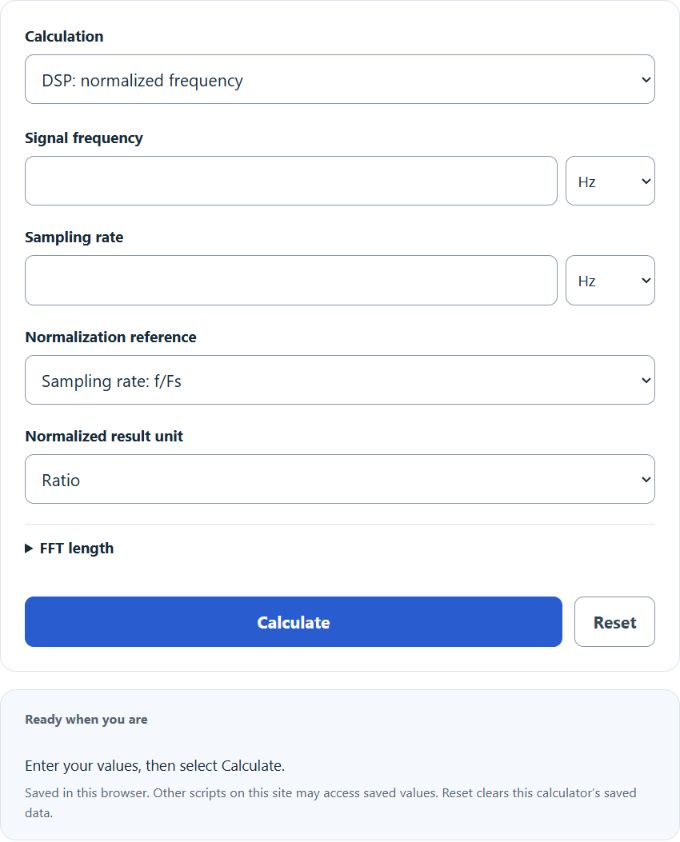
Calculate normalized frequency for DSP signals or fiber optics from frequency, sample rate, core radius, wavelength, and NA, with Nyquist and mode results.
Related Calculators
- Discrete Time Convolution Calculator
- Average Rate Calculator
- Usage Percentage Calculator
- Attainment Percentage Calculator
- All Math and Numbers Calculators
Normalized Frequency Formula
For DSP, normalized frequency is the signal frequency divided by the chosen reference: sampling rate Fs or Nyquist frequency Fs/2. The separate fiber modes use V = 2πa NA / λ for an ideal circular step-index fiber.
Variables:
- f_n is the normalized frequency
- f_a is the actual frequency
- f_{max} is the selected reference frequency: Fs or Fs/2 in the DSP modes
Divide signal frequency by the selected reference frequency. Values above Nyquist are supported and identified as aliased; exactly Nyquist is a limiting boundary.
What is Normalized Frequency?
Normalized frequency is a dimensionless quantity that represents the ratio of an actual frequency to a reference or maximum possible frequency. It is often used in signal processing and communications to compare different frequencies on a common scale. Normalized frequency helps in analyzing and designing systems where frequency scaling is important, such as in digital signal processing (DSP) and filter design.
How to Calculate Normalized Frequency?
The following steps outline how to calculate the normalized frequency.
- First, determine the actual frequency (f_a).
- Next, select the reference (f_{max}): sampling rate Fs or Nyquist frequency Fs/2.
- Finally, calculate the normalized frequency using the formula f_n = f_a / f_{max}.
- After inserting the values and calculating the result, check your answer with the calculator above.
Example Problem :
Use the following variables as an example problem to test your knowledge.
Actual Frequency (f_a) = 50 Hz
Reference Frequency (f_{max}) = 100 Hz; 50 / 100 = 0.5. For Fs = 100 Hz, this is sampling-rate normalization at Nyquist.