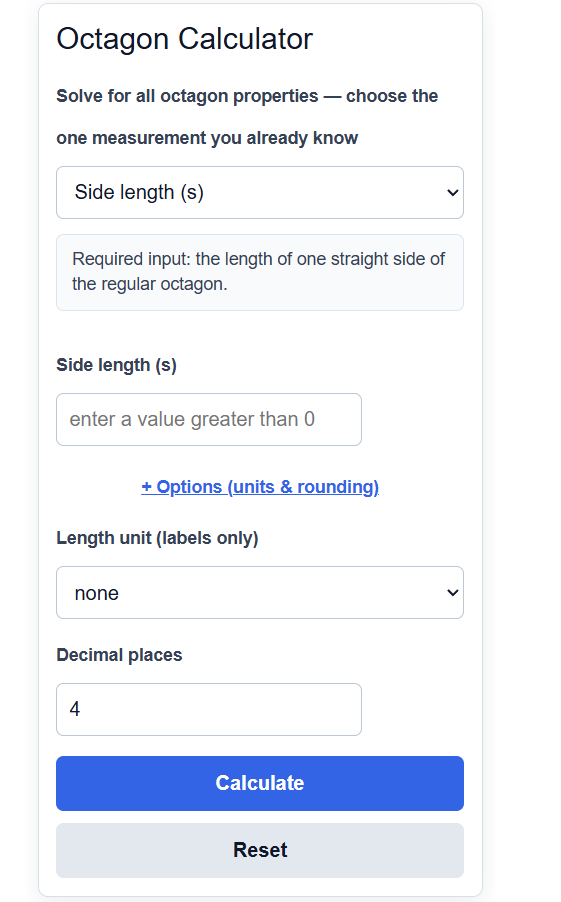
Calculate every property of a regular octagon from any one measurement, including area, perimeter, side length, apothem, circumradius, and diagonals.
Octagon Formula
A regular octagon has eight equal sides and eight equal angles. Once you know any single measurement, every other property is fixed by the side length s. The core relationships are:
P = 8 * s
A = 2 * (1 + sqrt(2)) * s^2
r = (1 + sqrt(2)) / 2 * s
R = s / (2 * sin(22.5 deg))
D_long = s / sin(22.5 deg)
W_flats = (1 + sqrt(2)) * s
Where:
- s = length of one side
- P = perimeter (the total length around all eight sides)
- A = area enclosed by the octagon
- r = apothem, also called the inradius, the distance from the center to the middle of a side
- R = circumradius, the distance from the center to a corner
- D_long = long diagonal, joining two opposite corners (the width across vertices)
- W_flats = width across flats, measured straight from one flat side to the opposite flat side
The calculator lets you enter the one measurement you already have, such as the side, perimeter, area, apothem, circumradius, or a diagonal. It first works backward to the side length s, then applies the formulas above to report every other property at once. The width across flats equals twice the apothem, and the long diagonal equals twice the circumradius, so those values are tied directly to r and R.
Octagon Property Multipliers
For a regular octagon, every dimension is a fixed multiple of the side length s. Use this table to estimate any property quickly, or to check a calculator result.
| Property | Formula | Value (in terms of s) |
|---|---|---|
| Perimeter | 8s | 8.0000 s |
| Area | 2(1+√2)s² | 4.8284 s² |
| Apothem (inradius) | (1+√2)/2 · s | 1.2071 s |
| Circumradius | s / (2 sin 22.5°) | 1.3066 s |
| Width across flats | (1+√2)s | 2.4142 s |
| Width across vertices (long diagonal) | s / sin 22.5° | 2.6131 s |
| Short diagonal | √(2+√2) · s | 1.8478 s |
The angles of a regular octagon never change, no matter the size:
| Angle property | Value |
|---|---|
| Interior angle | 135° |
| Exterior angle | 45° |
| Central angle | 45° |
| Sum of interior angles | 1080° |
| Number of diagonals | 20 |
Example Problems
Example 1: Find the area and perimeter from the side length.
A regular octagon has a side length of 5 inches. The perimeter is P = 8 × 5 = 40 inches. The area is A = 2(1 + √2) × 5² = 4.8284 × 25 = 120.71 square inches. The apothem is r = 1.2071 × 5 = 6.036 inches, and the circumradius is R = 1.3066 × 5 = 6.533 inches.
Example 2: Find the side length from the area.
You know an octagon has an area of 50 square cm and want the side length. Rearranging the area formula gives s = √(A / 4.8284) = √(50 / 4.8284) = √10.355 = 3.218 cm. The perimeter is then 8 × 3.218 = 25.74 cm, and the width across flats is 2.4142 × 3.218 = 7.77 cm.
FAQ
Does this calculator work for irregular octagons?
No. The formulas assume a regular octagon, meaning all eight sides are equal in length and all eight angles equal 135 degrees. An irregular octagon has sides or angles that differ, so a single side length cannot describe it. For an irregular shape you would need to break it into triangles and add their areas.
What is the difference between width across flats and width across vertices?
Width across flats is the distance measured straight from one flat side to the opposite flat side, and it equals twice the apothem (about 2.4142 times the side). Width across vertices is the distance from one corner to the opposite corner, which is the long diagonal and equals twice the circumradius (about 2.6131 times the side). The width across vertices is always the larger of the two.
How do you find the apothem of an octagon?
Multiply the side length by (1 + √2) / 2, which is about 1.2071. For a side of 10 units the apothem is 12.071 units. The apothem is useful because area can also be written as one half the perimeter times the apothem, A = (1/2) × P × r.