Estimate odometer and speedometer correction from tire diameters or a manual measured-route factor to find corrected interval distance, speed and mileage.
Related Calculators
- RPM Tire Size Calculator
- Speedometer Driven Gear Calculator
- Staggered Tire Calculator
- Rev Per Mile Calculator
- RPM to Distance Calculator
- Tire Rollout Calculator
- Oil Change Calculator
- All Automotive Calculators
Odometer Correction Formula
The following formulas are used to calculate a corrected (actual) distance from an odometer-reported distance.
CF = AD / RDCD = RD * CF
Variables:
- CD is the corrected (actual) distance traveled (mi, km, etc.)
- RD is the distance reported by the odometer (mi, km, etc.)
- AD is the actual distance traveled over the same route (from GPS, mile markers, etc.) (mi, km, etc.)
- CF is the correction factor (unitless), calculated as AD / RD
- If the error is primarily due to a tire-size change, CF can be estimated as Cnew / Cstock, where C is tire circumference (any consistent length unit)
To calculate odometer correction using a measured test route, determine CF by dividing the actual distance (AD) by the odometer-reported distance (RD). Then multiply the indicated distance for the affected interval by CF to estimate that interval’s actual distance. Add this to an already accurate starting reading; the factor does not recover unknown earlier mileage. If the main cause of error is a change from the stock tire size, you can estimate CF using the ratio of new to stock tire circumference instead.
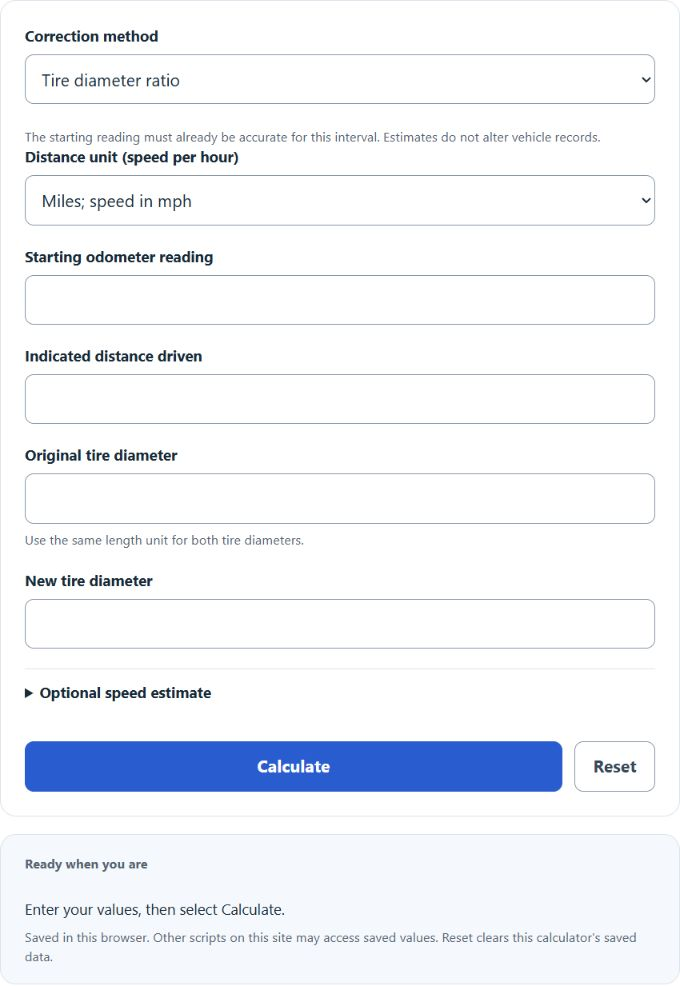
Using the calculator: Select Tire diameter ratio or Manual correction factor. Enter the starting reading and indicated distance in the selected distance unit; optional speed uses the same unit per hour. Both tire diameters must use one consistent length unit. Changing the distance-unit selection relabels the entries rather than converting their numbers. The correction percentage is (CF − 1) × 100 relative to indicated distance, including when the entered interval is zero. Tire dimensions estimate rolling circumference; load, pressure and wear affect real calibration, so verify over a measured route. Successful results are saved in this browser; edits mark them out of date and Reset clears the saved scenario.
What is Odometer Correction?
Odometer correction is the process of calculating (or calibrating) a vehicle’s distance readings so they reflect the true distance traveled. This is commonly needed when the tire size installed on the vehicle differs from the manufacturer’s stock size, which can cause the odometer to report a distance that is higher or lower than the actual distance traveled. Correcting the reading helps keep mileage-based maintenance schedules and mileage records accurate.
How to Calculate Odometer Correction?
The following steps outline how to calculate the Odometer Correction.
- Determine a known actual distance traveled (AD) using GPS, mile markers, or a measured course.
- Drive the same route and record the distance reported by the odometer (RD).
- Calculate the correction factor (CF) as CF = AD / RD.
- Correct the affected interval distance by calculating CD = RD × CF. For an estimated total, add CD to an already accurate starting reading.
- If the odometer error is mainly from a tire-size change (and you do not have a measured test route), estimate CF as CF = Cnew / Cstock (new circumference divided by stock circumference).
- If you are using tire size specs, estimate diameter (in) as D = Rim(in) + 2 × (Width(mm) × Aspect/100) / 25.4, then circumference as C = π × D.
- After inserting the variables and calculating the result, check your answer with the calculator above.
Example Problem :
Use the following variables as an example problem to test your knowledge.
actual distance traveled (AD) = 100 miles
distance reported by the odometer (RD) = 95 miles
correction factor (CF) = AD / RD = 100 / 95 ≈ 1.052632. Choose Manual correction factor and enter the unrounded value when available; 95 indicated miles then gives 100 corrected miles.