Calculate your off-grid daily load in watt-hours with an appliance-by-appliance energy audit, then size the battery bank and solar array to match.
- All Construction Calculators
- Solar Charge Controller Size Calculator
- Load Wattage Calculator
- Load Percentage Calculator
Off-Grid Daily Load Formula
The energy audit starts with one formula applied to every appliance on your list, then summed:
E_appliance = W * Q * H
 E_load = SUM(E_appliance)
Raw appliance energy is not what your batteries deliver. AC loads pass through an inverter that wastes some power, and standby draws run around the clock, so the sizing number is the battery-side total:
E_battery = E_AC / n_inv + E_DC + 24 * P_standby
The second mode converts that daily load into hardware. The battery bank must hold enough usable energy to ride through cloudy days, and the solar array must replace a full day of use during your worst month:
Bank = (E_battery * D) / DoD
 Ah = Bank / V
 P_array = E_battery / (PSH * n_sys)
Variables:
- E_appliance is the daily energy of one line item in watt-hours (Wh)
- W is running watts, Q is quantity, and H is hours of use per day
- E_AC and E_DC are the summed watt-hours of your AC and DC line items
- n_inv is inverter efficiency as a decimal; most units run at 0.85 to 0.95, and the calculator defaults to 0.90
- P_standby is the always-on standby draw in watts, counted 24 hours per day
- E_battery is the battery-side daily load in Wh, the number every other sizing step uses
- D is days of autonomy, the cloudy days the bank must cover without charging
- DoD is the usable fraction of battery capacity: 0.90 for LiFePO4, 0.50 for lead-acid
- V is battery bank voltage (12, 24, or 48), and Ah is the bank size in amp-hours
- PSH is peak sun hours for your worst month, and n_sys is total system efficiency, typically 0.70 to 0.80
- P_array is the required solar array size in watts
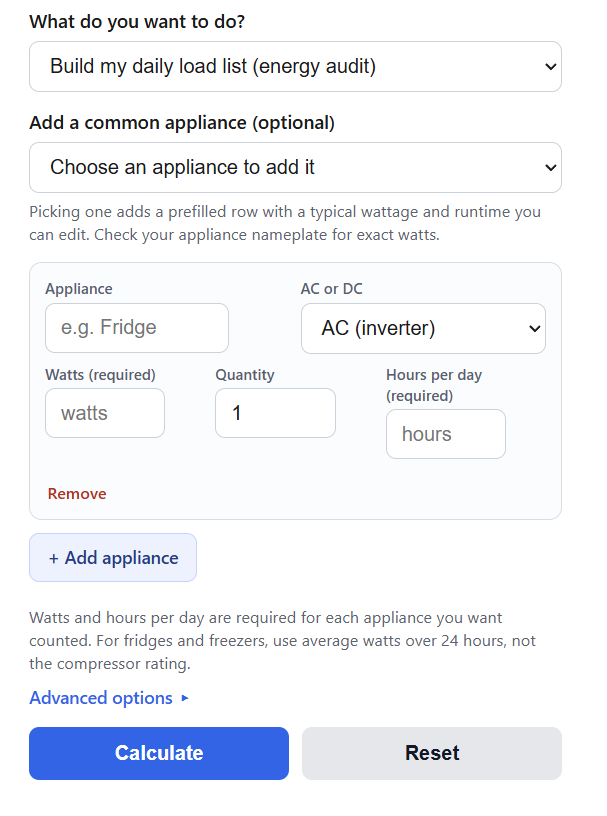
The audit mode applies the first two formulas. Each row takes a name, watts, quantity, hours per day, and an AC or DC setting, so inverter losses land only on the loads that actually pass through the inverter. It returns the battery-side total in Wh and kWh, the average continuous draw, a ranked breakdown showing which appliances dominate, and the combined running watts you would see if everything switched on at once, which is the starting point for inverter sizing. The sizing mode applies the remaining formulas to any daily load, including the audit total carried over with one tap, and returns the bank size in kWh and Ah, an approximate count of 100 Ah batteries, the array wattage, a panel count, and a minimum MPPT charge controller rating with the standard 1.25 safety factor.
Typical Appliance Draws and the Standby Loads Most Audits Miss
Use nameplate watts where you can, and a plug-in energy meter for anything that cycles, like fridges. These figures are realistic starting values for a load list:
| Appliance | Running watts | Typical hours/day | Wh/day |
|---|---|---|---|
| LED light bulb | 10 | 5 | 50 |
| Wi-Fi router | 12 | 24 | 288 |
| Starlink (average) | 45 | 24 | 1,080 |
| Full-size refrigerator (average) | 50 | 24 | 1,200 |
| Chest freezer (average) | 40 | 24 | 960 |
| Laptop | 60 | 4 | 240 |
| LED TV (50 in) | 70 | 3 | 210 |
| Microwave | 1,000 | 0.25 | 250 |
| Induction burner | 1,400 | 0.5 | 700 |
| Water pressure pump | 500 | 0.3 | 150 |
| Ceiling fan | 50 | 6 | 300 |
| CPAP (no humidifier) | 40 | 8 | 320 |
| Mini-split AC (cooling, average) | 700 | 6 | 4,200 |
| Washing machine (per load) | 500 | 0.75 | 375 |
The loads that sink most first-time audits never appear on an appliance list at all. Standby draws look tiny in watts, but they run 24 hours a day, and the inverter’s own idle consumption is usually the largest of them. This table shows what always-on draws cost per day, which is what the calculator’s standby field accounts for:
| Always-on draw | Standby watts | Wh/day | Share of a 2,000 Wh/day budget |
|---|---|---|---|
| Inverter idling (1,000 to 3,000 W unit) | 10 to 25 | 240 to 600 | 12 to 30% |
| TV on standby | 0.5 to 3 | 12 to 72 | 1 to 4% |
| Microwave clock | 2 to 4 | 48 to 96 | 2 to 5% |
| Game console in rest mode | 1 to 10 | 24 to 240 | 1 to 12% |
| Smart speaker | 2 to 4 | 48 to 96 | 2 to 5% |
| Coffee maker with clock | 1 to 3 | 24 to 72 | 1 to 4% |
| Combined typical off-grid standby | 15 to 40 | 360 to 960 | 18 to 48% |
A cabin with a modest 2,000 Wh/day budget can lose a fifth to a half of it to loads nobody is using. The cheapest fix is a habit, not hardware: switch the inverter off overnight and put standby electronics on a switched power strip, then enter whatever remains in the standby field so the audit reflects reality.
Off-Grid Daily Load Example Problems
Example 1: A weekend cabin runs four 10 W LED bulbs for 5 hours (200 Wh), a full-size fridge averaging 50 W around the clock (1,200 Wh), a 70 W TV for 3 hours (210 Wh), and a 60 W laptop for 4 hours (240 Wh), all AC. A 12 V water pump draws 60 W for 0.3 hours (18 Wh) direct from the battery. AC loads total 1,850 Wh. With 90 percent inverter efficiency, the battery must supply 1,850 / 0.90 = 2,056 Wh for them. Adding the DC 18 Wh and a 10 W standby draw (240 Wh) gives a battery-side load of about 2,314 Wh/day, or 2.31 kWh/day, with an average continuous draw of 96 W. Note the audit lists 1,868 Wh of appliance energy, but the system must be sized for 2,314 Wh.
Example 2: Size hardware for that 2,314 Wh/day load with 2 days of autonomy, LiFePO4 batteries at 90 percent usable capacity, a 24 V bank, 4 worst-month peak sun hours, and 75 percent system efficiency. Usable storage needed is 2,314 * 2 = 4,628 Wh. Nameplate bank capacity is 4,628 / 0.90 = 5,142 Wh, which is 5,142 / 24 = 214 Ah at 24 V, about three 100 Ah batteries. The array must be 2,314 / (4 * 0.75) = 771 W, so two 400 W panels. The MPPT controller minimum is 771 / 24 * 1.25 = 41 A, so choose the next standard size, 50 A.
Frequently Asked Questions
How many watt-hours per day does an off-grid home use?
A weekend cabin with lights, a small fridge, and electronics typically lands between 1,000 and 3,000 Wh/day. A full-time off-grid home with efficient appliances usually runs 4,000 to 10,000 Wh/day, and adding air conditioning, electric cooking, or well pumping can push past 15,000. For contrast, the average grid-connected US home uses about 29,000 Wh/day, which is why off-grid design starts with trimming loads before buying panels. Propane or wood for heating, cooking, and water heating is the single biggest reason off-grid budgets stay small, since electric resistance heat would swamp any reasonably priced battery bank.
Why is my battery-side total higher than the sum of my appliances?
Two costs sit between your appliances and your batteries. First, every AC watt-hour passes through an inverter that is only 85 to 95 percent efficient, so a 1,800 Wh AC load pulls about 2,000 Wh from the battery at 90 percent. Second, standby draws run 24 hours a day; an inverter idling at 15 W consumes 360 Wh daily before you switch anything on. Skipping these two adjustments is the most common reason new systems run out of power by morning even though the appliance list added up.
Should I audit for the average day or the worst day?
Size for the heaviest realistic day of the season you will actually use the system. A summer-only cabin should be audited with fans and fridge duty at their July peak, while a year-round home should be checked against winter, when lights run longer and peak sun hours are lowest. If your summer and winter routines differ a lot, run the audit twice and size from whichever combination of daily load and worst-month sun hours demands the larger array. Days of autonomy then cover the abnormal days, so audit a full normal day rather than a rare worst case, and let the autonomy setting absorb storms.