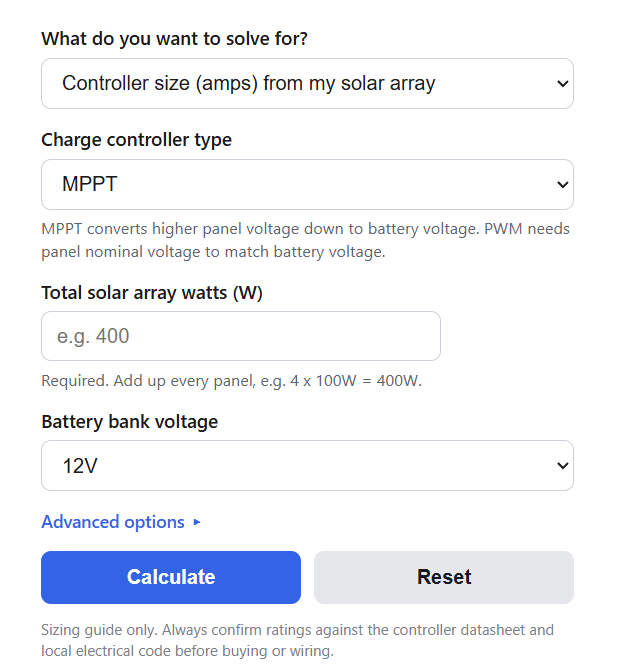
Calculate what size solar charge controller you need from solar array watts and battery voltage, with MPPT and PWM amp ratings, fuse size, and a cold Voc check.
Solar Charge Controller Size Formula
A = (P / V) * 1.25
A = Isc * Np * 1.25
Voc_cold = Voc * (1 + (TC/100) * (Tmin - 25))
- A is the minimum controller charging current rating in amps
- P is the total solar array power in watts
- V is the battery bank voltage (12V, 24V, 36V, or 48V)
- 1.25 is the safety factor required by NEC 690.8, which rates PV circuits at 125% of continuous current
- Isc is the short-circuit current of one panel or one series string in amps
- Np is the number of strings wired in parallel
- Voc is the panel open-circuit voltage at standard test conditions (25°C)
- TC is the temperature coefficient of Voc in %/°C, typically -0.25 to -0.35
- Tmin is the coldest expected temperature at your site in °C
The calculator uses these formulas in three modes. The controller size mode applies the first formula to find the minimum charging current for an MPPT controller, or for a PWM controller sized from array watts, then rounds up to the next standard amp rating and adds a matching battery-side fuse and copper wire suggestion. For PWM controllers you can switch to the Isc method, which applies the second formula, because a PWM controller passes panel current directly to the battery. The max array mode runs the first formula in reverse to find how many watts of panels a given controller rating supports at each battery voltage. The cold-weather Voc check applies the third formula to confirm your string voltage stays below the controller’s maximum PV input voltage on the coldest morning of the year, which is the most common way MPPT controllers are destroyed.
Standard Controller Ratings and Cold-Weather Voc Correction Factors
The first table shows the maximum recommended array wattage for each standard controller rating after the 1.25 safety factor is applied. Round your required current up, never down.
| Controller rating | Max array at 12V | Max array at 24V | Max array at 48V |
|---|---|---|---|
| 10A | 96 W | 192 W | 384 W |
| 20A | 192 W | 384 W | 768 W |
| 30A | 288 W | 576 W | 1,152 W |
| 40A | 384 W | 768 W | 1,536 W |
| 50A | 480 W | 960 W | 1,920 W |
| 60A | 576 W | 1,152 W | 2,304 W |
| 80A | 768 W | 1,536 W | 3,072 W |
| 100A | 960 W | 1,920 W | 3,840 W |
The second table gives the low-temperature Voc correction factors from NEC Table 690.7 for crystalline silicon panels. If your panel datasheet does not list a temperature coefficient, multiply the array’s rated Voc by the factor for the coldest expected temperature at your site instead. The result must stay below the controller’s maximum PV input voltage.
| Coldest expected temperature | Voc correction factor |
|---|---|
| 25 to 20°C (77 to 68°F) | 1.02 |
| 19 to 15°C (66 to 59°F) | 1.04 |
| 14 to 10°C (57 to 50°F) | 1.06 |
| 9 to 5°C (48 to 41°F) | 1.08 |
| 4 to 0°C (39 to 32°F) | 1.10 |
| -1 to -5°C (30 to 23°F) | 1.12 |
| -6 to -10°C (21 to 14°F) | 1.14 |
| -11 to -15°C (12 to 5°F) | 1.16 |
| -16 to -20°C (3 to -4°F) | 1.18 |
| -21 to -25°C (-6 to -13°F) | 1.20 |
| -26 to -30°C (-15 to -22°F) | 1.21 |
| -31 to -35°C (-24 to -31°F) | 1.23 |
| -36 to -40°C (-33 to -40°F) | 1.25 |
Solar Charge Controller Size Example
Example 1. You have 600W of panels charging a 24V battery bank through an MPPT controller. Divide 600 by 24 to get 25 amps of charging current, then multiply by 1.25 to get 31.25 amps. The next standard rating up is 40A, so you would buy a 40A MPPT controller, protect the battery circuit with a 50A DC-rated fuse (40 times 1.25), and run at least 6 AWG copper wire between the controller and the battery.
Example 2. You plan four panels in series, each with a Voc of 41V and a temperature coefficient of -0.28 %/°C, at a site where the record low is -15°C. The temperature difference from STC is -15 minus 25, which is -40 degrees. Multiply -0.28/100 by -40 to get a 11.2% rise, so each panel reaches 41 times 1.112, which is 45.6V. Four in series gives 182.4V, which exceeds a 150V controller’s input limit by about 32V. You would either drop to three panels in series (136.8V) or step up to a 250V-class controller.
FAQ
What size charge controller do you need for 400 watts of solar?
It depends on your battery bank voltage. On a 12V bank, 400 divided by 12 times 1.25 is 41.7 amps, so you need a 50A controller. On a 24V bank the same math gives 20.8 amps, so a 30A controller works. On a 48V bank you only need 10.4 amps, so a 15A controller is enough. Doubling the bank voltage halves the current, which is why larger systems use 24V or 48V banks.
Can your solar array be bigger than the controller rating?
With most MPPT controllers, yes, within limits. An MPPT controller simply caps its output at its rated charging current, so a modestly oversized array just clips a little production on perfect days while charging faster in the morning, in winter, and under clouds. This is called overpaneling and manufacturers such as Victron explicitly allow it. Two limits are absolute, though: the array’s cold-weather Voc must stay below the controller’s maximum PV input voltage, and the array’s short-circuit current must stay below the controller’s rated maximum input current. PWM controllers should not be overpaneled because they pass panel current straight through.
Does battery capacity in amp hours change the controller size?
No. The controller’s amp rating is set by the solar array wattage and the battery bank voltage, not by amp hours. Battery capacity only matters as an upper limit on charge rate: flooded lead-acid batteries generally should not be charged faster than about C/8 to C/10 (roughly 10 to 12 amps per 100Ah), while AGM and lithium accept much higher rates. If your calculated controller current exceeds the battery’s recommended maximum charge current, the battery bank is undersized for the array rather than the controller being wrong.