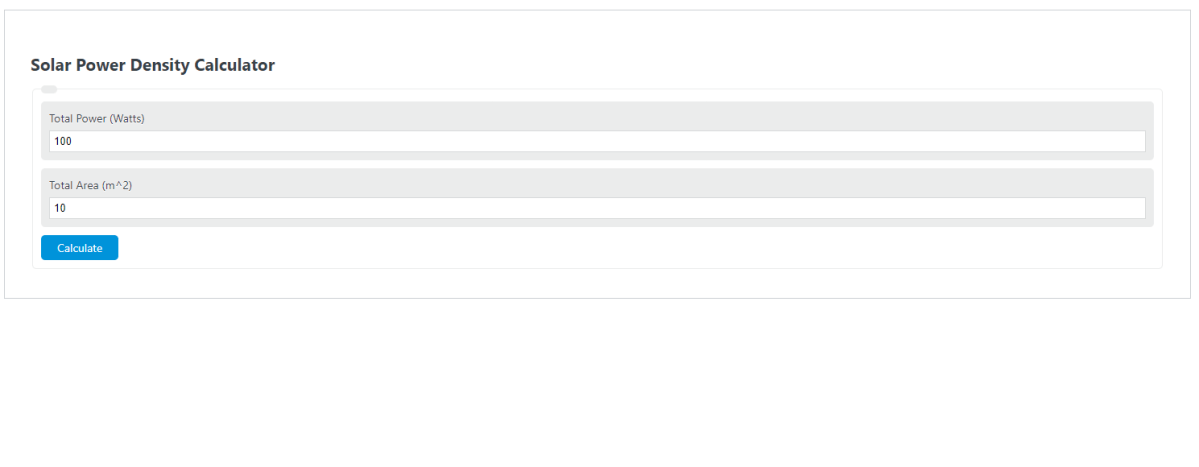
Calculate solar power density, total power, or area from any two values with conversions in W, kW, sqft, m², and sqyd, plus step-by-step calculations.
- All Physics Calculators
- All Density Calculators
- Total Solar Reflectance Calculator
- Solar Panel Series and Parallel Array Calculator
- Solar Battery Bank Size Calculator
- PV Performance Ratio Calculator
Solar Power Density Formula
Solar power density measures how much power is produced over a given area. In the context of this calculator, it is the solar system’s power output divided by the total surface area being evaluated. This makes it useful for comparing panel layouts, roof utilization, and space efficiency across different installations.
| Symbol | Meaning | Typical Units |
|---|---|---|
| Pd | Solar power density | W/m², W/sqft, W/sqyd |
| P | Total power generated | W, kW |
| A | Total area | m², sqft, sqyd |
If you know any two variables, you can rearrange the equation to solve for the third:
| Unknown | Equation |
|---|---|
| Power Density | Pd = (P) / (A) |
| Total Power | P = Pd × A |
| Total Area | A = (P) / (Pd) |
What This Calculator Tells You
This calculator shows how effectively a solar installation uses space. A higher power density means more power is being generated from each unit of area. That is especially helpful when:
- comparing two panel configurations with different footprints,
- evaluating rooftop space limitations,
- estimating land-use efficiency for larger arrays,
- checking whether a design change improves output per unit area.
How to Use the Solar Power Density Calculator
- Enter the total power generated.
- Enter the total area covered by the system.
- Click calculate to find the solar power density.
- If needed, change units so the result matches your project requirements.
Because the calculator can solve for any missing value, you can also enter power density and area to find total power, or power and density to find area.
How to Calculate Solar Power Density Manually
- Measure or estimate the total power output of the solar system.
- Measure the area associated with that output.
- Divide power by area.
Example:
In this case, the system produces 300 watts per square meter.
How to Interpret the Result
- Higher value: more power is produced from the same amount of area.
- Lower value: the system uses more area for the same output or produces less power from a fixed area.
- Best use: compare designs only when the area basis is consistent.
That last point matters. Power density can be calculated using different definitions of area, such as:
- Panel face area for module-level comparisons,
- roof footprint for rooftop planning,
- site or land area for utility-scale projects.
A result based on panel face area will usually differ from one based on total site area, even for the same system. For fair comparisons, always use the same area definition.
Solar Power Density vs. Solar Irradiance
These terms are related but not identical:
- Solar irradiance describes incoming sunlight on a surface.
- Solar power density in this calculator describes output power per unit area.
In other words, irradiance is energy arriving at the surface, while power density here is the electrical output you get from the system area being measured.
Factors That Affect Solar Power Density
- Panel efficiency: more efficient modules generally produce more power from the same area.
- Sun angle and orientation: tilt and azimuth affect how much sunlight reaches the array.
- Shading: trees, buildings, vents, and nearby structures reduce output.
- Temperature: hotter panels typically operate less efficiently.
- Soiling: dust, dirt, pollen, and snow can reduce usable output.
- Inverter and wiring losses: electrical losses lower delivered power.
- Module spacing: wider spacing may reduce site-level density even if module performance stays the same.
- Weather and season: clouds and shorter daylight hours reduce average output density.
Common Mistakes
- Mixing kilowatts and watts without converting first.
- Using square feet for area but interpreting the answer as W/m².
- Comparing systems that use different area definitions.
- Using rated DC power for one system and delivered AC power for another.
- Confusing instantaneous output with average output over time.
Practical Tips
- Use nameplate or rated power when comparing equipment.
- Use actual measured power when evaluating real-world performance.
- Decide whether you want module-level density or site-level density before entering area.
- Keep units consistent throughout the calculation to avoid scaling errors.
Frequently Asked Questions
- Is a larger solar system always more power dense?
- No. A larger system may produce more total power, but power density depends on how much area it uses to produce that power.
- Can two systems have the same total power but different power densities?
- Yes. If one system produces the same power using less area, it has the higher power density.
- Should I use panel area or roof area?
- Use panel area when comparing module efficiency and packing performance. Use roof or site area when planning space requirements.
- Why is power density useful?
- It helps normalize performance by area, making comparisons more meaningful than total power alone.