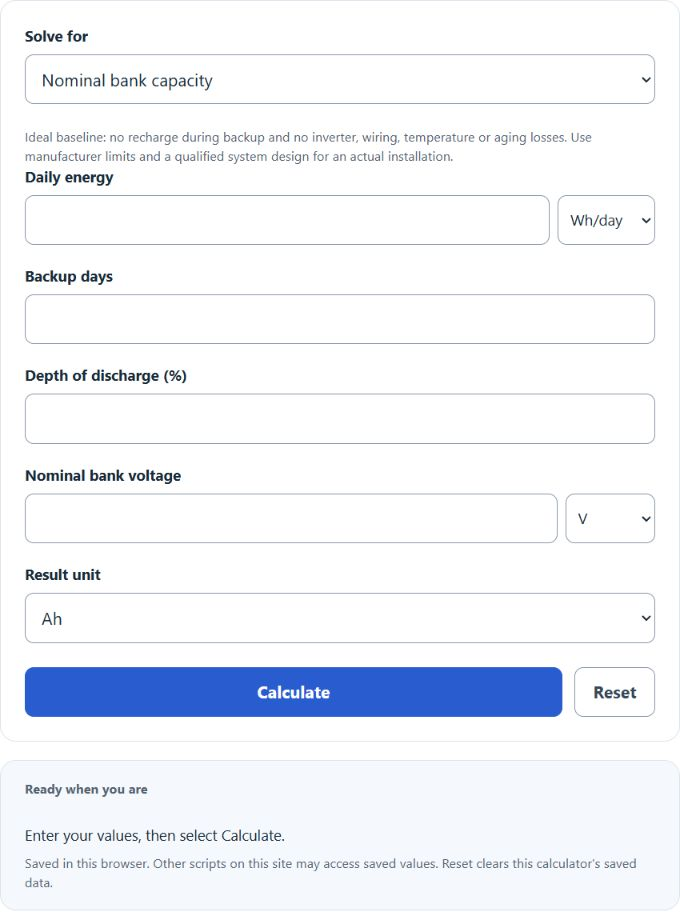
Calculate solar battery bank size from daily energy use, backup days, voltage, and depth of discharge, or solve any missing value.
- All Physics Calculators
- Battery Capacity Calculator (Amp Hours)
- Battery Backup Calculator
- Battery Run Time Calculator
- Battery Reserve Capacity to Amp Hours Calculator
- Battery Energy Calculator
- Inverter Size Calculator
Solar Battery Bank Size Formula
A solar battery bank is sized by converting the energy you need during an outage or low-solar period into amp-hours at a specific system voltage, then adjusting for the maximum allowable depth of discharge. This ideal model is a starting estimate for battery-based systems. It assumes no recharging during backup and excludes conversion losses, aging and temperature effects; actual systems require appropriate design margins.
- BB = required battery bank size in amp-hours (Ah)
- P = energy consumption per day in watt-hours (Wh/day)
- D = number of backup days required
- V = system voltage in volts (V)
- DI = maximum depth of discharge entered as a percentage
You can also think about the process in two steps: first calculate the total energy that must be stored, then convert that stored energy into battery capacity.
The result is the nominal battery bank size needed at the chosen voltage. If you allow a smaller portion of the battery to be used, the required bank size increases.
How to Use the Calculator
- Estimate your total daily energy usage in watt-hours.
- Choose how many days of backup you want the battery bank to support.
- Enter the maximum depth of discharge your battery chemistry can safely handle.
- Enter the battery bank voltage for the system.
- Use the result to choose a real battery configuration with at least that much total capacity.
Select Wh/day or kWh/day to match the load energy; the calculator converts units internally.
How Each Input Changes the Result
| Input | What It Means | Effect on Battery Bank Size |
|---|---|---|
| Energy consumption per day | Total energy your loads use in one day | Higher daily usage increases required capacity directly |
| Backup days | How long the system must run without meaningful recharging | More days require a larger bank |
| Depth of discharge | How much of the battery you plan to use before recharging | Lower allowable discharge means a larger nominal bank is needed |
| Voltage | The nominal battery bank voltage | Higher voltage reduces the amp-hour value needed for the same energy storage |
Example
Assume a system uses 6 kWh per day, requires 2 days of backup, has an 80% maximum depth of discharge, and operates at 48 V.
In this case, the system needs about 312.5 Ah at 48 V. In practice, most users round up and choose the next larger available bank size rather than sizing exactly to the minimum result.
Converting Battery Capacity to Stored Energy
Loads are usually discussed in watt-hours or kilowatt-hours, while batteries are often sold in amp-hours. These conversions help compare the calculator output to actual battery products.
That means two battery banks with the same amp-hour rating can store very different amounts of energy if their voltages are different.
Practical Sizing Notes
- Daily load is the main driver. Underestimating energy use is one of the fastest ways to undersize a battery bank.
- Autonomy matters. A system designed for one day of backup will be much smaller than one designed for multiple cloudy days.
- Depth of discharge affects usable storage. A battery that is only lightly discharged each cycle needs more total nameplate capacity to deliver the same usable energy.
- Voltage changes the amp-hour number. Higher-voltage systems deliver the same energy with fewer amp-hours.
- The calculator is a baseline sizing tool. Real systems often add extra margin for inverter losses, wiring losses, battery aging, temperature effects, and future load growth.
Common Input Mistakes
- Using watts instead of watt-hours for daily energy consumption
- Entering monthly or weekly usage as if it were daily usage
- Comparing amp-hours across different voltages without converting to energy
- Choosing a depth of discharge that is deeper than the battery manufacturer recommends
- Ignoring surge loads, inverter efficiency, or seasonal changes in power demand
Choosing an Actual Battery Bank
After calculating the required amp-hours, choose a battery configuration that matches your system voltage and meets or exceeds the target capacity. The final bank should also be checked against discharge rate limits, charging rate limits, inverter requirements, and the battery manufacturer’s recommended operating range. For most installations, it is better to treat the calculator result as a minimum design point rather than an exact final specification.