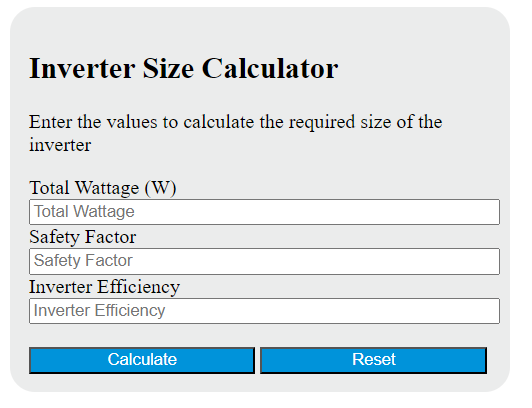
Calculate inverter continuous and surge size, DC current, battery runtime, or supported load with real W/kW conversion, efficiency, and safety margin.
Related Calculators
- Inverter Cable Size Calculator
- Load Wattage Calculator
- Watts to Amps Calculator
- Amps to Watts Calculator
- Solar Battery Bank Size Calculator
- Battery Run Time Calculator
- All Construction Calculators
Inverter Size Formula
The inverter size calculator estimates the required inverter capacity in volt-amps (VA) from the total running watts, power factor, and extra headroom for startup surge or safety margin.
Total watts mode:
By appliances mode:
- W = total running load in watts
- Input Load = the watt or kilowatt value you enter in total watts mode
- Unit Multiplier = 1 for watts, 1000 for kilowatts
- Quantity_i = number of each appliance
- Watts_i = running watts for each appliance
- PF = power factor for the selected load type
- Safety Factor = extra capacity added for headroom or surge
- Required VA = calculated inverter capacity before rounding
In total watts mode, you enter the combined load directly. In appliance mode, the calculator adds each appliance’s watts multiplied by its quantity. The selected load type then sets the power factor and safety factor. The final answer is rounded up to a common inverter size, since inverters are usually sold in standard VA or kVA ratings.
Load Type Factors Used for Inverter Sizing
| Load type | Examples | Power factor | Safety factor |
|---|---|---|---|
| Resistive | Heaters, kettles, toasters, incandescent lights | 1.0 | 1.25 |
| Mixed home loads | TVs, laptops, lights, chargers, small electronics | 0.9 | 1.30 |
| Motor-driven | Refrigerators, pumps, fans, air conditioners, drills | 0.7 | 2.00 |
Common Inverter Size Ranges
| Recommended size | Typical use |
|---|---|
| 150 to 300 VA | Small chargers, modem/router, laptop, a few LED lights |
| 500 to 1,000 VA | TV, lights, fan, small electronics |
| 1,500 to 3,000 VA | Refrigerator plus small loads, microwave, limited kitchen loads |
| 4,000 to 6,000 VA | Partial home backup, small cabin, several larger appliances |
| 8,000 VA and above | Whole-home backup, larger off-grid systems, heavy workshop loads |
Example Inverter Size Calculations
Example 1: Mixed home load
You want to power 800 W of mixed home loads.
The next common inverter size is 1,500 VA.
Example 2: Motor-driven load
You want to power a 900 W window air conditioner, and the load type is motor-driven.
The next common inverter size is 3,000 VA.
FAQ
Is inverter size the same as battery size?
No. Inverter size tells you the maximum load the inverter can supply at one time, usually shown in VA, kVA, or watts. Battery size tells you how long the system can run that load. A larger inverter lets you power more devices at once, but it does not automatically give you longer runtime.
Why does the calculator use VA instead of only watts?
Many inverters are rated in volt-amps because AC loads do not always use power perfectly efficiently. Power factor accounts for the difference between watts and VA. Resistive loads have a power factor close to 1. Motor and mixed electronic loads often need more VA than their watt rating alone suggests.
Should you choose a pure sine wave inverter?
For refrigerators, pumps, air conditioners, microwaves, power tools, medical equipment, and most modern electronics, a pure sine wave inverter is usually the safer choice. Modified sine wave inverters may work for simple resistive loads, but they can cause heat, noise, poor performance, or failure with some motor-driven and electronic devices.