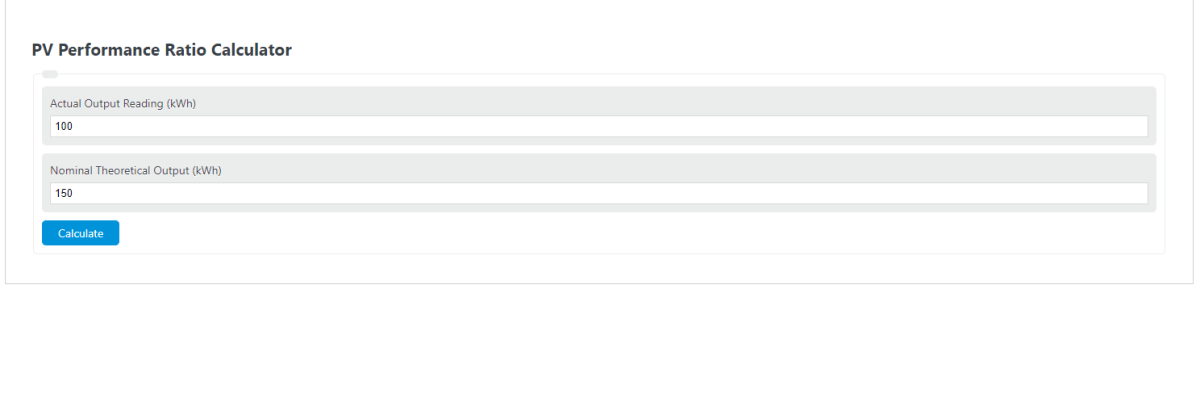
Calculate PV performance ratio, actual output, or nominal theoretical output from any two energy inputs in Wh, kWh, MWh, GWh, or BTU.
- All Physics Calculators
- Total Solar Reflectance Calculator
- Solar Battery Bank Size Calculator
- Heat Rate (Efficiency) Calculator
- Energy Performance Index Calculator
PV Performance Ratio Formula
The PV performance ratio compares how much energy a solar plant actually produced to how much it was expected to produce over the same measurement period. It is a compact performance metric that helps you evaluate whether a system is operating close to its modeled output.
If you want the answer as a percentage, convert the decimal ratio by multiplying by 100.
Variable Definitions
| Variable | Meaning | Typical Input | Important Note |
|---|---|---|---|
| PR | Performance ratio | Decimal or percent | A value of 1.00 equals 100% |
| AO | Actual output reading | Measured plant energy output | Use the real output for the selected time period |
| NO | Nominal theoretical output | Expected or modeled energy output | Must use the same time period and unit as AO |
How to Use the Calculator
- Enter the actual output reading from the PV system.
- Enter the nominal theoretical output for that same period.
- Make sure both values use the same energy unit.
- Calculate the result to get the PV performance ratio.
The most important requirement is consistency: both values should represent the same plant, the same time window, and the same unit basis.
Example
If a solar plant produced 4,850 kWh and the expected output for that period was 5,000 kWh, the ratio is:
As a percentage:
This means the system delivered 97% of its expected output during that interval.
How to Interpret the Result
| Performance Ratio | Interpretation | General Meaning |
|---|---|---|
| Greater than 1.00 | Above expectation | The plant produced more than the nominal estimate |
| Equal to 1.00 | On target | Actual output matched expected output |
| Less than 1.00 | Below expectation | The plant produced less than the modeled output |
A lower ratio does not always indicate equipment failure. It may also reflect temporary shading, soiling, high module temperature, inverter limits, wiring losses, downtime, curtailment, or an unrealistic nominal estimate.
Why the PV Performance Ratio Matters
- Tracks operational health: quickly shows whether the system is meeting expectations.
- Supports troubleshooting: helps flag underperformance that may justify inspection.
- Improves reporting: gives owners and operators a simple benchmark for period-to-period comparison.
- Validates maintenance results: useful before and after cleaning, repairs, or component replacement.
- Highlights model accuracy: persistent deviations can reveal issues in the expected-output assumptions.
Best Practices for Accurate Inputs
- Use values from the same date range, such as one day, one month, or one billing cycle.
- Keep the same unit for both numbers before calculating.
- Use a real measured output for AO rather than an estimate.
- Use a credible expected output for NO based on your design model, forecast, or engineering calculation.
- Check that the nominal output is greater than zero; otherwise the ratio is not valid.
Common Input Mistakes
- Mixing units: entering actual output in kWh and nominal output in MWh without converting.
- Mismatched time periods: comparing one day of actual production to one month of expected production.
- Reversing the formula: the calculator should divide actual output by nominal output, not the other way around.
- Using power instead of energy: this calculator is intended for output totals over a period, not instantaneous power snapshots.
- Using an unrealistic nominal value: poor assumptions can make the ratio look artificially high or low.
Frequently Asked Questions
- Can the PV performance ratio be greater than 100%?
- Yes. If actual production exceeds the nominal theoretical output, the ratio will be greater than 1.00, or greater than 100%.
- What happens if the nominal output is zero?
- The ratio cannot be calculated because division by zero is undefined.
- Should both values use the same unit?
- Yes. The ratio is only valid when actual and nominal output are expressed in matching units.
- Is a low ratio always caused by bad panels?
- No. A low result can come from environmental conditions, system losses, outages, modeling assumptions, or component issues.
Summary of the Calculation
To find the PV performance ratio, divide the measured output by the expected output for the same system and period. A result near 1.00 indicates the plant is operating close to expectation, while higher or lower values show overperformance or underperformance relative to the nominal model.