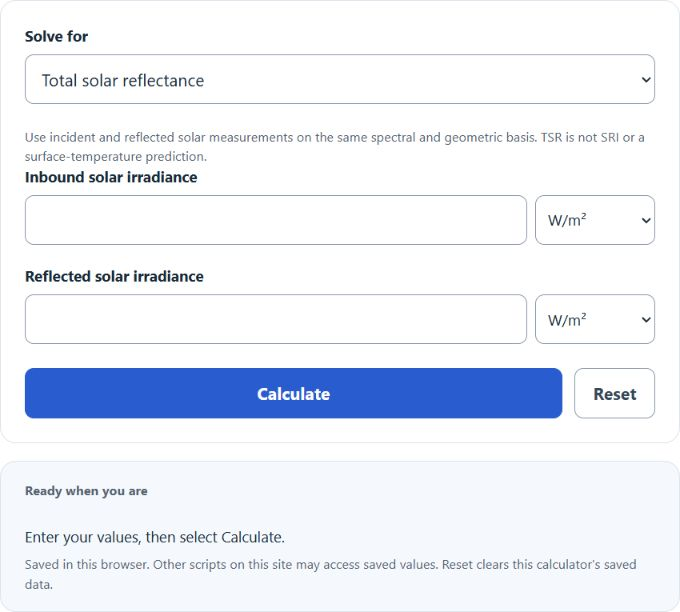
Calculate total solar reflectance from inbound and reflected solar radiation, or find either radiation value using W/m² or Btu_IT/(h·ft²).
- All Construction Calculators
- Candlepower to Lumens Calculator
- Light Intensity Calculator
- TSER Calculator
Total Solar Reflectance Formula
Total solar reflectance (TSR) is the percentage of incoming solar radiation that a surface reflects away. It is a simple but useful measure for comparing roofing materials, coatings, membranes, pavements, and exterior finishes where solar heat gain matters.
In this formula:
| Variable | Meaning | Typical Units | Important Note |
|---|---|---|---|
| TSR | Total solar reflectance | % | Higher values mean more solar energy is reflected |
| OSR | Outbound or reflected solar radiation | W/m² or Btu_IT/(h·ft²) | Converted automatically to W/m² before comparison |
| ISR | Inbound solar radiation | W/m² or Btu_IT/(h·ft²) | Must be greater than 0 |
If you already know the reflectance percentage and need to solve for one of the radiation values, the calculator can be rearranged as follows:
How to Use the Calculator
- Enter the inbound solar radiation striking the surface.
- Enter the reflected solar radiation coming off the surface.
- Select the correct unit for each radiation value; mixed units are converted automatically.
- Click calculate to find the total solar reflectance percentage.
Select the value to solve for, enter the known radiation and TSR percentage, then select Calculate. Recovering inbound radiation requires positive reflectance and reflected radiation; zero reflectance with zero reflected radiation is indeterminate. The International Table conversion is 1 Btu_IT/(h·ft²) ≈ 3.154591 W/m².
How to Interpret the Result
- Higher TSR: the surface reflects more sunlight and generally absorbs less solar energy.
- Lower TSR: the surface reflects less sunlight and generally retains more solar energy.
- 0% TSR: an idealized case where no solar radiation is reflected.
- 100% TSR: an idealized case where all incoming solar radiation is reflected.
In real applications, a higher TSR often helps reduce solar heat buildup on exposed surfaces. That can matter in roof selection, coating performance, thermal comfort, and cooling-load considerations. Surface temperature, however, also depends on other factors such as emissivity, airflow, insulation, thickness, orientation, and exposure conditions.
Energy Balance Context
Reflectance is only one part of how a material interacts with sunlight. In general, incoming solar energy is divided into reflected, absorbed, and transmitted portions.
For many opaque construction materials, transmitted energy is negligible, so lower reflectance usually means more solar energy is absorbed by the material.
Example
Suppose a surface receives 600 W/m² of solar radiation and reflects 210 W/m².
A TSR of 35% means the surface reflects 35% of the incoming solar radiation and does not reflect the remaining 65%.
Common Uses of Total Solar Reflectance
- Comparing roof colors and roofing membranes
- Evaluating exterior wall finishes and coatings
- Assessing pavement and hardscape materials
- Estimating how reflective a surface is under solar exposure
- Supporting material selection where heat gain is a concern
Practical Notes
- The calculator converts both irradiances to W/m². Use measurements on the same spectral and geometric basis; the simple ratio does not perform standardized spectral weighting or product certification.
- If inbound radiation is 0, TSR cannot be calculated because division by zero is undefined.
- Under normal physical conditions, TSR should not exceed 100%.
- If your result is above 100%, check for unit mismatch, input error, or measurement error.
- TSR is not the same as solar reflectance index (SRI). SRI also accounts for thermal behavior beyond reflectance alone.
- Material color, finish, texture, weathering, and cleanliness can all affect measured reflectance.
Frequently Asked Questions
Is total solar reflectance a percentage or a decimal?
It is commonly reported as a percentage, although the underlying ratio can also be expressed as a decimal.
Do darker materials usually have lower TSR?
Often yes, because darker surfaces generally reflect less solar radiation, but actual performance depends on the specific material and coating.
Why is TSR useful?
It gives a direct measure of how reflective a surface is under solar radiation, making it helpful for comparing materials in heat-exposed environments.