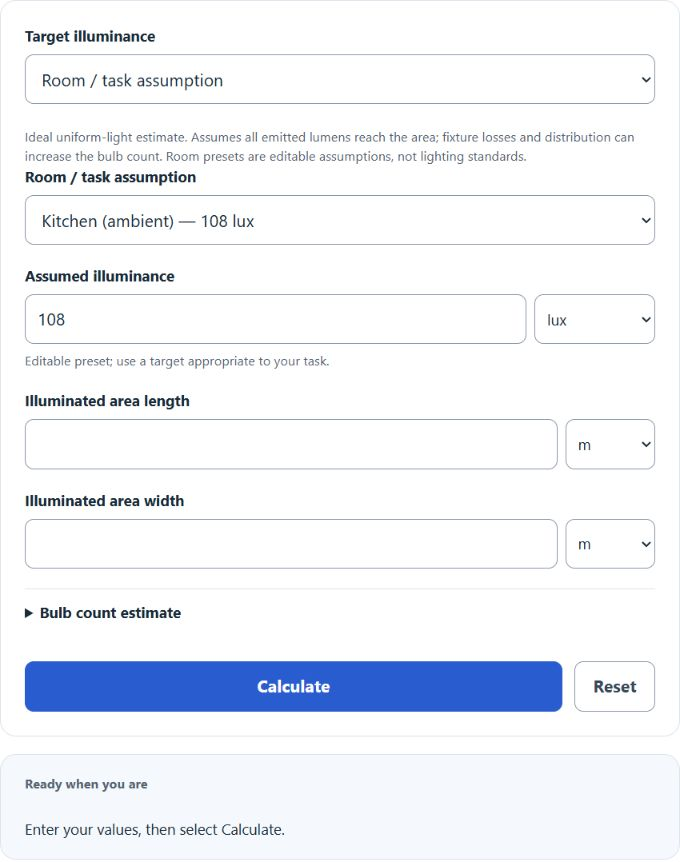
Estimate lumens reaching a rectangular area and an ideal bulb count from an editable room/task illuminance assumption or custom target, dimensions, and optional bulb lumens. Target illuminance uses lux or foot-candles; presets are illustrative, not lighting standards.
- All Physics Calculators
- Candlepower to Lumens Calculator
- Threshold Frequency Calculator
- Total Solar Reflectance Calculator
- Light Efficacy Calculator
Light Intensity Formula
The following formula estimates luminous flux (lumens) reaching a rectangular area at uniform target illuminance (lux or foot-candles). Comparing this directly with rated bulb lumens assumes all emitted light reaches the area; actual fixtures and room geometry cause losses.
- Where Φ is the required luminous flux (lumens, lm)
- E is the target illuminance (lux or foot-candle)
- A is the illuminated area (m² if using lux, or ft² if using foot-candles)
- For an ideal bulb count: bulbs = Φ ÷ (rated lumens per bulb), rounded up to the next whole bulb. This assumes all rated lumens reach the illuminated area; leave bulb lumens blank to omit the count.
Light Intensity Definition
In room lighting, “light intensity” is commonly used to mean illuminance (also called “light level”)—the amount of luminous flux falling on a surface per unit area.
Illuminance is measured in lux (lm/m²) or foot-candles (lm/ft²). This calculator uses illuminance and area to estimate the total lumens needed; it does not model beam angle, mounting height, fixture losses, or reflection from walls/ceilings.
Example Problem
How to estimate required lumens and number of bulbs?
- First, choose a target illuminance.
For this example, use 300 lux as the desired light level.
- Next, measure the room dimensions.
Assume the room is 5 m long and 4 m wide.
- Then, calculate the area.
Area A = 5 m × 4 m = 20 m².
- Then, calculate the required lumens.
Required lumens Φ = E × A = 300 lux × 20 m² = 6,000 lm.
- Finally, estimate the number of bulbs.
If each bulb provides 800 lm, bulbs = 6,000 ÷ 800 = 7.5, so you would round up to 8 bulbs.
FAQ
What units is light intensity measured in?
For room and workspace lighting, “light intensity” is commonly expressed as illuminance, measured in lux (lm/m²) or foot-candles (lm/ft²). In photometry, luminous intensity (a different quantity) is measured in candela (cd).