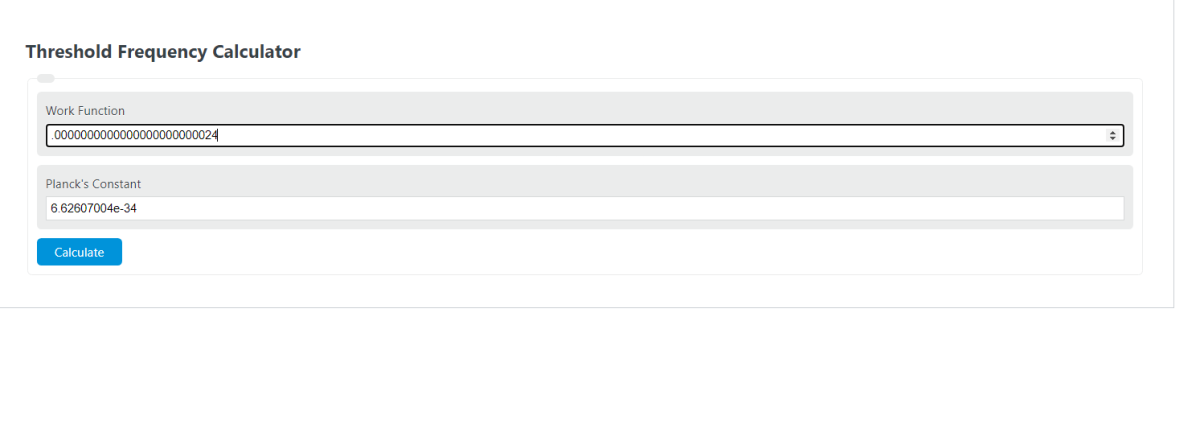
Calculate threshold frequency from work function, or work function from frequency, using Planck’s constant with joules, eV, Hz, kHz, MHz, or GHz.
- All Physics Calculators
- Nanometers to Joules Calculator
- Energy to Wavelength Calculator
- Light Intensity Calculator
Threshold Frequency Formula
The threshold frequency is the minimum light frequency needed to eject electrons from a material surface in the photoelectric effect. It is set by the material’s work function, which is the minimum energy required to free an electron. If the incoming light is below the threshold, electrons are not emitted even if the light intensity is increased.
In this relationship, the threshold frequency depends directly on the work function:
- Threshold frequency = the minimum frequency that can produce emission
- Work function = the energy barrier of the material
- Planck’s constant = the proportionality constant relating energy and frequency
How to Use the Threshold Frequency Calculator
- Enter the work function of the material.
- Select the correct unit, usually joules or electronvolts.
- Calculate the threshold frequency.
- Interpret the result as the minimum frequency of radiation required to start electron emission.
Most textbook and lab problems provide the work function and ask for the threshold frequency. Since Planck’s constant is fixed, the calculation is usually a direct one-step division.
Electronvolt to Joule Conversion
Work function values are often listed in electronvolts rather than joules. If you are calculating by hand, convert electronvolts to joules before using the main formula.
This is one of the most common places students make mistakes. Using electronvolts directly with Planck’s constant in joule-seconds will give the wrong threshold frequency unless the unit conversion is done first.
Why Threshold Frequency Matters
Threshold frequency is a core concept in the photoelectric effect:
- Below the threshold: no electrons are emitted.
- At the threshold: electrons are just barely emitted.
- Above the threshold: electrons are emitted and any extra photon energy becomes kinetic energy.
At the exact threshold, the emitted electron has essentially zero maximum kinetic energy, so the photon energy is just enough to overcome the work function.
Threshold Wavelength Relation
If you know wavelength instead of frequency, the same concept can be expressed using the threshold wavelength. Light with wavelengths shorter than the threshold wavelength has enough energy to produce emission.
This is useful when comparing ultraviolet, visible, or infrared light to the material’s emission limit.
Example Calculation
Suppose a material has a work function of 2.30 electronvolts.
So the material requires light with a frequency of about 5.56 × 10¹⁴ hertz or higher to begin ejecting electrons.
The corresponding threshold wavelength is:
Practical Interpretation
- A larger work function means a higher threshold frequency.
- A larger work function also means a shorter threshold wavelength.
- Threshold frequency depends on the material, not on the brightness of the light.
- Increasing intensity increases the number of photons, but it does not reduce the minimum frequency required for emission.
Common Mistakes
- Entering electronvolts when the calculation expects joules.
- Confusing threshold frequency with the frequency of the incoming light source.
- Assuming brighter light can eject electrons even when the frequency is too low.
- Mixing wavelength and frequency without converting properly.
This calculator is most useful for physics problems involving the photoelectric effect, photon energy, emission from metallic surfaces, and comparisons between work function, frequency, and wavelength.