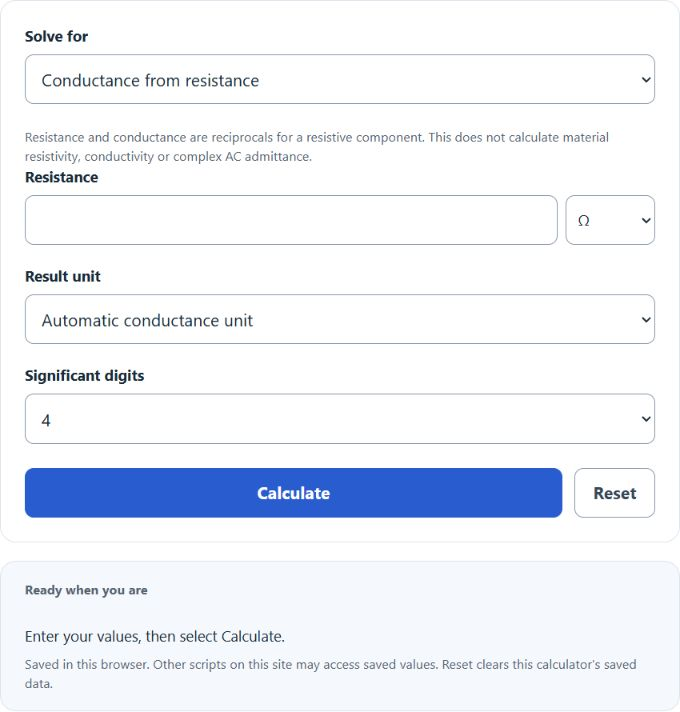
Convert ohms to siemens (conductance = 1 ÷ resistance) or siemens to ohms, with prefixes from milliohms to gigaohms and nanosiemens to kilosiemens.
Calculator Functions
| Function | What it does | What it requires |
|---|---|---|
| Conductance from resistance | Converts a resistance in ohms to the matching conductance in siemens | Requires the resistance in mΩ, Ω, kΩ, MΩ or GΩ |
| Resistance from conductance | Converts a conductance in siemens to the matching resistance in ohms | Requires the conductance in nS, µS, mS, S or kS |
Both functions also take a result unit, which is chosen automatically unless set, and a number of significant digits: 3, 4 or 6. Every result lists the value in each supported prefix and in scientific notation. Conductance from resistance also shows the answer in mhos, which equal siemens one for one [2].
Ohms To Siemens Formulas
| G | Conductance in siemens (S) |
| R | Resistance in ohms (Ω) |
The ohm is one volt per ampere and the siemens is one ampere per volt, so each is the reciprocal of the other [1]. An input with a prefix is converted to plain ohms or siemens first, and the answer is scaled to the result unit afterwards.
Conductance from resistance
The conductance is 1 divided by the resistance. A 10 Ω resistor has a conductance of 1 ÷ 10 = 0.1 S, or 100 mS. A 4.7 kΩ resistor is 4,700 Ω, which gives 1 ÷ 4,700 = 0.0002128 S, or 212.8 µS.
Resistance from conductance
The resistance is 1 divided by the conductance. One siemens equals one ohm, 0.5 mS is 1 ÷ 0.0005 = 2,000 Ω (2 kΩ), and 17.6 µS is 1 ÷ 0.0000176 = 56,818 Ω (56.82 kΩ).
Ohms and siemens equivalents
Because the two units are reciprocals, the prefixes mirror each other [1]: a thousand times more resistance is a thousand times less conductance.
| Resistance | Conductance |
|---|---|
| 1 mΩ | 1 kS |
| 0.1 Ω | 10 S |
| 1 Ω | 1 S |
| 10 Ω | 100 mS |
| 100 Ω | 10 mS |
| 1 kΩ | 1 mS |
| 10 kΩ | 100 µS |
| 100 kΩ | 10 µS |
| 1 MΩ | 1 µS |
| 1 GΩ | 1 nS |
Limits of This Estimate
- The reciprocal applies to a resistive component. For AC circuits with capacitance or inductance, conductance comes from complex impedance and admittance, not from 1 ÷ R alone.
- This converts resistance and conductance. It does not convert resistivity (Ω·m or Ω·cm) to conductivity (S/m or µS/cm), which also depends on the size and shape of the sample.
- An input of zero returns ∞. That describes an ideal short or open circuit, not a measurable component value.
Sources
- NIST, Guide for the Use of the International System of Units (SP 811), Chapter 4, Tables 3 and 5: the ohm as V/A, the siemens as A/V, and the SI prefixes
- NIST, Guide for the Use of the International System of Units (SP 811), Appendix B.8: 1 mho equals 1 siemens