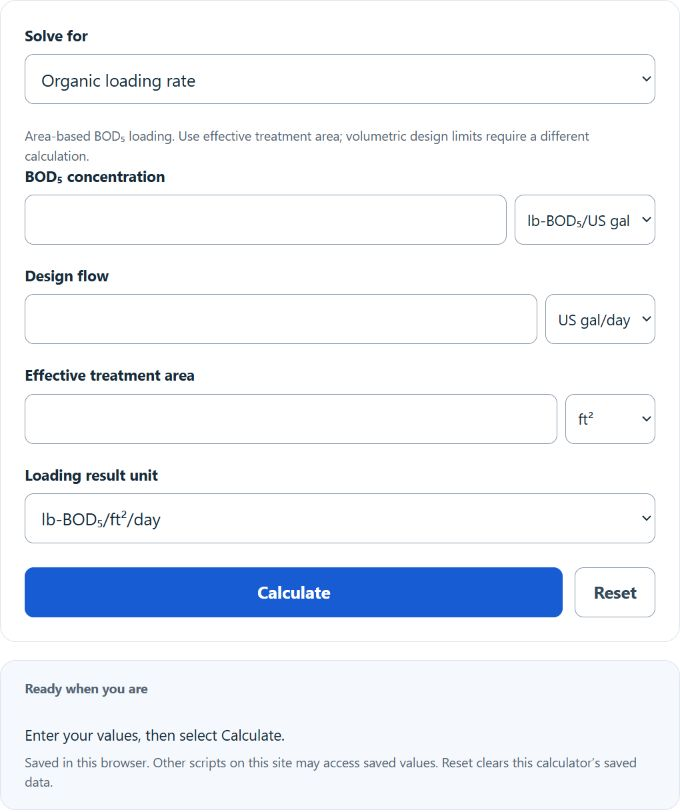
Calculate organic loading rate, BOD₅ concentration, design flow, or effective area from three inputs with unit options in wastewater treatment.
Related Calculators
- SVI (Sludge Volume Index) Calculator
- CFU/mL Calculator
- Bacterial Concentration Calculator
- Log Reduction Calculator
- All Biology Calculators
Organic Loading Rate Formula
The organic loading rate (OLR) measures how much biodegradable organic material is applied to a treatment area each day. It is commonly used to evaluate whether a basin, filter, bed, pond, or other treatment surface is being loaded lightly, moderately, or heavily relative to its available area.
In this calculator, the result is expressed as organic mass per unit area per day, such as lb-BOD5/ft2/day or kg-BOD5/m2/day.
| Variable | Meaning | Typical Units |
|---|---|---|
| OLR | Organic loading rate | lb-BOD5/ft2/day, kg-BOD5/m2/day |
| OM | Organic matter concentration or loading basis of the incoming flow | lb-BOD5/gal, kg-BOD5/L, g-BOD5/L |
| DF | Design flow | US liquid gal/day, L/day, m3/day |
| A | Effective treatment area | ft2, m2, acres, hectares |
Rearranged Forms
Choose the quantity to solve for, then enter the other three positive quantities. Supported concentration, flow and area units are converted automatically.
How to Calculate Organic Loading Rate
- Determine the influent organic matter value used for design, usually on a BOD5-based mass-per-volume basis.
- Determine the design flow for the system.
- Measure or confirm the effective treatment area receiving the load.
- Multiply organic matter by design flow to estimate the daily organic mass applied.
- Divide that daily mass by the available area to obtain the loading rate.
This makes OLR especially useful for quick screening. If influent strength rises or flow increases, the loading rate increases. If treatment area increases, the loading rate decreases.
Example Calculation
Suppose the incoming wastewater has an organic matter value of 0.002 lb-BOD5/gal, the design flow is 10,000 gal/day, and the treatment area is 500 ft2.
The organic loading rate is 0.04 lb-BOD5/ft2/day. In plain terms, each square foot of treatment area is receiving 0.04 pounds of BOD5 per day.
Why OLR Matters
- Process protection: Excessive loading can reduce treatment efficiency and increase the risk of operational stress.
- Sizing support: OLR helps estimate how much area is required for a target influent condition.
- Performance comparison: It creates a normalized way to compare systems of different sizes.
- Troubleshooting: A sudden rise in loading may explain odor issues, reduced removal, or unstable performance.
Interpreting the Result
The number by itself is only part of the picture. A “good” or “bad” OLR depends on the treatment process, media type, oxygen availability, detention time, temperature, and the design basis used for the facility. In general:
- Higher influent strength increases OLR in direct proportion.
- Higher flow increases OLR in direct proportion.
- Larger effective area reduces OLR because the same load is spread over more surface.
- Design review should compare the calculated value against the specific criteria used for that system.
Unit Check
Keeping units consistent is critical. The concentration, flow, and area must all align so the final result is expressed in mass per area per day.
- The calculator converts supported input units into a consistent SI basis; the result is mass per area per day.
- If flow is entered in m3/day, make sure the concentration basis matches that volume basis.
- Use the effective treatment area, not simply the gross site footprint, unless your design method specifically calls for gross area.
Common Input Mistakes
- Mixing average flow with design flow.
- Using inconsistent unit systems without converting first.
- Entering total daily mass as if it were a concentration value.
- Using nominal area instead of the area actually receiving the organic load.
- Comparing an area-based OLR to a design limit that is actually volume-based.
Practical Notes
Use this calculator when you want a fast estimate of loading intensity on an area basis. It is most helpful during preliminary design checks, routine operational review, what-if analysis, and capacity planning. If your process is evaluated on a volumetric basis instead of a surface basis, a different loading-rate approach should be used.
Frequently Asked Questions
Can I solve for area instead of OLR?
Yes. If you know the organic matter value, design flow, and target loading rate, the rearranged area formula can be used to estimate the required treatment area.
Does doubling the flow double the loading rate?
Yes, assuming the organic matter value and area stay the same.
Does increasing area lower OLR?
Yes. Spreading the same daily organic mass over a larger area reduces the loading per unit area.
Should I use BOD5 or another parameter?
Use the same organic parameter that your design method or operating criteria are based on, and keep that basis consistent throughout the calculation.