Calculate owner’s equity from total assets and liabilities, or find ending equity from beginning balance, income, contributions, and draws.
Owner's Equity Formula
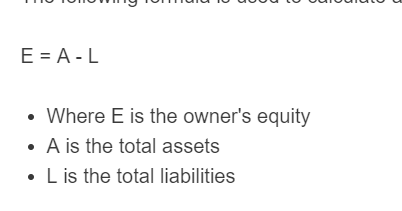
The calculator uses one of two formulas depending on the mode you select.
From Balance Sheet:
Period Change:
- Total Assets — everything the business owns (cash, receivables, inventory, equipment, property).
- Total Liabilities — everything the business owes (payables, loans, accrued expenses).
- Beginning Equity — the owner's equity balance at the start of the period.
- Net Income — profit for the period; enter as a negative number for a loss.
- Contributions — new cash or assets the owner put into the business.
- Draws — cash or assets the owner took out for personal use.
Both formulas come from the accounting equation (Assets = Liabilities + Equity). Use the balance sheet method when you have a current snapshot. Use the period change method when you're rolling forward last period's equity to this period. Numbers should be in the same currency and as of the same reporting date.
Reference Tables
Quick reference for interpreting your result and benchmarking against typical small business ranges.
| Equity Result | What It Means |
|---|---|
| Positive and growing | Business is building book value; profits exceed draws. |
| Positive but shrinking | Draws or losses are eroding the owner's stake. |
| Zero | Assets exactly cover liabilities; no cushion. |
| Negative | Insolvent on a book basis; lenders and investors will flag this. |
| Equity Component | Effect on Equity |
|---|---|
| Net income | Increases |
| Net loss | Decreases |
| Owner contributions | Increases |
| Owner draws | Decreases |
| Asset revaluation (gain) | Increases |
| New debt taken on | No direct effect (assets and liabilities both rise) |
Example
A sole proprietor has $250,000 in assets and $120,000 in liabilities at year end.
Owner's Equity = $250,000 - $120,000 = $130,000
The next year she earned $40,000 in net income, contributed $5,000 in new capital, and drew $30,000 for personal use.
Ending Equity = $130,000 + $40,000 + $5,000 - $30,000 = $145,000
FAQ
Is owner's equity the same as net worth? For a sole proprietor, yes — it's the book value of the owner's stake. For corporations, the equivalent is "stockholders' equity."
Can owner's equity be negative? Yes. If liabilities exceed assets, equity is negative. It usually signals sustained losses or excessive draws.
Does taking out a loan change my equity? No. A loan adds an asset (cash) and a liability (debt) of equal size. Equity only moves when income, losses, contributions, or draws occur.
Where do retained earnings fit in? Retained earnings are part of equity. In the period change formula, they're captured through net income minus draws accumulating over time.