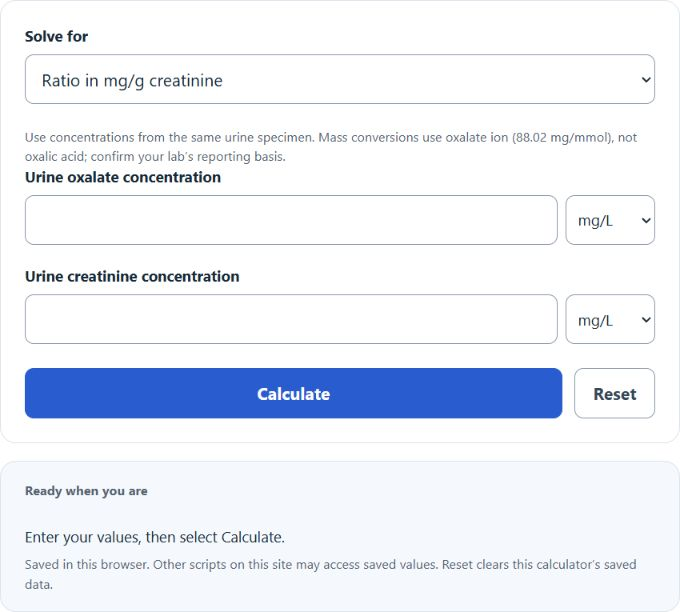
Calculate the urine oxalate/creatinine ratio from oxalate and creatinine concentrations in mg/L or mmol/L, shown as mg/g or mmol/mol.
Medical note: This calculator is for education only and is not a diagnosis. Labs report oxalate/creatinine ratios in different units and reference ranges (often varying by age and lab method). Discuss results with a clinician—seek urgent care for severe flank pain, fever, vomiting, or blood in urine.
Related Calculators
- Urine Osmolality Calculator
- Gfr To Creatinine Clearance Calculator
- Corrected Potassium Calculator
- Potassium Replacement Calculator
- All Health and Medical Calculators
Oxalate/Creatinine Ratio Formula
The oxalate/creatinine ratio compares urine oxalate concentration with urine creatinine concentration. This helps adjust for urine dilution, especially when using a spot urine sample.
For mg/g creatinine:
For mmol/mol creatinine:
Unit conversions used:
- Ratio = urine oxalate/creatinine ratio, reported as either mg/g creatinine or mmol/mol creatinine
- O_mg/L = urine oxalate concentration in milligrams per liter
- O_mmol/L = urine oxalate concentration in millimoles per liter
- Cr_mg/L = urine creatinine concentration in milligrams per liter
- Cr_mmol/L = urine creatinine concentration in millimoles per liter
- 88.02 = conversion factor for oxalate ion (C₂O₄²⁻), mg per mmol. Confirm the lab’s mass-reporting basis; this factor is not for oxalic acid or an oxalate salt.
- 113.12 = molecular weight conversion factor for creatinine, mg per mmol
The ratio unit selector controls which formula is used. If you choose mg/g creatinine, the calculator converts oxalate to mg/L and creatinine to g/L, then divides oxalate by creatinine. If you choose mmol/mol creatinine, the calculator converts both values to mmol/L, divides oxalate by creatinine, and multiplies by 1000.
The oxalate and creatinine unit dropdowns allow mixed input units, such as oxalate in mmol/L and creatinine in mg/L. Creatinine must be greater than zero because it is the denominator of the ratio.
Oxalate and Creatinine Unit Conversions
| Substance | Conversion | Used for |
|---|---|---|
| Oxalate | 1 mmol/L = 88.02 mg/L | Converting oxalate between mmol/L and mg/L |
| Creatinine | 1 mmol/L = 113.12 mg/L | Converting creatinine between mmol/L and mg/L |
| Creatinine | 1000 mg/L = 1 g/L | Calculating a mg/g creatinine ratio |
Common Reporting Units for Oxalate/Creatinine Ratio
| Reporting unit | Meaning | Formula basis |
|---|---|---|
| mg/g creatinine | Milligrams of oxalate per gram of creatinine | Oxalate in mg/L divided by creatinine in g/L |
| mmol/mol creatinine | Millimoles of oxalate per mole of creatinine | Oxalate in mmol/L divided by creatinine in mmol/L, then multiplied by 1000 |
Example Calculations
Example 1: mg/g creatinine
You have urine oxalate of 20 mg/L and urine creatinine of 1000 mg/L.
The oxalate/creatinine ratio is 20 mg/g creatinine.
Example 2: mmol/mol creatinine
You have urine oxalate of 0.25 mmol/L and urine creatinine of 10 mmol/L.
The oxalate/creatinine ratio is 25 mmol/mol creatinine.
FAQ
What does the oxalate/creatinine ratio show?
It shows urine oxalate relative to urine creatinine. Because creatinine helps account for urine concentration, the ratio can be more useful than oxalate concentration alone when a spot urine sample is used. Interpretation depends on age, specimen type, lab method, and the reference range printed on your lab report.
Can I compare mg/g and mmol/mol results directly?
No. They are different reporting systems. A result in mg/g creatinine should be compared with a mg/g reference range, and a result in mmol/mol creatinine should be compared with a mmol/mol reference range. Use the same unit system your lab report uses when checking your result.
Why does creatinine have to be greater than zero?
Creatinine is the denominator in the ratio. Dividing by zero is not possible, and a very low creatinine value can make the ratio appear unusually high. If the creatinine value seems very low or does not match the expected unit, check the lab report and unit selection before using the result.