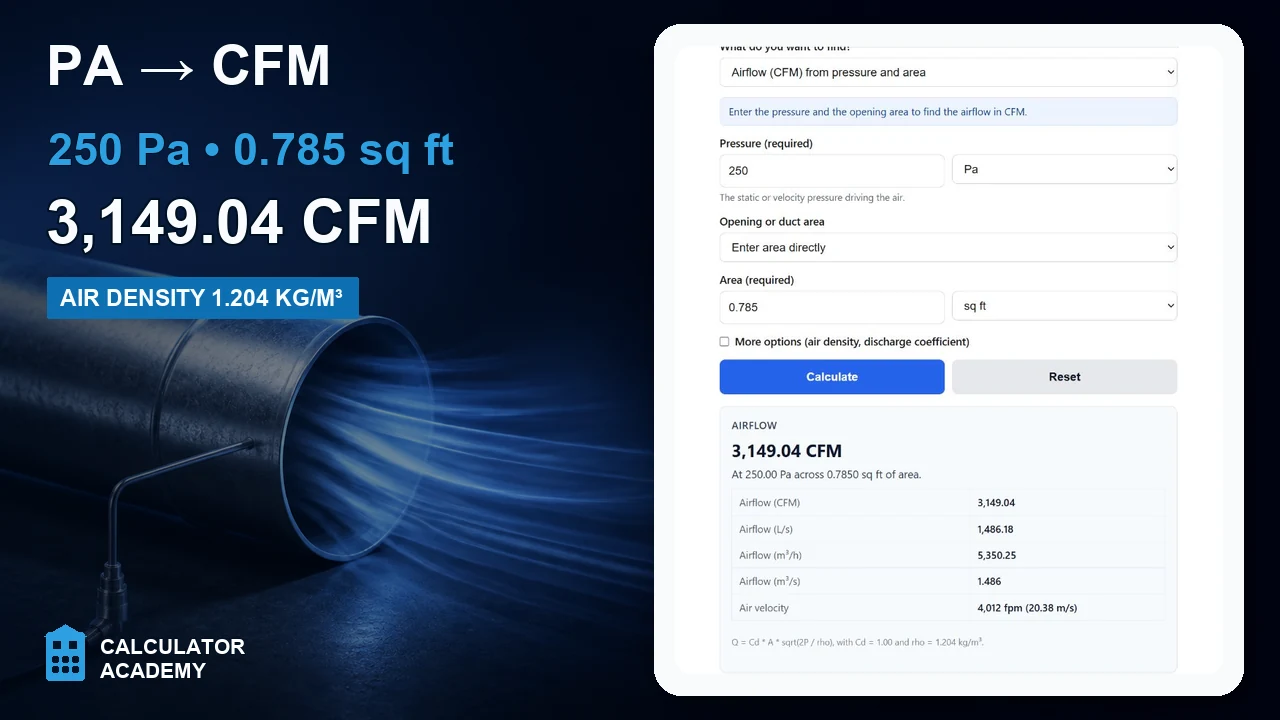
Calculate airflow in CFM from pressure and area, or solve pressure or area using Pa, kPa, psi, bar and common area and flow units.
| Pa to CFM | CFM to Pa |
|---|---|
| 25 Pa = 1,269 CFM | 500 CFM = 3.88 Pa |
| 50 Pa = 1,794 CFM | 750 CFM = 8.74 Pa |
| 75 Pa = 2,197 CFM | 1,000 CFM = 15.53 Pa |
| 100 Pa = 2,537 CFM | 1,200 CFM = 22.38 Pa |
| 125 Pa = 2,837 CFM | 1,500 CFM = 34.96 Pa |
| 150 Pa = 3,107 CFM | 1,800 CFM = 50.35 Pa |
| 200 Pa = 3,588 CFM | 2,000 CFM = 62.13 Pa |
| 250 Pa = 4,011 CFM | 2,500 CFM = 97.09 Pa |
| 300 Pa = 4,393 CFM | 3,000 CFM = 139.70 Pa |
| 400 Pa = 5,074 CFM | 3,500 CFM = 190.10 Pa |
| 500 Pa = 5,670 CFM | 4,000 CFM = 248.70 Pa |
| 600 Pa = 6,210 CFM | 5,000 CFM = 388.30 Pa |
| 750 Pa = 6,950 CFM | 6,000 CFM = 559.30 Pa |
| 1,000 Pa = 8,021 CFM | 7,000 CFM = 761.10 Pa |
| 1,250 Pa = 8,969 CFM | 8,000 CFM = 994.20 Pa |
| 1,500 Pa = 9,826 CFM | 9,000 CFM = 1,258 Pa |
| 2,000 Pa = 11,341 CFM | 10,000 CFM = 1,553 Pa |
| 2,500 Pa = 12,685 CFM | 12,000 CFM = 2,237 Pa |
| 3,000 Pa = 13,893 CFM | 14,000 CFM = 3,045 Pa |
| 4,000 Pa = 16,042 CFM | 16,000 CFM = 3,978 Pa |
| Formulas: Q = A * sqrt(2P / rho) and P = (Q / A)^2 * rho / 2. Assumes Cd = 1, rho = 1.204 kg/m3, A = 1 sq ft. | |
- All Unit Converters
- Thermodynamics and Fluid Unit Converters
- Flow Rate Pressure Calculator
- Air Watts To Pa Calculator
Pa to CFM Formula
The conversion from pascals to CFM uses the orifice flow equation derived from the Bernoulli principle:
Where Q is the volumetric flow rate (m3/s, then converted to CFM), Cd is the discharge coefficient (1.0 for an ideal open duct, typically 0.6 to 0.65 for a sharp-edged orifice), A is the cross-sectional area of the opening (m2), delta P is the pressure differential in pascals, and rho is air density in kg/m3. At standard conditions (20 °C, sea level), rho = 1.204 kg/m3.
To convert the result from m3/s to CFM, multiply by 2,118.88. The calculator above handles all unit conversions automatically.
What is Pa to CFM?
Pa to CFM converts a pressure reading (pascals) into an airflow rate (Cubic Feet per Minute) across a known opening area. Pascals measure the force per unit area driving air through a system. CFM measures the volume of air passing a point each minute. The two are related through the area of the duct or opening and the density of the air.
This conversion appears in HVAC commissioning, blower door testing, fan selection, cleanroom pressurization, fume hood verification, and compressed air system design. It is not a direct unit-to-unit conversion the way inches to centimeters would be. It requires knowing the geometry (area) and conditions (temperature, altitude) of the system.
Pressure Types in Airflow Systems
HVAC and ventilation systems reference three distinct pressure measurements. Static pressure (SP) is the outward force air exerts on duct walls, independent of airflow direction. Velocity pressure (VP) is the kinetic energy component, proportional to the square of air speed. Total pressure (TP) equals static plus velocity pressure. When using this calculator, clarify which pressure type your measurement represents. A pitot tube reading in a duct gives velocity pressure. A manometer tap on the side of a duct gives static pressure.
For reference: 1 inch of water column (in. wc) equals 249.09 Pa. Most residential HVAC systems operate between 25 and 100 Pa (0.1 to 0.4 in. wc) of static pressure. Commercial systems often run at 250 to 750 Pa (1 to 3 in. wc).
Air Density by Temperature and Altitude
The formula above assumes standard air density of 1.204 kg/m3 (0.075 lb/ft3) at 20 °C and sea level. Real conditions rarely match this standard exactly. As temperature rises or altitude increases, air becomes less dense, meaning a given pressure differential produces more volumetric flow (higher CFM) but carries fewer pounds of air per minute. The tables below show how air density shifts.
| Temperature | Density (kg/m3) | Density (lb/ft3) | Change vs 20 °C |
|---|---|---|---|
| -10 °C (14 °F) | 1.342 | 0.0838 | +11.5% |
| 0 °C (32 °F) | 1.293 | 0.0807 | +7.4% |
| 10 °C (50 °F) | 1.247 | 0.0779 | +3.6% |
| 20 °C (68 °F) | 1.204 | 0.0752 | Standard |
| 30 °C (86 °F) | 1.164 | 0.0727 | -3.3% |
| 40 °C (104 °F) | 1.127 | 0.0703 | -6.4% |
| 50 °C (122 °F) | 1.092 | 0.0682 | -9.3% |
| Altitude | Density (kg/m3) | Correction Factor |
|---|---|---|
| Sea Level (0 ft) | 1.204 | 1.000 |
| 1,000 ft (305 m) | 1.161 | 0.964 |
| 2,000 ft (610 m) | 1.119 | 0.930 |
| 3,000 ft (914 m) | 1.079 | 0.896 |
| 4,000 ft (1,219 m) | 1.040 | 0.864 |
| 5,000 ft (1,524 m) | 1.002 | 0.832 |
| 6,000 ft (1,829 m) | 0.966 | 0.802 |
| 7,000 ft (2,134 m) | 0.931 | 0.773 |
| To adjust, replace rho in the formula with the density for your conditions. | ||
SCFM vs ACFM
Standard CFM (SCFM) is referenced to standard conditions: 68 F (20 C), 14.696 psia, and 0% relative humidity. Actual CFM (ACFM) is the volume at the real temperature, pressure, and humidity of the system. At sea level and 68 F, SCFM equals ACFM. At higher altitudes or temperatures, ACFM is larger than SCFM for the same mass flow rate because the air is less dense and occupies more volume. The conversion is: ACFM = SCFM * (P_standard / P_actual) * (T_actual / T_standard), where temperatures are in Rankine (F + 460) and pressures are absolute (psia).
When using this calculator at non-standard conditions, the output is ACFM. If you need SCFM, divide the result by the density correction factor from the altitude table above, or apply the full ACFM-to-SCFM conversion.
Common Duct Sizes and Typical Airflow
The table below gives the cross-sectional area for standard round duct sizes and the resulting CFM at a velocity of 900 fpm (a common residential design velocity) and 1,500 fpm (typical commercial design velocity).
| Duct Diameter | Area (sq ft) | CFM at 900 fpm | CFM at 1,500 fpm |
|---|---|---|---|
| 4 in | 0.087 | 78 | 131 |
| 6 in | 0.196 | 177 | 295 |
| 8 in | 0.349 | 314 | 524 |
| 10 in | 0.545 | 491 | 818 |
| 12 in | 0.785 | 707 | 1,178 |
| 14 in | 1.069 | 962 | 1,604 |
| 16 in | 1.396 | 1,257 | 2,094 |
| 18 in | 1.767 | 1,590 | 2,651 |
| 20 in | 2.182 | 1,964 | 3,273 |
| 24 in | 3.142 | 2,827 | 4,712 |
| Residential design velocity: 600 to 900 fpm. Commercial main ducts: 1,200 to 2,000 fpm. Industrial: up to 4,000 fpm. | |||
How to Calculate Pa to CFM
Example: A 12-inch round duct has a measured static pressure of 250 Pa. What is the airflow in CFM?
- Calculate the duct area. A 12-inch duct has a radius of 6 inches = 0.5 ft. Area = pi * (0.5)^2 = 0.785 sq ft = 0.0729 m2.
- Apply the formula: Q = 1.0 * 0.0729 * sqrt(2 * 250 / 1.204) = 0.0729 * sqrt(415.28) = 0.0729 * 20.378 = 1.486 m3/s.
- Convert to CFM: 1.486 * 2,118.88 = 3,148 CFM.
- Cross-check with the duct table above. At 3,148 CFM through a 0.785 sq ft duct, the velocity is 3,148 / 0.785 = 4,010 fpm, which is reasonable for an industrial duct application.
For lower pressures typical of residential HVAC (25 to 75 Pa), the same 12-inch duct would carry roughly 1,269 to 2,197 CFM. Use the calculator at the top of this page to check specific values instantly.