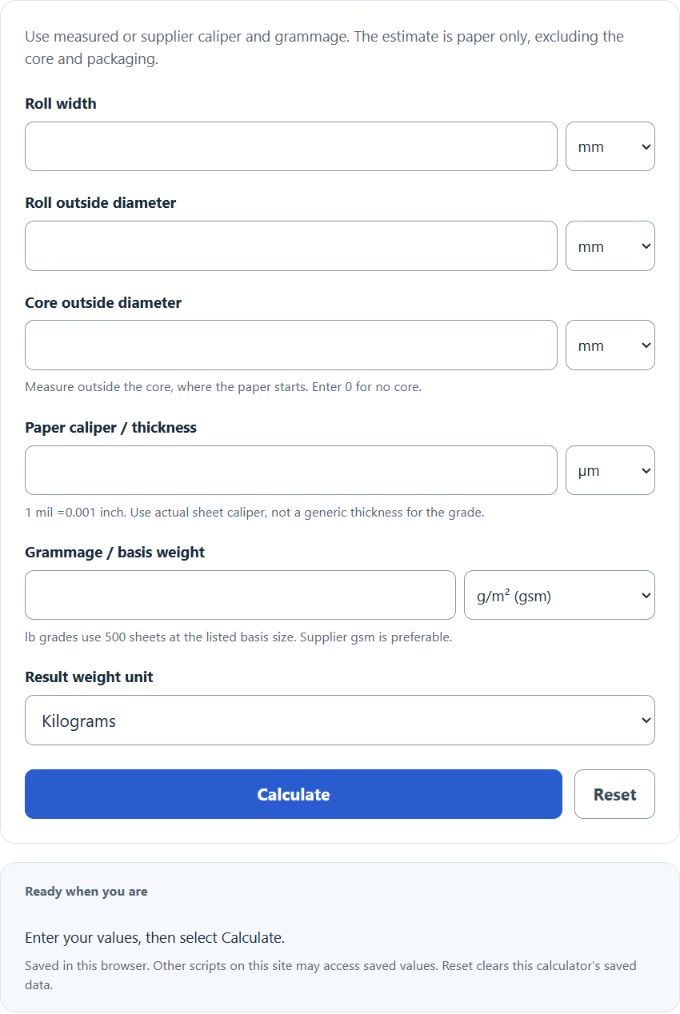
Estimate paper-only roll weight from roll width, outside diameter, core outside diameter, paper caliper and grammage or grade-specific basis weight. Core and packaging mass are excluded.
Paper Roll Weight Formula
The calculator estimates roll weight from the roll geometry, paper thickness, roll width, and basis weight. It first calculates the length of paper wound on the roll, then multiplies that length by width to get area, then multiplies area by basis weight.
L = π × (OD − CD) × (OD + CD) / (4 × T)
A = L × W
Weight in kg = A × GSM / 1000
- L = roll length in meters
- OD = outer diameter of the roll in meters
- CD = core outside diameter in meters, where the paper begins (not the bore)
- T = paper caliper or thickness in meters
- A = paper area in square meters
- W = roll width in meters
- GSM = basis weight in grams per square meter
- Weight_kg = estimated paper roll weight in kilograms
The calculator converts all length inputs to meters before applying the formulas. It converts caliper values from microns, millimeters, mils, or inches to meters. It also converts common paper basis weights, such as text, cover, and index, to gsm before calculating weight.
The result section shows the estimated roll weight, roll length, paper area, and the gsm value used in the calculation.
Basis Weight Conversion Reference
These nominal conversions use 500 sheets at the conventional basis size: text 25 × 38 in, cover 20 × 26 in, and index 25.5 × 30.5 in. Factors below are rounded; the calculator uses the exact pound and inch definitions. Use supplier gsm when available; these conversions do not determine caliper.
| Input Type | Conversion to GSM | Example |
|---|---|---|
| gsm | same value | 80 gsm = 80 gsm |
| lb text | lb text × 1.48014648 | 50 lb text ≈ 74.01 gsm |
| lb cover | lb cover × 2.70411377 | 80 lb cover ≈ 216.33 gsm |
| lb index | lb index × 1.80795777 | 90 lb index ≈ 162.72 gsm |
Paper Caliper Input Guidance
Paper grade and gsm do not uniquely determine thickness. Use the actual supplier specification or a suitable measurement; no generic caliper is assumed.
| Paper Type | Caliper Input | Notes |
|---|---|---|
| Light office or copy paper | Use supplier caliper | Gsm alone does not specify thickness |
| Book or text paper | Use measured or specified caliper | Depends on finish and bulk |
| Cover stock | Use the grade specification | Finish and bulk affect thickness |
| Label or specialty paper | Varies widely | Use the supplier caliper when available |
Example Calculations
Example 1: Metric roll
You have a roll that is 1000 mm wide, with a 1000 mm outer diameter, a 76 mm core outside diameter, 100-micron caliper, and 80 gsm paper.
- Roll length ≈ 7,808.6 m
- Paper area ≈ 7,808.6 m²
- Paper roll weight ≈ 624.7 kg
Example 2: Inch inputs with text weight
You have a roll that is 30 in wide, with a 40 in outer diameter, a 3 in core outside diameter, 4-mil caliper, and 50 lb text basis weight.
- 50 lb text ≈ 74.01 gsm
- Roll length ≈ 7,934.8 m
- Paper area ≈ 6,046.3 m²
- Paper roll weight ≈ 447.5 kg, or about 986.5 lb
FAQ
Does the paper roll weight include the core?
No. The formula estimates the weight of the paper only. It subtracts the circular area inside the core outside diameter from the roll cross-section. It does not add the physical weight of the cardboard, plastic, or metal core or packaging.
Why does caliper matter so much?
Caliper controls how much paper length fits into the roll diameter. A thinner sheet produces more length in the same roll size. More length means more area, which increases the estimated roll weight when the basis weight stays the same.
Why is this an estimate?
Real roll weight can vary because of winding tightness, moisture content, coating, density changes, and measurement tolerance. For best results, use the actual measured outer diameter, actual core outside diameter, supplier caliper, and supplier basis weight.