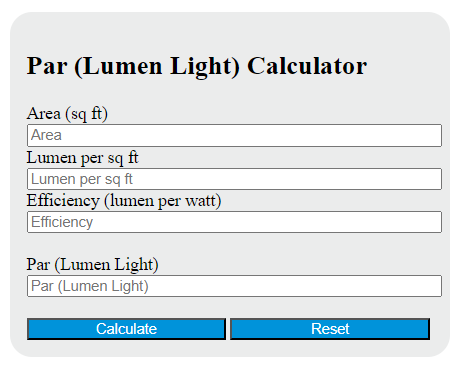
Calculate PAR light output, area, target illuminance, or efficiency factor from three known values in sq ft, fc or lux, and lumens.
Par (Lumen Light) Formula
This calculator estimates the PAR lighting requirement for a space from three inputs: the illuminated area, the target light level, and the efficiency of the light source. It is useful for quick planning when you want to size a PAR lamp setup, compare fixture options, or translate a brightness target into a practical lighting requirement.
In this equation, the area is combined with the target light level to determine how much total light the space needs, and the efficiency term adjusts that requirement based on how effectively the source converts power into visible light.
| Variable | Meaning | Typical Unit | Why It Matters |
|---|---|---|---|
| PL | Calculated PAR lighting requirement | Calculator result | Represents the lighting capacity needed to meet the design target. |
| A | Area to be illuminated | sq ft, sq m, sq yd | Larger spaces need more total light. |
| L | Target light level across the area | lumens per unit area | Higher brightness targets increase the lighting requirement. |
| E | Light source efficiency | lm/W | More efficient fixtures produce the same light with less input power. |
How the Calculation Works
It helps to break the process into two steps. First, determine the total lumens needed for the space. Then use fixture efficiency to understand the source capacity required to produce that light.
Here, LT is the total lumen demand for the area. This is the most useful intermediate value because it can also be used to estimate fixture count, compare lamp options, or check whether an existing lighting plan is likely to be sufficient.
How to Estimate the Number of PAR Fixtures
If you know the lumen output of one PAR lamp or fixture, convert the total lumen requirement into fixture count with the following relationship:
N is the number of fixtures and LF is the lumen output of one fixture. In practice, round up to the next whole fixture and then check beam spread, spacing, and mounting height to make sure the light is distributed evenly.
Rearranged Forms of the Formula
Because the calculator can solve for a missing value when the other three are known, these rearrangements are useful for planning and troubleshooting:
How to Use the Calculator
- Measure the area that needs illumination.
- Choose the area unit you want to work in.
- Set the target light level for that space.
- Enter the efficiency of the PAR lamp or fixture you plan to use.
- Leave one field blank so the calculator can solve for the missing value.
- Review the result and, if needed, convert the total lumen demand into fixture count using the lumen output of one fixture.
Unit Guidance
For accurate results, keep the area unit and light-level basis aligned. If your area is in square feet, your target should be based on square feet. If your area is in square meters, your target should be based on square meters.
This matters because the same space can appear very different on paper depending on whether the design notes are written in foot-candles, lux, total lumens, or lumens per fixture.
Example
Assume a 250 square foot area needs 20 lumens per square foot, and the selected PAR source operates at 100 lm/W.
The space needs 5,000 total lumens. At 100 lm/W, that corresponds to about 50 watts of lighting capacity. If each PAR fixture produces 1,250 lumens, the fixture count becomes:
That means four fixtures would be the starting point for the layout, subject to beam angle and spacing.
What Affects Real-World PAR Lighting Performance?
- Beam angle: Narrow beams concentrate light; wide beams spread it out over more surface area.
- Mounting height: Higher mounting positions generally reduce intensity at the target surface unless output increases.
- Fixture spacing: Poor spacing can create hot spots or dim gaps even when total lumens look correct.
- Surface reflectance: Dark floors, walls, and ceilings absorb more light than bright reflective surfaces.
- Task type: Accent lighting, display lighting, and work lighting often require different brightness targets.
- System losses: Dirt, lens losses, aging, and driver performance can reduce delivered light over time.
Common Mistakes to Avoid
- Mixing square feet with a light target intended for square meters.
- Using total fixture lumens when the design target is based on delivered light at the surface.
- Assuming total lumens alone determine performance without considering beam spread.
- Forgetting to round fixture counts up to a whole number.
- Ignoring efficiency when comparing two PAR lamp options with similar brightness claims.
PAR Lighting Basics
PAR stands for parabolic aluminized reflector. PAR lamps and fixtures are designed to produce a controlled, directional beam, which makes them useful for accent lighting, display lighting, stage applications, architectural highlighting, and other situations where aiming and beam control matter as much as raw output.
Frequently Asked Questions
Does a higher efficiency reduce the required lighting capacity?
Yes. A higher lm/W value means the source produces more visible light for each watt of input power, so less power is needed to achieve the same target light level.
Why can the fixture count differ from the calculator result?
The calculator focuses on area, target light level, and efficiency. Actual fixture count also depends on the lumen output of one fixture, beam angle, mounting height, and layout geometry.
Should I round the result up?
If you are converting the requirement into fixture count, round up to the next whole fixture. Lighting layouts are installed with whole fixtures, not fractional ones.
When is this calculator most useful?
It is most useful during early lighting design, retrofit planning, fixture comparison, and quick validation of whether a PAR lamp selection is in the right range for the area being illuminated.