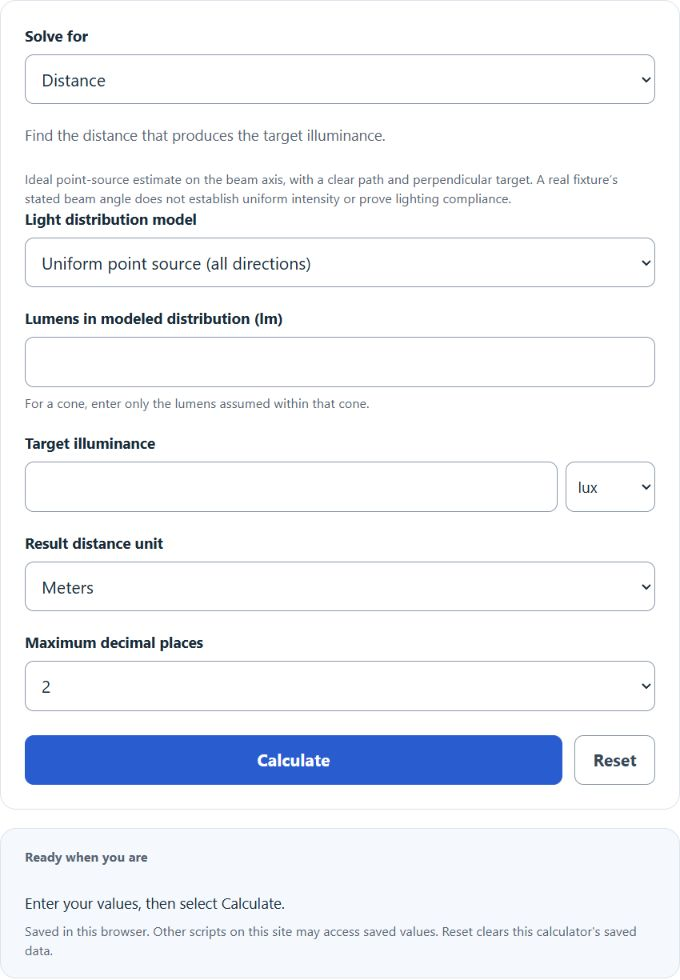
Calculate distance, illuminance, or required lumens with isotropic and beam-angle models, using lux, foot-candles, meters, feet, and inches.
Optical Distance Formula
- D = distance (m)
- Φ = luminous flux (lm)
- E = illuminance (lux = lm/m²)
- Ω = solid angle (sr); isotropic point source: Ω = 4π sr; conical beam: Ω = 2π(1 − cos(θ/2))
The inverse-square law governs this relationship: luminous flux from a point source spreads across a sphere of area 4πD², so illuminance falls proportionally to 1/D². Doubling the distance reduces illuminance to one-quarter; halving it quadruples it.
Ideal Isotropic Examples by Lumen Output
The table below uses hypothetical lumen outputs in the ideal isotropic point-source model (Ω = 4π). Source names are illustrative; these are not verified throw distances for actual products. Directional light requires its angular intensity distribution, and near-field values may be inaccurate.
| Light Source | Lumens | 500 lux | 100 lux | 1 lux |
|---|---|---|---|---|
| Candle | 12 lm | 4 cm | 10 cm | 98 cm |
| LED night light | 80 lm | 11 cm | 25 cm | 2.5 m |
| LED bulb (60W equiv) | 800 lm | 36 cm | 80 cm | 8.0 m |
| LED bulb (100W equiv) | 1,600 lm | 50 cm | 1.1 m | 11.3 m |
| Flashlight (1,000 lm) | 1,000 lm | 40 cm | 89 cm | 8.9 m |
| LED flood (5,000 lm) | 5,000 lm | 89 cm | 2.0 m | 19.9 m |
| High-bay LED | 10,000 lm | 1.3 m | 2.8 m | 28.2 m |
| LED streetlight | 20,000 lm | 1.8 m | 4.0 m | 39.9 m |
| Stadium floodlight | 100,000 lm | 4.0 m | 8.9 m | 89.2 m |
An ideal isotropic 1,000 lm point source predicts 500 lux at about 0.40 m. If all 1,000 lm are instead assumed uniformly distributed in intensity within a 10° cone (Ω ≈ 0.02391 sr), the model predicts about 9.15 m. A manufacturer’s beam angle is ordinarily measured at half maximum intensity; it does not imply that all fixture lumens lie uniformly within that cone. Use measured candela or IES/LDT photometry for real fixtures.
Illustrative Illuminance Inputs (Not Compliance Targets)
| Application | Illustrative input range (lux) | Qualification |
|---|---|---|
| Outdoor footpath (night) | 10–20 | Example only; verify task requirements |
| Residential corridor / stairway | 50–100 | Example only; verify task requirements |
| Living room (ambient) | 100–200 | Example only; verify task requirements |
| Kitchen, general | 200–300 | Example only; verify task requirements |
| Office / classroom | 300–500 | Example only; verify task requirements |
| Workshop / assembly | 500–750 | Example only; verify task requirements |
| Technical drawing / inspection | 750–1,000 | Example only; verify task requirements |
| Surgical / fine inspection | 1,000–2,000 | Example only; verify task requirements |
Worked Examples
Example 1 — Pendant height over a kitchen counter
For a hypothetical 1,600 lm isotropic point source and a selected target of 300 lux, D = SQRT(1600 / (4π × 300)) ≈ 0.65 m. At 1.2 m, the model predicts about 88 lux directly below. Actual pendant performance depends on optics, distribution, losses and surroundings; this calculation does not establish task-lighting compliance.
Example 2 — Streetlight fixture sizing for a parking lot
Using a hypothetical 10 lux target at one point 6 m from an isotropic point source: Φ = 10 × 4π × 6² ≈ 4,524 lm. This is not a universal parking-lot minimum or a fixture-compliance test. Area lighting also requires maintained illuminance, uniformity, glare and applicable project criteria. EN 12464-1 covers indoor workplaces; outdoor workplaces and road lighting have separate standards.