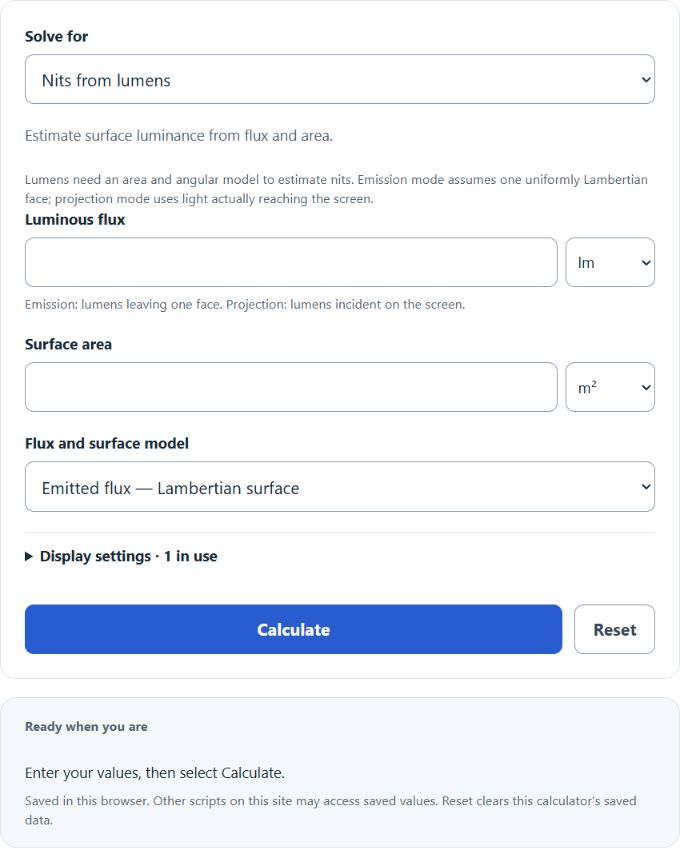
Convert lumens to nits using the emitting or illuminated surface area, estimate lumens required for a target luminance, or convert directly between nits and foot-lamberts.
AssumptionsRead first
- Lumens require a surface area and angular-distribution model to estimate nits. Nits and foot-lamberts convert directly without area.
- Emission mode assumes a uniform Lambertian face, with flux leaving that face into its hemisphere: L = Φemitted / (πA).
- Projection mode instead uses lumens actually incident on the screen and measured gain G for the viewing direction: L ≈ Φincident G / (πA). Blank gain assumes an ideal reference of 1.
- Foot-lamberts and nits are directly convertible: 1 fL = 1 / (π × 0.3048²) cd/m² ≈ 3.4262591 cd/m².
- Real systems can differ because of optical losses, illumination uniformity, reflectance, viewing angle, and non-Lambertian screen behavior.
When to Use
- Estimating luminance from total lumens spread over a known surface area.
- Estimating required lumens for a target luminance and known area.
- Converting directly between nits and foot-lamberts.
Input Definitions
- Flux (Φ): lumens leaving one emitting face, or lumens reaching the projection screen, according to the selected model; 1 klm = 1,000 lm.
- Luminance (L): brightness per projected area and direction, in cd/m² (nits) or fL.
- Area (A): area of the emitting face or projection screen. It is not the area of a uniform-intensity light cone.
- Screen gain (G): projection-only directional luminance relative to a Lambertian reference. It includes screen behavior; it is not a hemispherical reflectance or a separate factor to multiply into emitted flux.
| Lumens (lm) | Nits (cd/m²) | Foot-lamberts (fL) |
|---|---|---|
| 500 | 159.15 | 46.45 |
| 700 | 222.82 | 65.03 |
| 1,000 | 318.31 | 92.90 |
| 1,500 | 477.46 | 139.35 |
| 2,000 | 636.62 | 185.81 |
| 2,500 | 795.77 | 232.26 |
| 3,000 | 954.93 | 278.71 |
| 3,500 | 1,114.08 | 325.16 |
| 4,000 | 1,273.24 | 371.61 |
| 5,000 | 1,591.55 | 464.52 |
| 10,000 | 3,183.10 | 929.03 |
| These values are only for A = 1.00 m² and G = 1.0. Formula: nits = lumens / (π x area in m²). | ||
| Foot-Lamberts (fL) to Nits | Nits to Foot-Lamberts (fL) |
|---|---|
| 10 fL ≈ 34.26 cd/m² | 100 cd/m² ≈ 29.19 fL |
| 14 fL ≈ 47.97 cd/m² | 200 cd/m² ≈ 58.37 fL |
| 16 fL ≈ 54.82 cd/m² | 300 cd/m² ≈ 87.56 fL |
| 30 fL ≈ 102.79 cd/m² | 500 cd/m² ≈ 145.93 fL |
| 50 fL ≈ 171.31 cd/m² | 1,000 cd/m² ≈ 291.86 fL |
| NIST conversion: 1 fL = 3.426259 cd/m² (approximately). | |
- All Unit Converters
- Waves, Optics, and Quantum Unit Converters
- Candlepower to Lumens Calculator
- Lumens Distance Calculator
Nits from Lumens Formula
For a uniform Lambertian emitting face, luminance equals its hemispherical emitted flux divided by pi times face area. For a Lambertian reflector, use reflected outgoing flux; if only incident flux is known, reflectance must also be included.
- Lv is luminance in cd/m² (nits)
- Φv is the luminous flux leaving the emitting face into its hemisphere, in lumens (lm)
- A is the emitting face area in square meters (m²); projection mode uses illuminated screen area
For the separate projection-screen approximation, use actual screen-incident flux: Lv ≈ Φincident G / (πA), or Φincident ≈ LvπA / G. Use gain for the stated projector/viewer geometry; rated projector lumens may differ from flux reaching the screen. The factor 3.426259 converts foot-lamberts to nits, not lumens: 1 fL ≈ 3.426259 cd/m².
What Nits and Lumens Actually Measure
Lumens and nits quantify different physical properties of light. A lumen (lm) is the SI unit of luminous flux, representing the total visible light emitted by a source in all directions. A nit, equivalent to one candela per square meter (cd/m²), measures luminance: the intensity of light emitted from a specific surface area into a specific solid angle. The term “nit” comes from the Latin “nitere” (to shine) and, while not an official SI unit name, is universally used in the display industry.
Because these units describe different quantities, flux-to-luminance calculations require area and an angular-distribution model. A uniform Lambertian face has M = πL and emitted flux Φ = MA, giving L = Φ/(πA). Its luminous intensity follows the cosine law; it is not a uniform-intensity conical source. Incident flux on a reflector additionally requires reflectance or measured directional screen gain. Real systems also depend on optical losses, illumination uniformity and viewing geometry.
Photometric Unit Hierarchy
The four core photometric units form a hierarchy based on how light is measured:
| Quantity | Unit | Symbol | What It Measures |
|---|---|---|---|
| Luminous intensity | Candela | cd | Light power per solid angle from a point source |
| Luminous flux | Lumen | lm | Total visible light output (1 lm = 1 cd x 1 sr) |
| Illuminance | Lux | lx | Light arriving at a surface (1 lx = 1 lm/m²) |
| Luminance | Candela per square meter (nit) | cd/m² | Directional luminous intensity per projected surface area |
Lumens tell you how much total light leaves a source. Nits tell you how bright a surface appears to the eye from a given viewing angle. A 1,000-lumen projector and a 1,000-nit display are not comparable without knowing the projection area and viewing geometry.
Illustrative Device Luminance References
| Device Type | Illustrative values (nits) | Notes |
|---|---|---|
| E-reader (e-ink) | Depends on illumination | Reflective display; luminance depends on ambient and front-light conditions. |
| Budget laptop LCD | 200 to 300 | Legibility also depends on ambient light and screen reflections. |
| Standard desktop monitor | 300 to 400 | Covers most indoor productivity tasks |
| MacBook Pro XDR example | 1,000 sustained / 1,600 peak HDR | Apple specifies different full-screen sustained and peak HDR values; these are not interchangeable. |
| Example smartphones | 2,000 / 2,600 peak | iPhone 16 Pro: 2,000 nits peak outdoor; Galaxy S25 Ultra: rated 2,600 nits. Conditions differ from typical or sustained full-screen luminance. |
| HDR television (LCD) | 600 to 2,000 | Mini-LED backlit sets reach the upper range |
| HDR television (OLED) | 800 to 2,100 | QD-OLED and MLA panels push past 1,500 |
| Professional reference monitor | 1,000 to 4,000 | Used in color grading and broadcast mastering |
| Outdoor digital signage | 2,500 to 7,000 | Must overcome direct sunlight glare |
| Outdoor LED video wall | 5,000 to 10,000+ | Stadium and billboard applications |
VESA DisplayHDR Certification Tiers
VESA DisplayHDR certification includes specified luminance tests plus black level, contrast, color and other requirements. Peak patch luminance differs from sustained full-screen luminance; the table summarizes CTS 1.2 values.
| Tier | Minimum peak patch luminance | Minimum sustained full-screen luminance |
|---|---|---|
| DisplayHDR 400 | 400 nits | 320 nits |
| DisplayHDR 500 | 500 nits | 320 nits |
| DisplayHDR 600 | 600 nits | 350 nits |
| DisplayHDR 1000 | 1,000 nits | 600 nits |
| DisplayHDR 1400 | 1,400 nits | 900 nits |
For OLED and other emissive displays, VESA uses the DisplayHDR True Black standard. Current performance levels include True Black 400, 500, 600, 1000, and 1400; the higher-numbered tiers require higher peak luminance while preserving very low black levels.
Illustrative Viewing Conditions
| Environment | Ambient Light (lux) | Illustrative nits |
|---|---|---|
| Dark room / home theater | less than 50 lux | 100 to 200 |
| Dim office / living room | 50 to 300 lux | 250 to 400 |
| Bright office / retail space | 300 to 750 lux | 400 to 700 |
| Covered outdoor (shade) | 1,000 to 5,000 lux | 700 to 1,500 |
| Direct sunlight | 10,000 to 100,000 lux | 2,500+ |
These ranges are illustrative scenarios, not universal minimum requirements. Readability depends on screen reflectance, ambient illumination, viewing angle, displayed content and display luminance. Peak nit values alone do not establish readable contrast in a particular installation; check the actual screen and conditions.
How to Calculate Nits from Lumens
- Select emission or projection mode. Enter lumens leaving one Lambertian emitting face, or lumens actually incident on the screen after optical losses, respectively.
- Determine the emitting or illuminated surface area in square meters. Lumens alone are not enough to determine luminance.
- For uniform Lambertian emission, calculate Lv = Φemitted / (πA). For projection, use Lv ≈ Φincident G / (πA) with viewing-direction screen gain; blank gain is the ideal-reference assumption G = 1.
- To express the result in foot-lamberts, divide nits by 3.4262591.
Example: Suppose 3,500 lumens actually reach a uniformly illuminated 2.75 m² projection screen, and gain 1.0 is assumed for the viewing direction. The model predicts L ≈ 3,500 / (π × 2.75) ≈ 405.12 nits ≈ 118.24 fL. These are idealized estimates; screen area, gain, incident-flux losses and viewing geometry change the result.