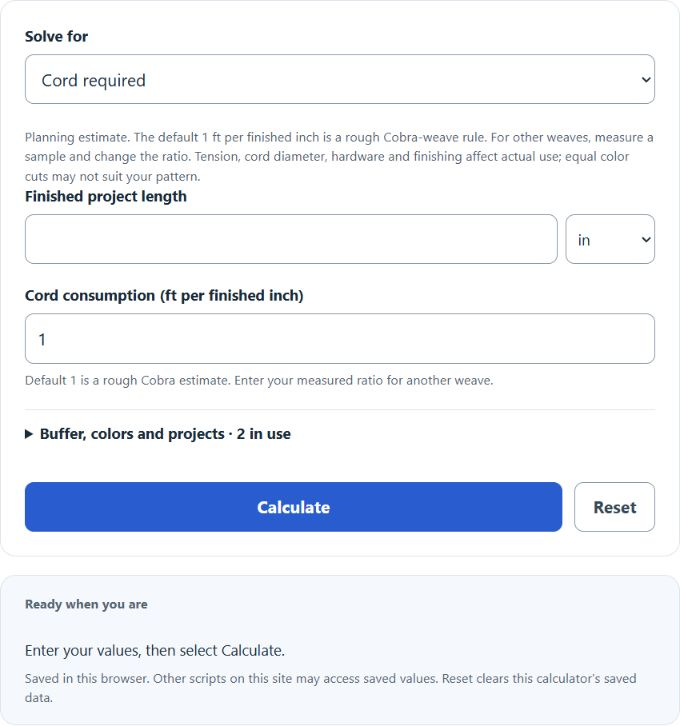
Estimate cord required, maximum finished length, or complete projects from available cord. Set a measured consumption ratio for your weave, then choose an optional buffer, equal color split and project count.
- Every Day Life And Education Calculators
- All Length Calculators
- Bead Calculator
- Jump Rope Length Calculator
- Scarf Length Calculator
- Bow String Length Calculator
- Tie Length Calculator
Paracord Length Formula
The default consumption ratio is a rough Cobra-bracelet estimate: about 1 foot of paracord for every 1 inch of finished length. It is not a universal ratio for every weave. Measure a sample for other patterns and enter its feet-per-finished-inch ratio. The baseline equations and table below use ratio 1, zero buffer and one project.
If both lengths are written in the same unit, the cord length is 12 times the finished bracelet size.
For that same unbuffered ratio 1 estimate, a convenient metric version is:
- Lc = paracord length needed
- Lb = finished bracelet size
- ft = feet, in = inches, m = meters, cm = centimeters
How to Calculate Paracord Length
- Measure the finished bracelet size you want.
- Enter that value into the calculator and choose the correct input unit.
- Select Calculate to read cord in feet with a metric equivalent. Maximum finished length is shown in inches with centimeters as a secondary result.
- Open the optional settings to add a cutting/finishing buffer, choose equal color sections, and set the number of projects. Blank buffer means 0%; the default equal split is 2 sections and the default count is 1 project. Pattern-specific unequal pieces are not modeled.
Example
At ratio 1ft/in, zero buffer and one project, an 8-inch finished length needs an estimated 8 ft of cord. With 10% buffer it needs 8.8 ft; two equal colors would each use 4.4 ft per project.
In inches of cord, that same result is:
Quick Reference Table
| Finished Bracelet Size | Paracord Needed | Paracord Needed | Paracord Needed |
|---|---|---|---|
| (in) | (ft) | (in) | (m) |
| 5 | 5 | 60 | 1.52 |
| 6 | 6 | 72 | 1.83 |
| 7 | 7 | 84 | 2.13 |
| 8 | 8 | 96 | 2.44 |
| 9 | 9 | 108 | 2.74 |
| 10 | 10 | 120 | 3.05 |
| 11 | 11 | 132 | 3.35 |
| 12 | 12 | 144 | 3.66 |
Why Actual Cord Use Can Differ
The calculator gives a planning estimate. Real projects can use more or less cord depending on build details; check a sample and the pattern’s cut instructions before cutting.
- Weave style: tighter or bulkier weaves consume more material.
- Bracelet width: wider designs and extra strands increase cord usage.
- Tension: loose weaving uses less cord than tight weaving.
- Buckles and closures: hardware changes the usable weaving length.
- Finishing allowance: end melts, knots, and trimming require a small reserve.
Helpful Planning Tips
- Measure the bracelet as a finished item, not just the loose wrist circumference.
- If you are using a buckle, account for the buckle length before cutting the cord.
- For a two-color bracelet, split the total cord length between the two colors unless your pattern calls for unequal lengths.
- When uncertain, it is usually better to cut a little extra cord than to run short near the end of the weave.
Reverse Calculation
At ratio 1and zero buffer, available cord feet estimate the finished length in inches with:
So 9 ft corresponds to about 9 finished inches only at ratio 1and zero buffer. In general: buffered feet per project = finished inches × ratio × (1 + buffer/100); maximum inches = available feet ÷ [ratio × (1 + buffer/100)]. Complete projects = floor(available cord ÷ buffered cord per project), with the unused remainder shown. Equal color cuts divide the per-project total; a spool total does not guarantee enough of every individual color.