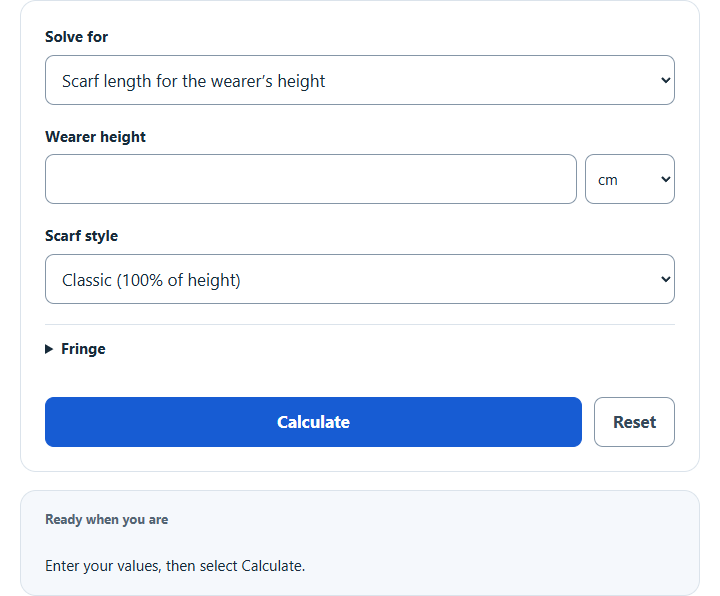
Find how long a scarf should be from the wearer height and style, get a knitted scarf length from rows and gauge, or estimate the yarn you need.
Related Calculators
- Crochet Increase Calculator
- Dress Length Calculator
- Knitting Needle Size Calculator
- Crochet Decrease Calculator
- Grams to Yards Yarn Calculator
- Stitches Per Inch Calculator
- All Everyday Life and Education Calculators
Calculator Functions
| Function | What it does | What it requires |
|---|---|---|
| Scarf length for the wearer’s height | Finds a finished scarf length from the wearer’s height and a wearing style | Requires the wearer’s height and a scarf style; fringe length per end is optional |
| Finished length from rows and gauge | Finds how long a scarf will be after a given number of rows | Requires the number of rows, plus the rows counted in a gauge sample and the length of that sample |
| Yarn needed from a swatch | Finds the yarn weight and the number of skeins for a scarf of a given size | Requires the weight, length and width of a swatch, the scarf length and width, and the yarn per skein |
Lengths can be entered in centimeters or inches, and height and scarf length also in meters or feet. Yarn weights are in grams or ounces. Each length result is shown in both centimeters and inches.
Scarf Length Formulas
| L | Finished scarf length |
| H | Wearer’s height |
| k | Style factor: 0.75 short tuck, 1 classic, 1.2 long wrap |
| F | Fringe length on each end, 0 if left blank |
The classic style follows a long-standing guideline that a scarf should be as long as its wearer is tall. The guideline suits a fairly narrow scarf worn around the neck with the ends hanging, which then fall just below the hips [1]. The short tuck and long wrap factors are this calculator’s own allowances for a shorter or longer style.
Scarf length for the wearer’s height
For a wearer 170 cm tall, a classic scarf is 170 × 1 = 170 cm, or 66.9 in. A long wrap with a 10 cm fringe on each end is 170 × 1.2 + 2 × 10 = 224 cm. The result adds a planning range of 10% either side, 153 to 187 cm for the classic example, to allow for fiber, stitch and wrapping preference.
Finished length from rows and gauge
R is the number of rows in the scarf, and the gauge is N rows counted over a sample length G. At 24 rows per 10 cm, 240 rows make 240 × 10 ÷ 24 = 100 cm. At 2 rows per inch, 120 rows make 60 in. The result also gives the length of one row, the rows per 10 cm and per inch, and the rows needed for a 180 cm scarf.
Yarn needed from a swatch
Aswatch) × 1.1
m is the weight of the swatch, and each area is length × width. A 10 cm × 10 cm swatch weighing 5 g scales to a 180 cm × 20 cm scarf as 5 × 3,600 ÷ 100 = 180 g, and the 10% allowance brings it to 198 g. The number of skeins is that weight divided by the yarn per skein, rounded up: 2 skeins of 100 g.
Limits of This Estimate
- The height guideline is a starting point, not a standard. Width, drape and the way the scarf is worn all change the length that looks right. These estimates are based on the best available data and estimations.
- Row gauge changes with washing and blocking, so measure the gauge sample after it has been washed. A 5% change in row gauge changes the length by about 5%.
- The yarn estimate assumes the scarf is worked in the same yarn and stitch as the swatch. Fringe, cables and heavier texture use more yarn than the 10% allowance covers.
Sources
- Handwoven magazine, Ask Madelyn: Dimensions of a Scarf: the guideline that a scarf is as long as its wearer is tall, and the kind of scarf it suits