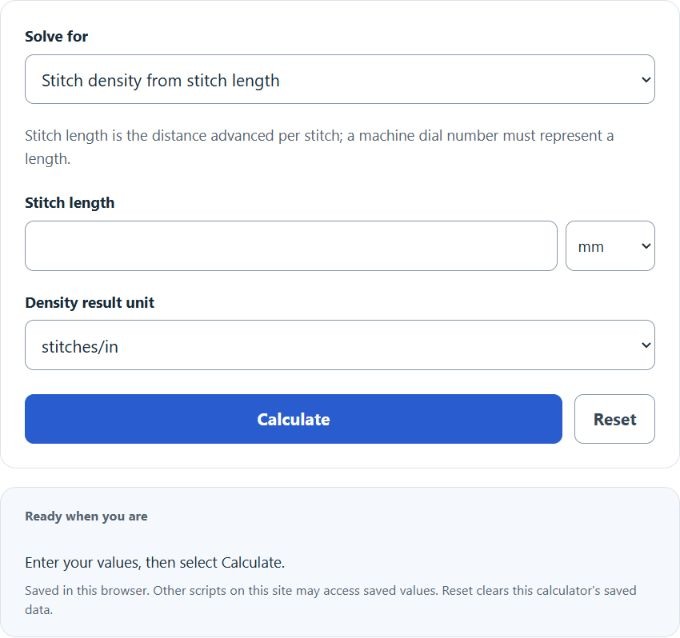
Calculate stitches per inch from total metric setting, or find the metric setting in mm, cm, m, in, or ft, and stitches per cm.
- Every Day Life And Education Calculators
- Knots Per Square Inch Calculator
- GSM (Grams Per Square Meter) Calculator
- Basis Weight Calculator
- Fabric Weight Calculator
Stitches Per Inch Formula
Stitches per inch, commonly abbreviated as SPI, describes how many stitches fit into one inch of sewn length. In most sewing applications, SPI is the inverse of stitch length: shorter stitches create a higher SPI, while longer stitches create a lower SPI.
Where:
- SPI = stitches per inch
- MS = machine stitch length or metric setting in millimeters per stitch
If you want the equivalent value in stitches per centimeter, use:
And to convert between the two stitch-density units:
Why Stitches Per Inch Matters
SPI is one of the fastest ways to describe seam appearance, seam durability, and overall stitch density. It is useful when comparing sewing machine settings, matching an existing seam, documenting production standards, or checking whether fabric is being over-stitched or under-stitched.
- Higher SPI usually means a shorter stitch length, a denser seam, and a finer appearance.
- Lower SPI usually means a longer stitch length, faster sewing, and less thread concentration.
- Balanced SPI depends on fabric weight, seam purpose, thread size, and whether the seam is decorative or structural.
How to Use the Calculator
- Choose whether to find stitch density or stitch length, then enter the known value and select its unit.
- Calculate the corresponding stitches per inch.
- Select the desired result unit: stitches per inch or centimeter, or a supported length unit.
- Use the result to compare machine settings, replicate a seam, or evaluate stitch density.
The key relationship is straightforward: one inch contains 25.4 millimeters, so dividing 25.4 by the stitch length in millimeters gives the number of stitches that fit into one inch.
Interpretation Guide
| SPI Range | Typical Interpretation |
|---|---|
| 4 to 6 | Very long stitches; often used for basting, temporary seams, or heavy materials |
| 7 to 9 | Common for medium to heavier fabrics and utility seams |
| 10 to 12 | Common general-purpose range for many garment seams |
| 13 to 16 | Shorter, denser stitches often used for finer fabrics or detail work |
| Above 16 | Very fine stitch density; may be used for topstitch detail or specialized sewing |
Common Metric Stitch Lengths and Their SPI
| Stitch Length | Approximate SPI | Typical Use |
|---|---|---|
| 2.0 mm | 12.7 | Fine seams, lighter fabrics, detail stitching |
| 2.5 mm | 10.16 | Standard all-purpose sewing |
| 3.0 mm | 8.47 | Medium fabrics and general construction |
| 3.5 mm | 7.26 | Heavier fabrics or more visible stitch spacing |
| 4.0 mm | 6.35 | Heavy seams, topstitching, or temporary joining |
| 5.0 mm | 5.08 | Basting and very long stitch applications |
Example Calculation
If the machine stitch length is 3 millimeters per stitch, the stitches per inch are:
If the stitch length is 2.5 millimeters, then:
This shows the inverse relationship clearly: reducing stitch length increases stitch density.
Practical Sewing Notes
- Lightweight fabrics often benefit from shorter stitches to keep seams neat and controlled.
- Heavy fabrics often use longer stitches so the seam does not become too dense or stiff.
- Topstitching frequently uses a lower SPI for a more visible, decorative look.
- Basting uses very low SPI because the stitches are intended to be removed easily.
- Very high SPI can weaken some materials by placing too many needle penetrations close together.
Formula Rearrangement
If you already know the desired stitches per inch and want the required metric stitch length, rearrange the formula as follows:
This is useful when a sewing specification is written in SPI, but your machine is adjusted in millimeters.
Frequently Asked Questions
Is a higher SPI always better?
No. Higher SPI creates a denser seam, but the best setting depends on the fabric, seam purpose, thread, and visual finish required.
What does the metric setting represent?
It represents stitch length in millimeters per stitch. A larger millimeter setting means each stitch is longer, so fewer stitches fit into one inch.
Can this calculator be used for stitches per centimeter?
Yes. You can calculate stitches per inch first and then convert, or use the stitches-per-centimeter relationship directly.
Why do sewing machines show millimeters instead of SPI?
Many machines use metric stitch length because it directly controls the linear distance traveled per stitch. SPI is then derived from that setting.