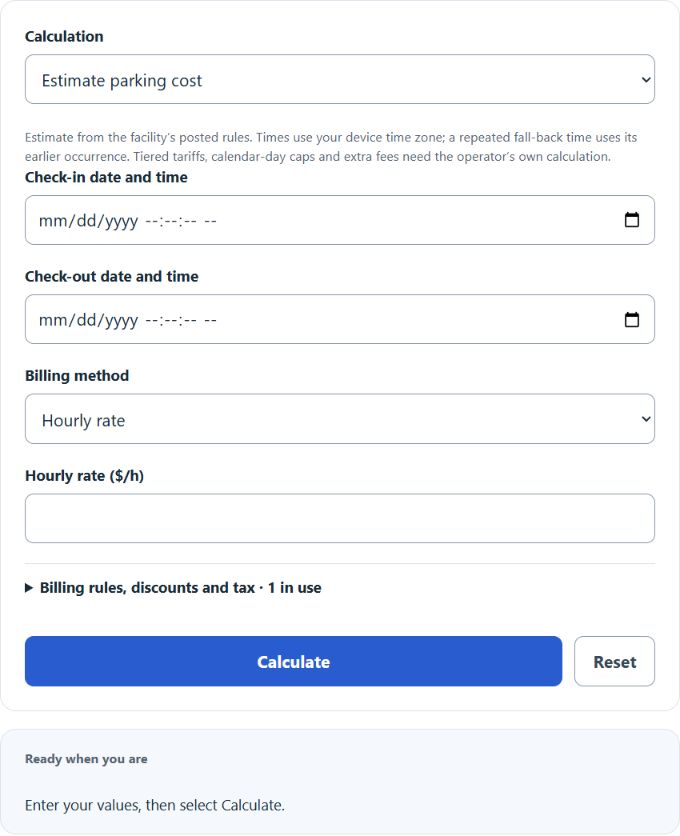
Enter the number of hours parked and the hourly rate into the calculator to determine the total cost of parking. This calculator helps you estimate parking expenses over a given duration.
Parking Rate Formula
The base formula for calculating total parking cost is:
TC = HP \times RPH
Where TC is total cost ($), HP is hours parked, and RPH is the rate per hour ($). Most garages round fractional hours up to the next full hour or half-hour increment, so 2 hours and 5 minutes typically bills as 2.5 or 3 hours depending on the facility.
When a daily maximum cap applies, the adjusted formula becomes:
TC = \min(HP \times RPH,\; D_{max} \times \lceil HP / 24 \rceil)Where D_max is the daily maximum rate and the ceiling function accounts for each 24-hour period. This protects long-stay parkers from accumulating charges that exceed the posted daily rate.
Parking Rates by U.S. City
Parking costs vary enormously across the United States. The table below shows representative rates for major metro areas, reflecting the combined effect of land values, density, transit availability, and local regulation.
| City | Median Hourly Rate | Typical Daily Rate | Avg. Monthly Lease |
|---|---|---|---|
| New York (Manhattan) | $20 to $30 | $40 to $80 | $450 to $700+ |
| San Francisco | $8 to $15 | $25 to $50 | $300 to $500 |
| Boston | $8 to $14 | $25 to $45 | $275 to $450 |
| Chicago | $6 to $12 | $19 to $35 | $143 to $350 |
| Los Angeles | $5 to $12 | $15 to $40 | $150 to $350 |
| Seattle | $5 to $10 | $15 to $30 | $175 to $350 |
| Miami | $4 to $10 | $15 to $30 | $125 to $275 |
| Denver | $3 to $8 | $10 to $25 | $100 to $225 |
| Houston | $3 to $7 | $8 to $20 | $80 to $175 |
| Phoenix | $2 to $5 | $6 to $15 | $60 to $130 |
Cities with higher population density and constrained land supply command the steepest rates. Manhattan hourly rates can exceed 10x those in Sun Belt cities with abundant surface parking.
Airport Parking Rates
Airport parking represents one of the largest single parking expenses most travelers face. Rates depend on proximity to the terminal, with on-site garage parking costing 3 to 5 times more than remote economy lots.
| Airport | Terminal/Garage (per day) | Economy Lot (per day) | 7-Day Trip Total (Economy) |
|---|---|---|---|
| JFK (New York) | $39 to $60 | $18 to $20 | $126 to $140 |
| LAX (Los Angeles) | $40 to $60 | $12 to $20 | $84 to $140 |
| SFO (San Francisco) | $36 to $42 | $18 to $22 | $126 to $154 |
| ORD (Chicago) | $35 to $55 | $10 to $15 | $70 to $105 |
| ATL (Atlanta) | $17 to $36 | $9 to $14 | $63 to $98 |
| DFW (Dallas) | $24 to $30 | $8 to $10 | $56 to $70 |
| DEN (Denver) | $26 to $28 | $7 to $11 | $49 to $77 |
| DSM (Des Moines) | $10 to $13 | $4 to $6 | $28 to $42 |
Pre-booking online can reduce airport parking costs by 30% to 50% compared to drive-up prices. Off-airport lots with shuttle service typically cost 40% to 60% less than on-site garages.
Parking Pricing Models
Parking facilities use several distinct pricing structures, each designed around different usage patterns and revenue goals.
Flat Hourly Rate is the simplest model: a fixed dollar amount per hour (or fraction thereof), applied uniformly regardless of duration. Most meters and many garages use this structure. Typical range is $1 to $8 per hour outside major urban cores.
Progressive (Escalating) Pricing charges more per hour as duration increases. A common structure is $1.00 for the first hour, $1.50 for the second, $2.00 for the third, and so on. This model favors short-term visitors and discourages all-day commuter parking in retail or downtown areas.
Regressive (Declining) Pricing works the opposite way: the first hour costs the most (often $5 to $8), with subsequent hours costing less ($2 to $3 each). This front-loads revenue from short visits while making extended stays more affordable.
Daily Maximum (Cap) sets a ceiling on what any single 24-hour period can cost. If the hourly rate is $4/hr and the daily max is $25, a parker who stays 8 hours pays $25 instead of $32. Most major garages in urban areas use this model.
Monthly Lease pricing provides a reserved or guaranteed space for a flat monthly fee, typically ranging from $60 in low-demand markets to over $700 in Manhattan. The industry benchmark ratio is that monthly rates are set at roughly 20x the daily rate.
Dynamic (Demand-Based) Pricing adjusts rates in real time based on occupancy. San Francisco pioneered this approach citywide with its SFpark program: when a block exceeds 80% occupancy, hourly rates increase by $0.25; when below 60%, rates decrease. Operators using dynamic pricing have reported 30% to 40% revenue increases without reducing driver satisfaction.
The Economics Behind Parking Rates
Parking rates are not arbitrary. They are driven by real infrastructure costs that vary dramatically by facility type.
| Facility Type | Cost per Space (Construction) | Cost per Sq Ft | Annual Operating Cost per Space |
|---|---|---|---|
| Surface Lot (asphalt) | $1,500 to $5,500 | $3 to $7 | $150 to $300 |
| Above-Ground Garage | $25,000 to $35,000 | $55 to $100 | $400 to $600 |
| Underground Garage | $27,500 to $55,000 | $80 to $150+ | $500 to $800 |
A structured garage costs roughly 5x to 10x more per space to build than a surface lot. This explains why garage hourly rates are typically 2x to 4x higher than surface lot rates in the same area. Underground parking, common in dense urban cores, is the most expensive to construct and therefore commands the highest rates.
The total annualized cost of all parking in the United States (land, construction, maintenance, and operation) exceeds $1 trillion, supporting roughly 2 billion parking spaces. That works out to approximately $5,000 per registered vehicle per year in parking infrastructure costs alone. On average, there are about 8 parking spaces for every car on the road in the U.S.
Industry Rate Ratio Benchmarks
Parking operators use standard multiplier ratios when setting rates across different time horizons.
| Rate Relationship | Industry Benchmark | Example |
|---|---|---|
| Daily rate to hourly rate | 6x or higher | $4/hr leads to $24+ daily |
| Monthly rate to daily rate | 20x or higher | $20/day leads to $400+ monthly |
| Monthly rate to hourly rate | 120x or higher | $3/hr leads to $360+ monthly |
| Event rate to daily rate | 1.5x to 3x | $20 daily leads to $30 to $60 event |
Operators who price daily rates below 6x the hourly rate lose revenue from short-term parkers who would otherwise pay more. Setting monthly rates too close to the daily rate discourages the steady occupancy that monthly parkers provide.
Hidden Costs and Surcharges
The posted hourly rate is rarely the full picture. Parking taxes range from 6% to over 25% depending on the city; Chicago imposes a combined parking tax that can reach 27% on commercial garages. Many facilities add a technology or transaction fee of $1 to $3 for credit card or app-based payments. Lost ticket fees typically range from $25 to $75. Validation programs at retail locations can offset 1 to 4 hours of charges but often require a minimum purchase amount.
U.S. drivers spend an average of 17 hours per year searching for parking. In New York City, that figure rises to 107 hours annually. Roughly 30% of urban traffic congestion is caused by vehicles circling for open spaces, costing American drivers an estimated $73 billion per year in wasted time and fuel.

Enter the number of hours parked and the hourly rate into the calculator to determine the total cost of parking. This calculator helps you estimate parking expenses over a given duration.
Parking Rate Formula
The base formula for calculating total parking cost is:
TC = HP \times RPH
Where TC is total cost ($), HP is hours parked, and RPH is the rate per hour ($). Most garages round fractional hours up to the next full hour or half-hour increment, so 2 hours and 5 minutes typically bills as 2.5 or 3 hours depending on the facility.
When a daily maximum cap applies, the adjusted formula becomes:
TC = \min(HP \times RPH,\; D_{max} \times \lceil HP / 24 \rceil)Where D_max is the daily maximum rate and the ceiling function accounts for each 24-hour period. This protects long-stay parkers from accumulating charges that exceed the posted daily rate.
Parking Rates by U.S. City
Parking costs vary enormously across the United States. The table below shows representative rates for major metro areas, reflecting the combined effect of land values, density, transit availability, and local regulation.
| City | Median Hourly Rate | Typical Daily Rate | Avg. Monthly Lease |
|---|---|---|---|
| New York (Manhattan) | $20 to $30 | $40 to $80 | $450 to $700+ |
| San Francisco | $8 to $15 | $25 to $50 | $300 to $500 |
| Boston | $8 to $14 | $25 to $45 | $275 to $450 |
| Chicago | $6 to $12 | $19 to $35 | $143 to $350 |
| Los Angeles | $5 to $12 | $15 to $40 | $150 to $350 |
| Seattle | $5 to $10 | $15 to $30 | $175 to $350 |
| Miami | $4 to $10 | $15 to $30 | $125 to $275 |
| Denver | $3 to $8 | $10 to $25 | $100 to $225 |
| Houston | $3 to $7 | $8 to $20 | $80 to $175 |
| Phoenix | $2 to $5 | $6 to $15 | $60 to $130 |
Cities with higher population density and constrained land supply command the steepest rates. Manhattan hourly rates can exceed 10x those in Sun Belt cities with abundant surface parking.
Airport Parking Rates
Airport parking represents one of the largest single parking expenses most travelers face. Rates depend on proximity to the terminal, with on-site garage parking costing 3 to 5 times more than remote economy lots.
| Airport | Terminal/Garage (per day) | Economy Lot (per day) | 7-Day Trip Total (Economy) |
|---|---|---|---|
| JFK (New York) | $39 to $60 | $18 to $20 | $126 to $140 |
| LAX (Los Angeles) | $40 to $60 | $12 to $20 | $84 to $140 |
| SFO (San Francisco) | $36 to $42 | $18 to $22 | $126 to $154 |
| ORD (Chicago) | $35 to $55 | $10 to $15 | $70 to $105 |
| ATL (Atlanta) | $17 to $36 | $9 to $14 | $63 to $98 |
| DFW (Dallas) | $24 to $30 | $8 to $10 | $56 to $70 |
| DEN (Denver) | $26 to $28 | $7 to $11 | $49 to $77 |
| DSM (Des Moines) | $10 to $13 | $4 to $6 | $28 to $42 |
Pre-booking online can reduce airport parking costs by 30% to 50% compared to drive-up prices. Off-airport lots with shuttle service typically cost 40% to 60% less than on-site garages.
Parking Pricing Models
Parking facilities use several distinct pricing structures, each designed around different usage patterns and revenue goals.
Flat Hourly Rate is the simplest model: a fixed dollar amount per hour (or fraction thereof), applied uniformly regardless of duration. Most meters and many garages use this structure. Typical range is $1 to $8 per hour outside major urban cores.
Progressive (Escalating) Pricing charges more per hour as duration increases. A common structure is $1.00 for the first hour, $1.50 for the second, $2.00 for the third, and so on. This model favors short-term visitors and discourages all-day commuter parking in retail or downtown areas.
Regressive (Declining) Pricing works the opposite way: the first hour costs the most (often $5 to $8), with subsequent hours costing less ($2 to $3 each). This front-loads revenue from short visits while making extended stays more affordable.
Daily Maximum (Cap) sets a ceiling on what any single 24-hour period can cost. If the hourly rate is $4/hr and the daily max is $25, a parker who stays 8 hours pays $25 instead of $32. Most major garages in urban areas use this model.
Monthly Lease pricing provides a reserved or guaranteed space for a flat monthly fee, typically ranging from $60 in low-demand markets to over $700 in Manhattan. The industry benchmark ratio is that monthly rates are set at roughly 20x the daily rate.
Dynamic (Demand-Based) Pricing adjusts rates in real time based on occupancy. San Francisco pioneered this approach citywide with its SFpark program: when a block exceeds 80% occupancy, hourly rates increase by $0.25; when below 60%, rates decrease. Operators using dynamic pricing have reported 30% to 40% revenue increases without reducing driver satisfaction.
The Economics Behind Parking Rates
Parking rates are not arbitrary. They are driven by real infrastructure costs that vary dramatically by facility type.
| Facility Type | Cost per Space (Construction) | Cost per Sq Ft | Annual Operating Cost per Space |
|---|---|---|---|
| Surface Lot (asphalt) | $1,500 to $5,500 | $3 to $7 | $150 to $300 |
| Above-Ground Garage | $25,000 to $35,000 | $55 to $100 | $400 to $600 |
| Underground Garage | $27,500 to $55,000 | $80 to $150+ | $500 to $800 |
A structured garage costs roughly 5x to 10x more per space to build than a surface lot. This explains why garage hourly rates are typically 2x to 4x higher than surface lot rates in the same area. Underground parking, common in dense urban cores, is the most expensive to construct and therefore commands the highest rates.
The total annualized cost of all parking in the United States (land, construction, maintenance, and operation) exceeds $1 trillion, supporting roughly 2 billion parking spaces. That works out to approximately $5,000 per registered vehicle per year in parking infrastructure costs alone. On average, there are about 8 parking spaces for every car on the road in the U.S.
Industry Rate Ratio Benchmarks
Parking operators use standard multiplier ratios when setting rates across different time horizons.
| Rate Relationship | Industry Benchmark | Example |
|---|---|---|
| Daily rate to hourly rate | 6x or higher | $4/hr leads to $24+ daily |
| Monthly rate to daily rate | 20x or higher | $20/day leads to $400+ monthly |
| Monthly rate to hourly rate | 120x or higher | $3/hr leads to $360+ monthly |
| Event rate to daily rate | 1.5x to 3x | $20 daily leads to $30 to $60 event |
Operators who price daily rates below 6x the hourly rate lose revenue from short-term parkers who would otherwise pay more. Setting monthly rates too close to the daily rate discourages the steady occupancy that monthly parkers provide.
Hidden Costs and Surcharges
The posted hourly rate is rarely the full picture. Parking taxes range from 6% to over 25% depending on the city; Chicago imposes a combined parking tax that can reach 27% on commercial garages. Many facilities add a technology or transaction fee of $1 to $3 for credit card or app-based payments. Lost ticket fees typically range from $25 to $75. Validation programs at retail locations can offset 1 to 4 hours of charges but often require a minimum purchase amount.
U.S. drivers spend an average of 17 hours per year searching for parking. In New York City, that figure rises to 107 hours annually. Roughly 30% of urban traffic congestion is caused by vehicles circling for open spaces, costing American drivers an estimated $73 billion per year in wasted time and fuel.