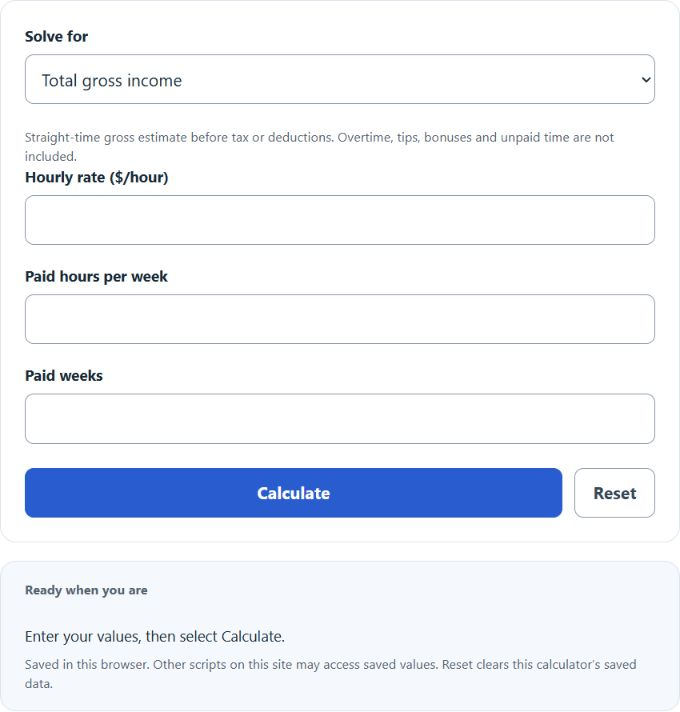
Choose total gross income, hourly rate, paid hours per week, or paid weeks, then enter the three known values. The estimate excludes tax, deductions, overtime premiums, tips and bonuses.
Part-Time Income Formula
The following equation is used to calculate the Part-Time Income.
- Where PTI is the estimated straight-time gross income ($), before tax and deductions
- R is the hourly rate ($/hour)
- WH is the number of weekly hours (hours/week)
- T is the total number of weeks (weeks)
To calculate the part-time income, multiply the hourly rate by the weekly hours, then by the number of weeks worked.
What is a Part-Time Income?
Definition:
Part-time income is earnings from a reduced-hours work schedule. The U.S. Fair Labor Standards Act does not define full-time or part-time employment; employer policies and other applicable rules may use different definitions.
How to Calculate Part-Time Income?
Example Problem:
The following example outlines the steps and information needed to calculate the Part-Time Income.
First, determine the hourly rate. In this example, the rate is $15/hour.
Next, determine the weekly hours worked. Here, we assume the individual works 20 hours per week.
Then, determine the total number of weeks worked. In this case, the individual plans to work 4 weeks.
Finally, calculate the part-time income using the formula above:
PTI = R * WH * T
PTI = $15 * 20 * 4
PTI = $1,200
FAQ
What factors can affect the total part-time income?
The total part-time income is primarily influenced by the hourly wage, the number of hours worked per week, and the duration of employment. Additional factors such as overtime premiums, tips and bonuses/commissions can affect actual earnings but are not included in this constant-rate calculator.
How can I increase my part-time income?
To increase your part-time income, you can negotiate a higher hourly rate, take on more weekly hours (if feasible), or look for additional part-time opportunities. Gaining specialized skills and experience can also help you qualify for higher-paying positions.
Is part-time work suitable for supporting long-term financial goals?
Part-time work can supplement income and help meet certain financial objectives, but it may not always be sufficient for extensive long-term goals. Many individuals use part-time jobs to balance other obligations such as school, family care, or to manage multiple streams of income alongside full-time employment or other ventures.