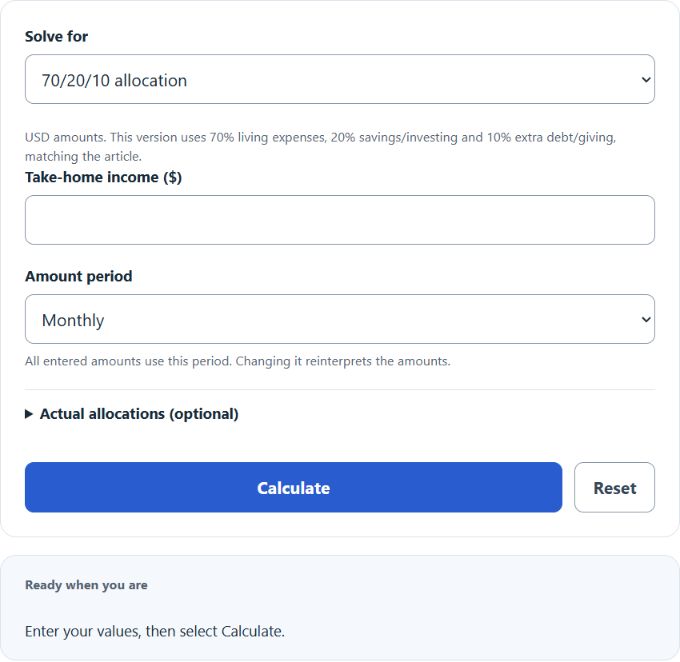
Split take-home income into 70% living expenses, 20% savings/investing and 10% extra debt/giving, or find income from a 20% savings target and compare actual allocations.
70/20/10 Budget Rule Definition
The 70/20/10 rule is a percentage-based budgeting framework that divides after-tax (net) income into three fixed buckets: 70% for living expenses, 20% for savings and investments, and 10% for debt repayment or charitable giving. It applies to take-home pay only, meaning federal and state income taxes, FICA payroll taxes, and any pre-tax deductions like health insurance premiums or 401(k) contributions have already been subtracted from gross income before the split is calculated.
The rule has no single credited inventor. It evolved as a simplified alternative to the more widely known 50/30/20 framework (popularized by Senator Elizabeth Warren in “All Your Worth,” 2005), adapted for households where fixed costs consume a larger share of income. The 70% living expense allocation reflects the reality that for many Americans, housing and transportation alone account for roughly 50% of total household spending according to Bureau of Labor Statistics Consumer Expenditure data.
What Each Bucket Covers
70% Living Expenses. This is the broadest category and includes all recurring and variable costs required to maintain your household. Specifically: rent or mortgage payments, property taxes, homeowners or renters insurance, utilities (electric, gas, water, internet, phone), groceries, transportation (car payment, fuel, insurance, public transit), minimum debt payments on credit cards and loans, childcare, medical co-pays, clothing, subscriptions, haircuts, pet care, and periodic costs like travel or gifts averaged across the year. IRA contributions made from take-home pay belong in the savings/investing bucket; avoid counting the same contribution twice.
20% Savings and Investments. This portion goes toward building wealth and financial resilience. Examples include emergency savings, savings accounts, investments and retirement contributions made from take-home pay. The emergency-fund amount you need depends on your situation, as the Consumer Financial Protection Bureau explains. For this calculator, additional debt principal payments belong in the 10% extra debt/giving bucket.
10% Debt Repayment and Giving. If you carry high-interest consumer debt (credit cards, personal loans), this 10% goes toward payments above the required minimums, which are already accounted for in the 70% bucket. For households that are debt-free, this allocation shifts to charitable contributions, tithing, or community donations. Some people split it, for example directing 5% to extra debt payments and 5% to giving.
70/20/10 Breakdown by Income Level
The table below shows how the 70/20/10 split maps to dollar amounts across common monthly after-tax income levels. The U.S. median household after-tax income was approximately $72,330 per year ($6,028/month) in 2024 Census data. This survey measure is not necessarily the amount deposited into a household’s bank account; the $6,028 row is a rounded illustrative income.
| Monthly After-Tax Income | 70% Living Expenses | 20% Savings/Investing | 10% Debt/Giving |
|---|---|---|---|
| $3,000 | $2,100 | $600 | $300 |
| $4,000 | $2,800 | $800 | $400 |
| $5,000 | $3,500 | $1,000 | $500 |
| $6,028 (U.S. median) | $4,219.60 | $1,205.60 | $602.80 |
| $7,000 | $4,900 | $1,400 | $700 |
| $8,000 | $5,600 | $1,600 | $800 |
| $10,000 | $7,000 | $2,000 | $1,000 |
How Americans Actually Spend vs. the 70/20/10 Target
BLS 2024 Consumer Expenditure Survey data reports average annual expenditures of $78,535 per consumer unit (about $6,545/month). Consumer units and income-survey households are different measures; these figures describe national spending, not a recommended personal budget.
Housing, transportation and food account for 33.4%, 17.0% and 12.9% of total expenditures in those data. These are shares of spending, not shares of take-home income. BLS categories also do not map exactly to this rule’s buckets, so adding them cannot establish how much a household spends on necessities relative to its income.
National averages do not show whether this split is achievable for a particular household. Compare your actual allocations with the displayed targets, then consider costs, debt obligations and savings goals when deciding whether the percentages fit.
70/20/10 vs. 50/30/20 vs. 60/20/20
Multiple percentage-based budgets exist because no single split fits all income levels and cost-of-living situations. The key differences are in how much room they leave for essentials and how they categorize discretionary spending.
| Rule | Essentials/Needs | Savings/Investing | Wants/Debt/Other | Best Suited For |
|---|---|---|---|---|
| 50/30/20 | 50% | 20% | 30% (wants) | Lower cost-of-living areas; budgeters who want a clear needs vs. wants distinction |
| 70/20/10 | 70% | 20% | 10% (debt/giving) | High cost-of-living areas; households where fixed costs are large; those carrying debt |
| 60/20/20 | 60% | 20% | 20% (flexible) | Middle ground; households with moderate expenses who want higher flexibility |
The rules group expenses differently as well as allocating different percentages. In this article’s 70/20/10 version, discretionary living costs are included in the 70% living-expense bucket, savings/investing receives 20%, and extra debt repayment or giving receives 10%. Use consistent definitions when comparing them.
When the 70/20/10 Rule Works and When It Doesn’t
The rule works well for people who want a simple, low-maintenance framework that groups expenses into three broad categories. You still need to track actual amounts to compare them with the targets. It is especially effective for salaried workers with predictable paychecks, households in high-rent cities where 50% for needs is unrealistic, people who are new to budgeting and want a single clear constraint (keep total spending under 70%), and dual-income households managing shared expenses.
The rule does not work well in several situations. If your fixed expenses already exceed 70% of take-home pay, the framework is not useful as a budgeting tool without first restructuring costs (downsizing housing, refinancing debt, reducing transportation expenses). The amount needed to reduce debt depends on its balance, interest rate and repayment terms. A fixed 10% allocation alone cannot show whether payments cover interest or meet required payments. And if your income is highly variable (freelancers, gig workers, commission-based roles), a percentage-based system can produce wildly different dollar amounts month to month, making it harder to automate.
Adapting the Percentages
The 70/20/10 split is a starting template, not a rigid rule. Common modifications include shifting to 70/25/5 for debt-free households that want to accelerate wealth building, moving to 75/15/10 during periods of high fixed costs (new mortgage, childcare years) with a plan to return to 70/20/10 once those costs drop, and using 60/30/10 for higher earners who can comfortably live on 60% while maximizing savings. The calculator above uses a fixed 70/20/10 split. Different percentages require a separate calculation.
70/20/10 Formula
The formulas for each allocation are:
Living Expenses = Net Monthly Income x 0.70
Savings and Investments = Net Monthly Income x 0.20
Debt Repayment or Giving = Net Monthly Income x 0.10
Where Net Monthly Income is your total take-home pay after all taxes and mandatory payroll deductions. If you know one allocation amount instead of total income, divide that amount by its decimal fraction (for example, if you know your savings target is $1,200, your implied income is $1,200 / 0.20 = $6,000).