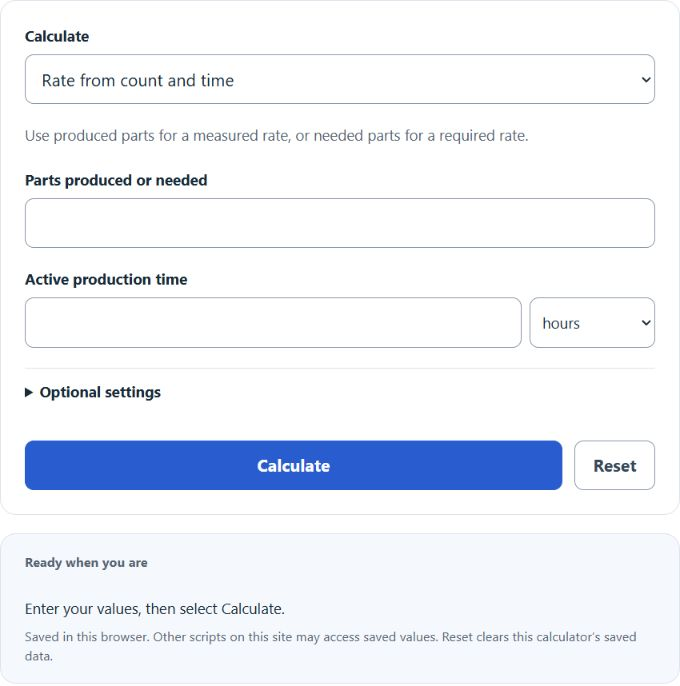
Calculate parts per hour from output and run time or cycle time, then estimate required production time, projected output, and equivalent rates.
Parts Per Hour Formula
The calculator uses one core formula and converts between time units as needed.
- PPH = parts produced per hour
- Parts = total parts produced or required (count)
- Hours = production time expressed in hours
For one part per cycle, convert a cycle time in seconds with the formula below. For multiple parts per cycle, multiply its result by the entered parts per cycle.
Time inputs in minutes, seconds, or days are converted to hours before dividing. The calculator uses active production time, so it does not subtract breaks, changeovers, or downtime unless you exclude that time from the input.
Calculator modes:
- Rate from count and time: divides produced parts by run time for a measured rate, or needed parts by available time for a required rate.
- Rate from cycle time: uses cycle time and parts per cycle to calculate the hourly rate.
- Time from target and rate: divides target parts by the production rate to estimate active time.
- Output from rate and time: multiplies the rate by active time to estimate output and whole completed parts.
- Convert production rate: restates a known rate as parts per hour, minute, second, and 24-hour day.
Reference Tables
Use these as quick lookups when you only have a cycle time or only have an hourly target.
| Cycle Time | Parts/Hour | Parts/Day (24h) |
|---|---|---|
| 1 sec | 3,600 | 86,400 |
| 5 sec | 720 | 17,280 |
| 15 sec | 240 | 5,760 |
| 30 sec | 120 | 2,880 |
| 45 sec | 80 | 1,920 |
| 1 min | 60 | 1,440 |
| 2 min | 30 | 720 |
| 5 min | 12 | 288 |
| 10 min | 6 | 144 |
| Daily Target (8h shift) | Required PPH | Cycle Time/Part |
|---|---|---|
| 100 | 12.5 | 288 sec |
| 500 | 62.5 | 57.6 sec |
| 1,000 | 125 | 28.8 sec |
| 2,500 | 312.5 | 11.5 sec |
| 5,000 | 625 | 5.76 sec |
| 10,000 | 1,250 | 2.88 sec |
Examples and FAQ
Example 1 — Run output. A line produces 1,250 parts in an 8-hour shift. PPH = 1250 / 8 = 156.25 parts/hour. That is one part every 23.04 seconds.
Example 2 — Required rate. You need 5,000 parts in 2 hours. Required PPH = 5000 / 2 = 2,500 parts/hour, which is a cycle time of 1.44 seconds per part.
Example 3 — Cycle time conversion. A press produces one part in each 45-second cycle. PPH = 3600 / 45 = 80 parts/hour, or 1,920 parts in a 24-hour run.
Should I use gross or net time? The calculator divides by whatever time you enter. Use net running time if you want the true machine rate. Use gross shift time if you want a planning rate that already accounts for breaks and downtime.
How does this relate to takt time? Takt time is available time divided by customer demand. The Rate from count and time mode gives you the inverse expressed as parts per hour when you enter customer demand and available time. If the actual run rate is below the required rate, the line will not meet demand without overtime or added capacity.
What about scrap? The formula counts whatever you enter. If you want a good-parts-per-hour figure, enter only accepted parts. If you want gross throughput, enter total parts produced including rejects.
How do I convert PPH to seconds per part? Divide 3600 by PPH. A rate of 240 parts/hour equals 15 seconds per part.