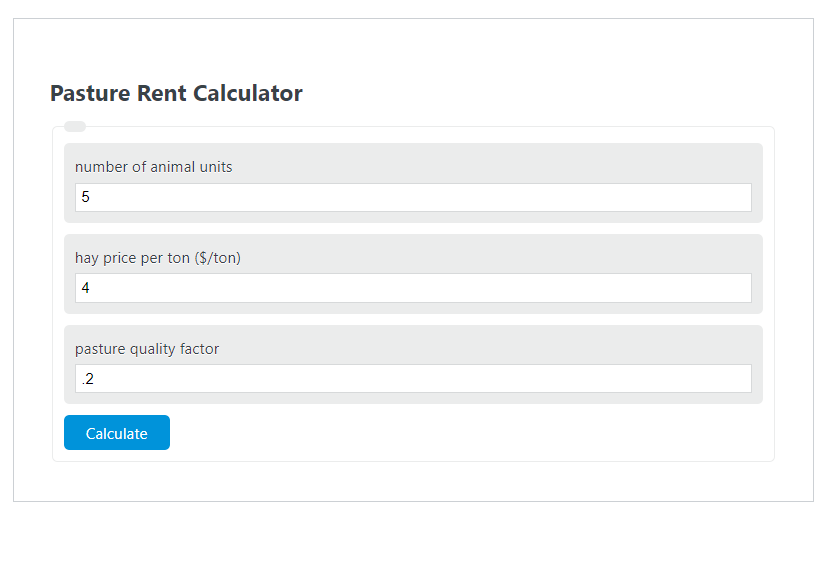
Calculate pasture rent by animal unit month, reverse-solve the AUM rate, or estimate supported head count with acreage, cattle weight, and grazing time.
Pasture Rent Formula
The following formula is used to calculate the pasture rent rate (in $/AUM).
- Where Rp is the pasture rent rate ($/AUM)
- H is the hay price per ton ($/ton)
- Q is the pasture quality factor (tons of hay equivalent per AUM)
- Total rent for a grazing period can be estimated as: Total Rent = Rp × AUM, where AUM = (animal units) × (months grazed)
To calculate the pasture rent rate, multiply the hay price per ton by the pasture quality factor. To estimate the total rent for a grazing period, multiply the rate ($/AUM) by the total AUM (animal units × months grazed).
How to Calculate Pasture Rent?
The following example problems outline how to calculate Pasture Rent.
Example Problem #1
- First, determine the number of animal units (AU) and the grazing period. In this example, the number of animal units is 3 and the grazing period is 1 month (so total AUM = 3).
- Next, determine the hay price per ton ($/ton). For this problem, the hay price per ton ($/ton) is given as 4.
- Next, determine the pasture quality factor. In this case, the pasture quality factor is found to be 0.2.
- Finally, calculate the pasture rent rate ($/AUM), then multiply by total AUM to find total rent for the grazing period.
Rp = H * Q
Inserting the values from above yields:
Rp = 4 * 0.2 = 0.8 ($/AUM)
Total Rent = Rp * AUM = 0.8 * 3 = 2.4 ($)
FAQ
What factors influence pasture quality and how do they affect the pasture rent calculation?
Pasture quality is influenced by factors such as soil fertility, rainfall, forage species, and management practices. In the hay-price method, the pasture quality factor (Q) represents the relative hay-equivalent value of grazing (tons of hay equivalent per AUM). Higher-quality or better-managed grazing typically justifies a higher Q, which increases the resulting $/AUM rate.
How can one accurately determine the number of animal units for pasture rent calculations?
The number of animal units can be determined by considering the type and size of the livestock. A common standard is that 1 animal unit (AU) is a mature ~1,000-pound cow with calf up to about 6 months of age. Different livestock types and sizes have equivalent animal unit values based on their feed requirements relative to this standard. Accurate determination involves assessing the livestock mix and applying the appropriate conversion factors.
Are there any tools or resources available to help landowners and farmers calculate pasture rent more efficiently?
Yes, there are several online calculators and software tools designed to help landowners and farmers calculate pasture rent. These tools often require inputting the hay price per ton and pasture quality factor to estimate a $/AUM rate, and may also use animal unit equivalents and grazing months to estimate total rent. Additionally, agricultural extension services and local farm advisors can provide guidance and resources tailored to specific regions and farming practices.